Get Full Government Meeting Transcripts, Videos, & Alerts Forever!
Get email alerts on the Foreign Policy topic
No spam. Unsubscribe anytime.
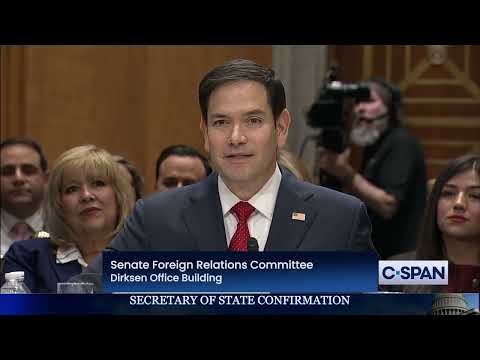
Nominee says U.S. must place national interest first in foreign policy at confirmation hearing
Summary
At a 2025 Senate confirmation hearing, the nominee framed U.S. foreign policy around national interest, criticized the post–Cold War global order and China, and cited past Trump administration achievements such as the Abraham Accords and actions against ISIS.
The nominee told senators at a 2025 confirmation hearing that the United States must center its foreign policy on the national interest, arguing that alliances and global institutions must be judged by whether they make “America safer,” “stronger” or “more prosperous.”
The nominee said the current era requires a “strong and a confident America” that puts U.S. interests first. “Every dollar we spend, every program we fund, every policy we pursue must be justified by the answer to one of three questions: Does it make America safer? Does it make America stronger? Or does it make America more prosperous?” the nominee said.
Why it matters: If confirmed to lead the department the nominee referenced, that approach would guide how the United States Department of State evaluates aid, diplomacy and alliances, potentially reshaping programs and spending decisions.
The nominee placed the remarks in a wide-ranging address that criticized what he described as an overly optimistic post–Cold War consensus that prioritized a global liberal order over U.S. national interests. “This wasn’t just a fantasy. We now know it was a dangerous delusion,” he said, blaming unfettered trade and immigration policies for hurting the American middle and working classes and for shifting critical supply chains to geopolitical rivals.
He singled out the People’s Republic of China, asserting that Beijing “took advantage of all of [the global order’s] benefits and ... ignored all of its obligations,” and accused it of stealing, hacking and repressing. He also warned of “narcoterrorists and dictators” in the Western Hemisphere exploiting open borders to traffic people and fentanyl.
The nominee credited aspects of the prior Trump administration’s foreign policy for improving U.S. security, saying, “There were no new wars. ISIS was eviscerated. Soleimani was dead. The historic Abraham Accords were born, and Americans were safer as a result.”
He framed the United States’ postwar role as now needing renewal: “At eight decades later, we are once again called to create a free world out of the chaos,” he said, adding that accomplishing that task will be “impossible without a strong and a confident America that engages in the world, putting our core national interest once again above all else.”
The nominee began by thanking senators who introduced and welcomed him and noted personal ties and family in the audience; he also said he would “lean and rely on” his faith in the months ahead. He referenced the country’s 249‑year history and stated that, before the role he is nominated for, only 71 other Americans have served in it.
The remarks in the transcript were framed as opening testimony; the hearing record in the provided transcript contains the nominee’s prepared remarks but does not include questions from senators or any formal vote or committee action in the supplied excerpt. The nominee closed by asking for senators’ support: “I hope I can earn your support whether it’s because you believe I would do a good job or because you want to get rid of me,” he said.
Less critical details: The nominee identified family members in the hearing room and referenced his parents’ arrival in the United States; he said some of his children could not attend but that his wife Jeanette and daughter Daniella were present. The transcript excerpt did not specify the nominee’s full name or the office title being sought in the hearing text provided.