Get Full Government Meeting Transcripts, Videos, & Alerts Forever!
Get email alerts on the Health Policy topic
No spam. Unsubscribe anytime.
HHS nominee tells Senate he will prioritize chronic disease, review food additives and agency conflicts
Summary
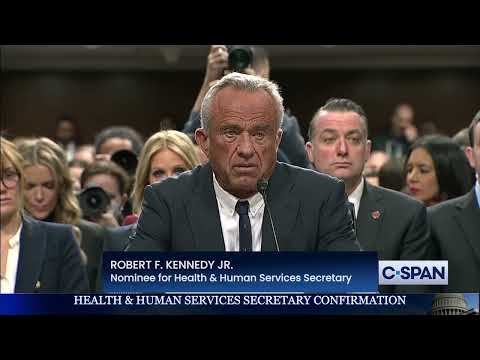
At his confirmation hearing, Mister Kennedy, President Trump’s nominee to lead the U.S. Department of Health and Human Services, outlined a plan to tackle chronic disease, pledged a review of chemical additives in food and said he would remove financial conflicts of interest at agencies if confirmed.
Mister Kennedy, nominee to lead the U.S. Department of Health and Human Services, told a Senate confirmation hearing that he would prioritize reversing the nation’s “chronic disease epidemic,” scrutinize food additives and remove financial conflicts of interest within health agencies if confirmed.
Kennedy said Americans’ health is worsening and costly: “Last year, we spent 4,800,000,000,000 not counting the indirect costs of missed work,” and he described health spending as “almost a 5th of GDP.” He repeatedly framed chronic disease as the main driver of high costs and poor outcomes and cited the Centers for Disease Control and Prevention when discussing spending patterns.
Why it matters: If confirmed, the nominee would oversee the U.S. Department of Health and Human Services (HHS), the federal agency that sets health policy and administers major programs. The nominee said he would pursue changes intended to reduce chronic illness and lower health-care spending, measures that would require agency-level action and congressional or administrative follow-through.
Kennedy described his background in environmental law and said his work with local communities taught him that “human health and environmental injuries are intertwined.” He cited several statistics during his remarks: that “over 70% of adults and a third of children are overweight or obese,” that diabetes is “10 times more prevalent than it was during the 19 sixties,” and that cancer among young people is rising “by 1 or 2 percent a year.” He also said, quoting the agency, that “The CDC says 90% of health care spending goes toward managing chronic disease.”
On vaccines and safety, he addressed media coverage and his published work: “News reports have claimed that I am anti-vaccine or anti-industry. I am neither. I am pro safety,” and later, “All of my kids are vaccinated.” He told the committee he has written books on vaccines and that his public positions reflect advocacy for safety standards rather than opposition to vaccination.
Kennedy also said he would “scrutinize the chemical additives in our food supply” and remove financial conflicts of interest “from our agencies,” promising “an honest, unbiased, gold standard science at HHS accountable to the president, to congress, and to the American people.” He framed this agenda as complementary to working with farmers and food producers, saying he wants a “full partnership of American farmers” while reducing “burdensome regulations.”
He described a grassroots movement he called “Make America Healthy Again,” led in part by what he called “Maha Moms,” and said the movement helped deliver “77,000,000 Americans” a mandate to President Trump. He told senators that he had been encouraged by the bipartisan tone of earlier committee conversations and expressed hope members could “put aside our divisions for the sake of a healthier America.”
The nominee repeatedly prefaced policy proposals with conditional language tied to confirmation: “Should I be so privileged as to be confirmed, we will make sure our tax dollars support healthy foods,” and he said the agency’s scientific standards would be reoriented if he is appointed.
Family members attended the hearing, he noted, naming his wife Cheryl Hines and several children and relatives in the gallery. He closed by saying he is motivated by faith and family and by a wish to reduce chronic illness among Americans.
No formal action on the nomination is recorded in this transcript excerpt; the remarks presented here are the nominee’s opening statement to the committee.