Get Full Government Meeting Transcripts, Videos, & Alerts Forever!
Get email alerts on the Building Energy Performance Standards topic
No spam. Unsubscribe anytime.
County committee approves amended building-energy rules; Green Bank readies $68.5 million for compliance support
Summary
The Montgomery County Transportation and Environment Committee on Jan. 30 approved an amended version of the county's building energy performance standards regulation, Executive Regulation 17‑23 AM, and heard that the Montgomery County Green Bank has $68.5 million in federal grant funds available to help building owners comply.
The Montgomery County Transportation and Environment Committee on Jan. 30 approved an amended version of the county's building energy performance standards regulation, Executive Regulation 17‑23 AM, and heard that the Montgomery County Green Bank has $68.5 million in federal grant funds available to help building owners comply.
The committee vote covered changes to the Department of Environmental Protection's (DEP) proposed regulations for the Building Energy Performance Standards (BEPS) program, including recalculated final performance targets using 2023 benchmarking data, a new 30% performance-cap option for individual buildings, added property-type targets for manufacturing/industrial floor area and ambulatory surgical centers, and clarified rules for deductions related to parking and electric vehicle charging. "30% is still a lot over the next 10 to 12 years," DEP program manager Emily Curley said during the presentation, describing the cap as an added compliance option for the buildings farthest from their targets.
Why it matters: Covered buildings account for a substantial share of the county's built area and are part of the county's climate strategy. The law the rules implement (the benchmarking and performance standards law, passed in April 2022) applies to most buildings of 25,000 square feet or larger—about 1,800 buildings representing roughly 250,000,000 gross square feet. DEP reported benchmarking compliance above 90% (about 95% last year), which provides the data the agency used to set and revise targets. Committee leadership and DEP officials emphasized that BEPS work is a long-term effort with interim and final deadlines stretching into the early‑to‑mid 2030s for the earliest building groups; DEP noted some groups have until 2033 to meet final standards.
Key changes adopted or clarified
- Target recalculation: DEP reran target-setting calculations using calendar-year 2023 benchmarking data to refine final site energy use intensity (EUI) standards for specific property types that stakeholders had flagged, including hospitals and laboratories.
- New property-type targets: The amended regulation adds an area-weighted standard for buildings that include at least 50% manufacturing/industrial floor area and adds ambulatory surgical centers to the property-type list, both to ensure mixed-use buildings receive appropriate targets.
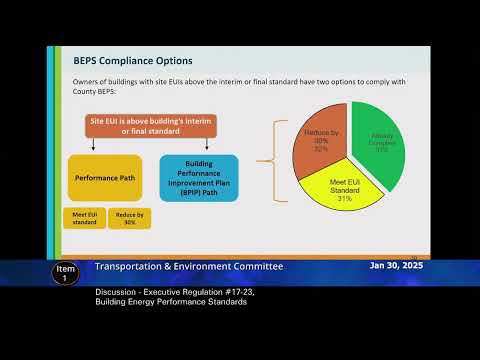
- 30% performance cap: The regulation now limits any single building's required reduction from its baseline to no more than 30% by the final standard date. DEP estimated that the cap will provide an additional compliance option for about 30% of covered buildings, particularly those that otherwise would face much larger percentage reductions.
- Two compliance paths: Owners may follow (1) the performance path—implement measures (operations and maintenance, retrocommissioning, retrofits, electrification, on-site renewables) to meet the interim or final EUI standard—or (2) a Building Performance Improvement Plan (BPIP) path, a tailored multi-step compliance plan based on an ASHRAE level 2 energy audit and a retrofit plan of cost‑effective measures.
- BPIP cost-effectiveness and payback rules: The amendment shifts from a prior package-level, 25‑year test to a measure‑by‑measure test based on the useful life of each piece of equipment. Buildings designated as "specially designated" (formerly termed "under‑resourced")—including affordable housing (regulated and unregulated), common ownership communities (condos and co‑ops), rent‑stabilized multifamily, nonprofit‑owned buildings and local small‑business‑owned buildings—use a 10‑year payback test. DEP also added a requirement that measures with simple payback of five years or less identified in an interim BPIP must be implemented before a subsequent BPIP can be approved for the final standard.
- Parking and EV charging deductions: DEP clarified that parking energy and electric‑vehicle charging energy will be deducted from site EUI using standard fields in EPA's Energy Star Portfolio Manager (aligning with state benchmarking guidance) rather than agency‑specific calculations.
Support, timing and implementation
DEP said it will publish program guidance and manuals for benchmarking, audits and BPIP procedures and that the Building Performance Improvement Board (established by the law) will participate in plan reviews. DEP staff noted the agency has engaged stakeholders since 2019 and the committee has held six prior BEPS work sessions during its year‑long review.
Stephen Morrell, chief executive officer of the Montgomery County Green Bank, told the committee the bank procured $68.5 million from a competitive EPA grant under the Greenhouse Gas Reduction Fund (referred to in the meeting as NCIF funds) and that those funds have been deposited and are available to support BEPS readiness and implementation. "We did procure 68 and a half million out of this grant program," Morrell said. He described a plan to use the federal funds for implementation while using existing county energy‑tax funds for the assessment phase, and to structure the grant dollars in ways that create revolving capital and potential leverage for bond issuance or other forms of financing.
Morrell and DEP officials said the Green Bank will focus initial capital on multifamily retrofit projects and pipeline projects that are or will become ready when the regulation is final. The Green Bank described subsidizing assessments (including submetering where appropriate), financing retrofits, supporting power purchase agreements and community solar where on‑site ownership is infeasible, and prioritizing equitable distribution (equity emphasis area targeting and other outreach). Committee members asked Green Bank staff to ensure outreach to less‑resourced building owners so the funds do not flow only to repeat or early applicants.
Committee action and next steps
The committee voted to approve the amended regulation (Executive Regulation 17‑23 AM). Committee leadership and DEP staff said the regulation will be forwarded for a full‑council work session scheduled for Feb. 11, with a full council vote anticipated before the end of February if the approval process continues on schedule. Chair Glass noted the funds for Green Bank programs "have been deposited." The committee recorded the approval action as unanimous in the meeting transcript; an exact roll‑call tally was not specified in the transcript.
The regulation establishes compliance pathways and technical and financial supports but does not prescribe individual retrofit measures beyond the audit and payback tests. DEP and the Green Bank said program guidance, audits and financial products will be available to help building owners evaluate measures, financing and timeline options. The Building Performance Improvement Board will review BPIPs and the agency said it will continue stakeholder outreach as plans are implemented.