
State projects MEMSOF to remain solvent through 2031 under DLS forecast; agencies highlight continuing uncertainty from fee changes and demand
Get AI-powered insights, summaries, and transcripts
Sign Up Free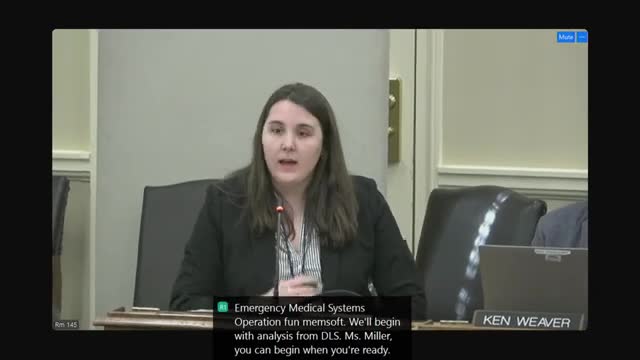
Summary
Department of Legislative Services analyst Madeline Miller told the Public Safety and Administration Subcommittee that the fiscal 2026 MEMSOF allowance is $110,600,000 and that the fund supports MSPAC, MEMS and multiple trauma and training programs.
Madeline Miller, a budget analyst with the Department of Legislative Services, told the Public Safety and Administration Subcommittee that the fiscal 2026 allowance for the Maryland Emergency Medical System Operations Fund (MEMSOF or MEMSOF) is $110,600,000 and that roughly 51.7% of the allowance supports the Maryland State Police Aviation Command (MSPAC).
Miller outlined key revenue changes enacted by Chapters 717, 718 and 719 of 2024, which raised the motor vehicle registration surcharge structure and directed additional revenue to MEMSOF; she and other witnesses said consumer choices, installment payments and other implementation details make short‑term revenue projections uncertain despite materially higher statutory surcharge levels.
"The fiscal 26 allowance provides for $110,600,000 in total expenditures," Miller said. She told the committee that the allowance includes roughly $21,700,000 for the Maryland Institute for Emergency Medical Services Systems (MEMS) and that $5,500,000 in MSPAC funding in the working appropriation is contingent on legislation expanding allowable fund uses.
Representatives of statewide EMS organizations and service providers told members how MEMSOF money is used and why predictability matters. Sally Showalter, a member of the State EMS Board, summarized the statewide system as a mix of volunteer and career personnel, communications and transport systems and specialty centers; she said the 2024 statutes were intended to eliminate a looming structural deficit for the fund but cautioned that the most recent analysis still projects pressure on fund balances later in the decade.
Dr. Ted Delbridge, executive director of the Maryland Institute for Emergency Medical Services Systems, described MEMS functions funded in part by MEMSOF: licensing and certifying roughly 20,000 EMS clinicians, running a statewide communication system and promulgating clinical protocols. "The backbone of Maryland's EMS system is the 20,000 men and women EMS clinicians... who answer more than 1,000,000 calls for help each year," Delbridge said.
Captain Jeffrey Thomas, assistant commander of the Maryland State Police Aviation Command, gave program statistics showing 1,878 medevacs and 1,935 patient contacts in 2024, and emphasized the role of MSPAC aircraft and crews in medevac, search and rescue, and disaster response. Pat Marlette, deputy director of the Maryland Fire and Rescue Institute (MIFRI), and other partners including the Maryland State Firefighters Association and representatives from R. Adams Cowley Shock Trauma Center described training, equipment and trauma system functions that rely on MEMSOF and related special fund support.
Miller explained differences between the DLS and Department of Budget and Management (DBM) forecasts. The two agencies diverge primarily on assumptions about motor vehicle registration fee income and on growth rates for major MEMSOF recipients beginning in fiscal 2027. DLS uses a 10‑year average growth rate for some expenditure projections; DBM applied a 5% growth rate for several line items. Under DLS assumptions, MEMSOF remains solvent at least through fiscal 2031 with a projected closing balance of about $20,500,000; DBM's forecast predicts pressures earlier, projecting expenditures to outpace revenues sooner (DBM's model puts that date around fiscal 2028 under its assumptions).
Miller noted additional sources of uncertainty: last year's fiscal note assumed registration counts remain constant and that biennial registrants are evenly distributed across years; Chapter 717 also authorized installment payments for registration fees and the MVA has reported more consumers selecting one‑year registrations in recent weeks. DLS said it expects some normalization in consumer behavior and, in the allowance, assumes full expected revenue growth will be available beginning in fiscal 2026 despite short‑run variability.
Committee members and agency witnesses discussed uses of MEMSOF funding: MSPAC fleet maintenance and overtime pressures, expanded inspector positions and software costs for MEMS, funding for the Senator William H. Amos Fire, Rescue and Ambulance Fund (the Amos Fund), and a $3,700,000 annual allocation referenced for R. Adams Cowley Shock Trauma Center in last year's fiscal note. Miller also flagged that $5,500,000 of MSPAC support in the working appropriation is contingent on legislation to broaden allowable uses of MEMSOF.
No formal votes were taken at the hearing. Witnesses thanked the committee for prior legislation that addressed near‑term insolvency risks and urged continued legislative and administrative attention to revenue assumptions, cost drivers across the trauma and EMS system, and coordination between DBM and DLS forecasts.