Get Full Government Meeting Transcripts, Videos, & Alerts Forever!
Get email alerts on the Restorative Justice topic
No spam. Unsubscribe anytime.
Montgomery County schools report fewer suspensions after restorative justice steps; leaders say disproportionality and implementation gaps remain
Summary
Principals and district officials described restorative justice (RJ) work at Farmland Elementary and Julius West Middle School and countywide supports that have reduced suspensions and recidivism; community advocates pressed for sustained funding, clearer accountability and measurable outcomes as staff roles are reorganized.
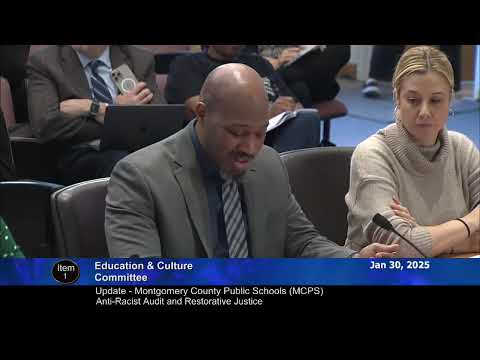
Principals and Montgomery County Public Schools officials reported progress on restorative justice (RJ) during a Jan. 16 county session, citing lower suspensions and lower recidivism where specialized coordinators and school coaches have supported implementation — but they also warned that RJ alone will not erase discipline disproportionality without clearer anti‑bias work and stronger, systemwide accountability.
Shauna Kaye Jornby, MCPS director of student engagement and behavioral health, introduced school leaders who described school‑level RJ work and results. April Longest, principal of Farmland Elementary School, said Farmland (about 860 students, including more than 140 multilingual learners) held three grade‑level town halls and classroom lessons focused on identity, hateful and harmful words, use of the code of conduct and restorative practices. Longest said students reported learning to "be inclusive and kind" and the school engaged parents and PTA members in reviewing the materials.
At Julius West Middle School, Principal Craig Staten described a multi‑year rollout that included hiring a restorative justice coordinator and prioritizing circles and dialogue over suspension. Staten said the school moved from more than 100 suspensions immediately after the pandemic to 15 current suspensions, and that circles resolved roughly half of referred incidents and reduced recidivism among students who participated.
District RJ staff described system supports: a network of school coaches (each with a stipend), eight RJ specialists who provide cluster support, published evaluation rubrics and public dashboards, and multi‑year evaluations that the district says have moved many schools from "early" toward "intermediate" or "mature" RJ practice.
District data cited in the presentation: MCPS said it maintains one of the lowest suspension rates in the state and reported an "unduplicated suspensions" value given as 1.4 (staff framed this against a state figure of about 5%). Staff also reported that 79–81% of students who experienced an RJ intervention did not repeat an incident (recidivism measure) and that some middle schools with RJ specialists saw 70% fewer suspensions for disruption and 44% fewer suspensions for disrespect in specific categories.
Officials and principals cautioned that universal benefits make disproportionality harder to eliminate: because RJ reduced suspensions across all student groups, the ratios that determine disproportionality did not always move as quickly as raw suspension counts. Staff warned that subjective categories such as "disrespect and disruption" are major drivers of disparity and said RJ must be paired with consistent anti‑bias work to address those subjective judgments.
Community representative Wylia Chase, who works with local equity groups and advisory committees, urged the council to prioritize funding for RJ and anti‑bias interventions in the FY26 budget and to hold MCPS accountable to measurable outcomes. Chase said the community sees RJ working in some schools but asked why the budget showed increases in security personnel while expansion of restorative programs and sustained investment was unclear.
District leaders also discussed staffing and structural shifts. Councilmembers were told that eight RJ specialist positions and three equity/training specialist positions will be moved into new "professional learning specialist" roles tied to the superintendent's reorganization; the superintendent's office confirmed those staff "will be placed into those roles," while acknowledging HR processes and that there are more new position slots than current staff. Staff said those professional learning specialists will work with principals on school improvement plans and that the equity unit will design system‑wide anti‑racism strategy and review materials and decisions.
The presentation flagged two Maryland bills that could affect RJ work: House Bill 0192, proposing a state designation for restorative practice schools, and House Bill 0488, proposing state reporting for restorative approaches (similar to suspension reporting). Both bills were described as possibly taking effect July 1, 2025; district staff said they are monitoring the bills and assessing whether their data systems and supports are ready to meet any new state requirements.
Staff acknowledged implementation challenges: coach experience varies across 211 schools, some schools have not completed the RJ self‑evaluation process (listed as "unreported" because teams did not submit full artifacts), and community engagement continues to be variable. District leaders said action plans are in place for reactive schools and that evaluations will continue into late spring, with results used to prioritize support.
Councilmembers and staff repeatedly urged clearer, public metrics: which trainings are mandatory, who attended, whether trainings are synchronous or asynchronous, what evaluation metrics are tied to training, and how principals who do not adopt practices will be held accountable. Sean McGee, an area associate superintendent, said the district uses goal‑setting conferences, supervisory visits and cross‑functional student support teams to monitor implementation and to provide targeted support for administrators who struggle.
District and community participants agreed to continue the conversation, with council members requesting further detail on training content, mandatory attendance, measurable outcomes and budget alignment before the FY26 budget process.