Get Full Government Meeting Transcripts, Videos, & Alerts Forever!
Get email alerts on the Anti Racist Strategic Plan topic
No spam. Unsubscribe anytime.
MCPS says anti‑racist audit will be embedded in new strategic plan; board to finalize in May
Summary
Montgomery County Public Schools officials told the County Council they are folding recommendations from the district's anti‑racist audit and action plan into a single strategic plan, establishing phased community engagement, new public data dashboards and accountability metrics; Board approval is scheduled for May.
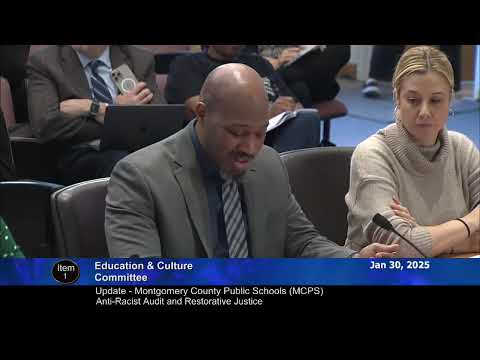
Montgomery County Public Schools officials told the County Council on Jan. 16 that they are incorporating the district's anti‑racist audit and action plan directly into a single strategic plan and that the Board of Education is expected to finalize that plan in May.
Officials said the goal is to replace separate work streams with one unified plan tied to measurable accountability so cross‑office recommendations are implemented more consistently across schools.
District staff framed the change as an attempt to address longstanding fragmentation in policy and implementation. A district equity staff member said, "Our organization is perfectly designed to get the results you are getting," and emphasized that the audit's cross‑domain recommendations must be completed before domain‑specific actions can produce systemwide change.
The district described its planning work in three phases. Phase 1 involved outreach to more than 200 people to map systemic barriers; phase 2 engaged more than 180 stakeholders in root‑cause analysis and produced a report that the district has posted on its website; phase 3 is under way and focuses on drafting goals and objectives. Dr. Alston, an MCPS official leading phase 3 work, told the council, "What you see are the draft goals, and we would absolutely love your feedback," and said staff will return to the community to test objectives before the board vote.
Superintendent Taylor directed that the strategic plan explicitly address barriers identified in the audit and action plan, the district said. In a December community message cited by staff, Dr. Taylor said, "We believe every student deserves an equitable and equal opportunity to succeed, regardless of race or background." Staff said that turnover in central‑office leadership last year delayed several cross‑office accountability structures called for in the audit.
District staff highlighted tools and actions already completed that will feed into the strategic plan: public and internal data dashboards (school profiles and monitoring tools), expanded professional learning tied to using those dashboards, revised parent‑engagement policies described as "culture responsive," and a set of professional development courses for administrators and teachers. Staff reported that 944 central office employees have taken the district's equitable teaching and learning professional learning (including 398 leaders and 595 specialists), that participant satisfaction on that training "has never dropped below 96%," and that 95% of leaders demonstrated targeted skills in initial assessments.
Staff cautioned that most students, families and frontline staff will not immediately feel the effects of the changes because the strategic plan integrates long‑term structural shifts rather than one‑off trainings. They said improved public tracking and clearer accountability metrics are needed so the community can see whether the district is implementing the audit's cross‑domain recommendations.
The district also committed to a schedule of additional community engagement, formation of strategy committees in February, community feedback opportunities in April and a board vote in May. Staff said the tracker that lists action items will be updated on a regular calendar and that project oversight structures will be aligned with strategic plan goals.
District officials and community members agreed on the need for transparent, measurable accountability. Community advocate Wylia Chase, representing multiple local groups, urged the council and district to show how budget and staffing decisions back up anti‑racist commitments and to ensure parents and caregivers receive usable resources.
Board finalization in May is the next formal milestone; district staff said additional implementation details and monitoring metrics will be presented to the board and the council in subsequent meetings.
Looking forward, the district said the strategic plan will fold the audit's recommendations into school improvement planning and central‑office structures so that equity and anti‑racism become part of routine practice rather than separate programs.