Get Full Government Meeting Transcripts, Videos, & Alerts Forever!
Get email alerts on the Nomination Tulsi Gabbard Dni topic
No spam. Unsubscribe anytime.
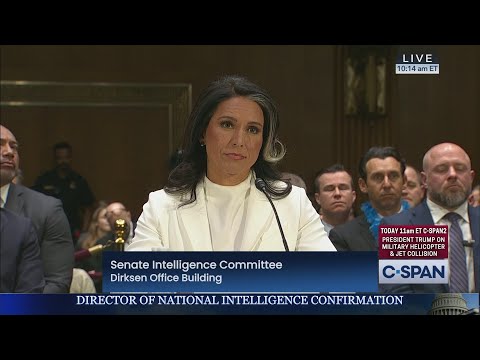
Senate Intel Committee grills Tulsi Gabbard on Snowden, FISA 702 and Syria trip; no vote set
Summary
President Donald Trump's nominee for director of national intelligence, Lieutenant Colonel Tulsi Gabbard, faced sustained questioning Thursday from the Senate Select Committee on Intelligence over her past praise for Edward Snowden, her prior opposition to Section 702 of the Foreign Intelligence Surveillance Act and a 2017 trip to Syria and Lebanon.
President Donald Trump's nominee for director of national intelligence, Lieutenant Colonel Tulsi Gabbard, faced sustained questioning Thursday from the Senate Select Committee on Intelligence over her past praise for Edward Snowden, her prior opposition to Section 702 of the Foreign Intelligence Surveillance Act and a 2017 trip to Syria and Lebanon.
The hearing, led by Sen. Tom Cotton, chairman of the Senate Select Committee on Intelligence, focused on whether Gabbard could win the trust of U.S. allies and the intelligence community if confirmed. Cotton repeatedly pressed Gabbard on shrinking and refocusing the Office of the Director of National Intelligence (ODNI); he told her, "Miss Gabbard, if confirmed, you have a lot of work ahead of you." Sen. Mark Warner, the committee's vice chairman, noted the scope of the job, saying the DNI "would lead 18 agencies of the IC" and would be responsible for more than "$100,000,000,000" across intelligence programs.
Why it matters: The DNI oversees the intelligence community's coordination, production and information sharing; the committee's evaluation centers on whether the nominee can protect classified sources and methods while restoring credibility with Congress and foreign partners.
Most of the hearing's time was used for five-minute public rounds of questioning in which senators pressed Gabbard on three persistent themes:
- Edward Snowden and whistleblower policy: Multiple senators demanded whether Gabbard would call Edward Snowden a traitor. Gabbard said in several exchanges, "Edward Snowden broke the law," and emphasized that she would work to prevent another unauthorized public disclosure of classified material. She declined to adopt the label "traitor" on the record, and reiterated that, if confirmed, she would "make sure that every single person in the workforce understands their rights as whistleblowers and the legal channels to take." Several senators pressed her about prior legislation she sponsored that would have narrowed prosecutions under the Espionage Act; Gabbard said that the intent of that legislation was to ensure due process for defendants and to address what she described as abuses.
- Section 702 of FISA and surveillance authorities: Senators repeatedly asked whether Gabbard now supports the warrant and safeguard reforms enacted since she left Congress. When Sen. Ron Wyden asked whether she stood by her written answer that "warrants should generally be required before an agency undertakes a US person query of section 702," Gabbard replied, "Yes. It is, senator." She also told senators she would assess implementation of the reauthorization reforms if confirmed and report to Congress.
- Syria trip, meetings and judgment: Senators pressed Gabbard about a 2017 privately organized trip to Syria and Lebanon and whether she knew of the backgrounds of local organizers. In response to questioning from Sen. Martin Heinrich, Gabbard said, "I paid for my own expenses and travel on that trip" and said she was not aware of certain accusations about some organizers until after the trip. Heinrich and others raised concerns that some sources Gabbard cited to question U.S. intelligence conclusions had ties sympathetic to the Assad regime or to Russian media.
Other topics that surfaced included ODNI reform, classified whistleblower channels, the handling of anomalous health incidents (often referred to as Havana- or anomalous-health incidents), and Gabbard's past public statements on Ukraine and Russia. Gabbard told the committee that, if confirmed, she would "find the truth no matter where it leads" and pledged to rebuild trust through transparency and accountability.
Procedural notes: The committee recessed the open session and said it would convene a closed session in approximately 30 minutes. Chairman Cotton announced his intention to schedule a committee vote on the nomination "as soon as possible" and asked senators to submit additional questions for the record by close of business Friday, Jan. 31. No committee vote or confirmation action occurred during the public session.
What senators said (samples): Sen. Mark Warner warned Gabbard that the DNI is "a position of great importance and significance to our national security created after one of our worst national security failures, 9/11," and emphasized the role's budgetary scope. Sen. James Lankford, Sen. Jim Risch and others underscored the intelligence community's need for officials who will protect classified information and maintain allies' trust.
Evidence from the hearing: The hearing transcript shows repeated exchanges about Snowden (Gabbard: "Edward Snowden broke the law") and explicit answers about Section 702 (Gabbard to Sen. Wyden: "Yes. It is, senator."). The chairman concluded the open session by directing the committee to meet in closed session and by announcing plans for a prompt committee vote.
Next steps: The committee will hold a closed session on classified matters and is expected to schedule a committee vote; the date was not set in the open hearing.
(Report compiled from the Jan. 30, 2025, open-session transcript of the Senate Select Committee on Intelligence confirmation hearing for Tulsi Gabbard.)