Get Full Government Meeting Transcripts, Videos, & Alerts Forever!
Get email alerts on the Land Use topic
No spam. Unsubscribe anytime.
Biloxi council upholds Planning Commission; 8 protected trees cleared for Chick‑fil‑A development after 6‑1 vote
Summary
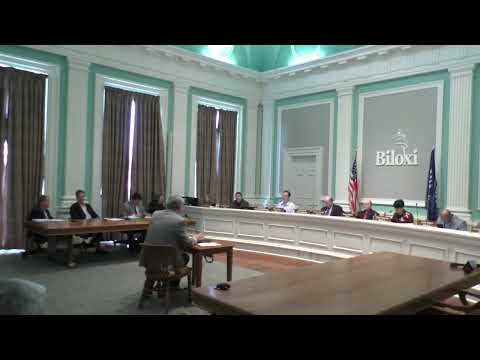
The Biloxi City Council voted 6‑1 on Jan. 28 to deny an appeal and affirm the Planning Commission’s decision allowing removal of eight protected trees to make way for a Chick‑fil‑A on Pass Road.
The Biloxi City Council voted 6‑1 on Jan. 28 to deny an appeal and affirm the Planning Commission’s decision allowing the removal of eight protected trees for a Chick‑fil‑A development on Pass Road.
The appeal (appeal reference TR‑25‑001) was filed by local residents and conservation advocates who urged the council to require a redesign that would conserve a large live oak identified in the tree report as tree number 18 (58 inches DBH). Carol Campbell, speaking for the Mississippi chapter of the Sierra Club, told the council the developer "chose to remove anything and everything that's in the way of their site plan" and argued the project did not show that conserving tree 18 would prevent compliance with the city’s zoning and development standards.
Developer representatives, who said they had revised the site layout multiple times, told the council the key constraint was the trees’ root systems and the location of utilities. The developer’s representative said engineers found that "it's the root structure that's underneath it" and that installing necessary utilities and drive aisles through the root zone would likely kill the trees within months.
Record of local review: The city’s Development Review Committee required a tree survey and, when the project exceeded removal of five protected trees, the City Tree Committee held a public review. The Tree Committee provided a letter of approval. The application then went to the Planning Commission, which the director of community development said approved the request by an 11‑1 vote.
Public turnout and positions: More than a dozen residents and local advocates spoke against removal during the hearing, describing the oaks as part of Biloxi’s historic canopy and urging the council to require plan changes. Appellants submitted petitions and letters, and speakers noted differences between the number of trees the developer said it would retain and which trees are actually on the subject parcel.
Mitigation and developer commitments: The developer said it has already planted eight replacement trees on the property at a cost it estimated at more than $50,000. In council remarks the developer’s representative said the company had voluntarily planted higher‑quality replacements beyond the city’s minimum mitigation standard. When asked by council members about additional mitigation specific to the 58‑inch oak, the developer said it could consider an additional payment or contribution and suggested a figure in the range of about $10,000 as a starting point for discussion.
Council action and vote: Councilman John McGillivray (motion) and Council member Newman (second) moved to deny the appeal and affirm the Planning Commission. The motion passed 6‑1; Councilman George Lawrence voted against denying the appeal and said he favored saving the tree.
Why it matters: The hearing highlighted tensions in Biloxi between protecting mature live oaks that form the city’s canopy and allowing redevelopment along commercial corridors. The city’s Land Development Ordinance (LDO) protects trees by requiring permits and mitigation, but the ordinance allows removal where standards are met and where mitigation is provided.
What’s next: With the council’s decision affirmed, the developer will proceed with the approved site plan and the city will require the developer to satisfy mitigation requirements and any DRC conditions, including final details on impervious surface treatments adjacent to retained trees. Council members and appellants urged the city to review the tree‑mitigation rules and consider strengthening how mitigation is calculated for large, mature trees.