Get Full Government Meeting Transcripts, Videos, & Alerts Forever!
Get email alerts on the House Bill 581 topic
No spam. Unsubscribe anytime.
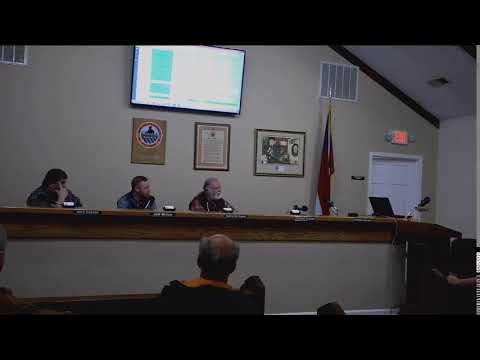
Hart County holds public hearing on opting out of House Bill 581
Summary
The Hart County Board of Commissioners opened and closed a public hearing on whether to opt out of state House Bill 581. Commissioners recorded unanimous 3-0 procedural votes to open and then close the hearing; no final decision on opting out was recorded during the meeting.
The Hart County Board of Commissioners opened and then closed a public hearing on whether to opt out of House Bill 581, recording unanimous 3-0 votes to open and to close the hearing but taking no final opt-out vote.
Commissioner Dorsey moved to open the hearing, saying, "I'll make a motion to open up the floor for public hearing. Opting out of House Bill 581." Commissioner Brown seconded the motion; the board voted 3-0 to open public comment.
The hearing focused on how HB 581 would affect property assessments, millage rates and county revenue. County staff and multiple residents described analysis showing the bill could freeze assessment calculations while requiring local governments to increase millage to maintain revenue. A staff presentation—available on the county YouTube channel, the board said—showed historical digest numbers applied to the new rules and projected revenue changes.
Resident Doug McCabe, of 90 Evelyn's Way, told the board, "Most of us are probably pretty ignorant about what was said there and what the impact of this is thought to be on Hart County." McCabe and other commenters urged clearer information and noted distributional effects: they said homesteaded properties would be treated differently than non-homesteaded parcels and that the school system absorbs a large share of property tax revenue.
Resident Ed Brady, of 353 Poinsettia Drive, said opting out could remove uncertainty in the near term but asked whether it would also preclude future participation in a state-level sales tax option. "If you opt out, are you actually eliminating your ability to participate in the sales tax in the future?" Brady asked; county officials answered that opting out would remove the county from the floating homestead-exemption sales tax tied to HB 581.
Staff and speakers offered several quantitative examples during the hearing. Presenters said the county receives roughly 27 cents on the dollar of locally assessed property tax revenue while the school system receives about 73 percent; they noted there are about 5,400 homesteaded properties versus roughly 18,000 total parcels and said roughly 4,500 parcels are non-homesteaded. Staff showed a year-by-year example in which maintaining the same revenue under HB 581 would require raising the millage rate (presented examples moved from about 5.75 mills toward about 6.15 mills in a single year and rising further in subsequent years).
Speakers also discussed alternatives to property-tax revenue, including local-option sales taxes (SPLOST) and a proposed transportation SPLOST (T-SPLOST). One commissioner estimated a 1-cent sales tax in a single county could generate about $30 million over five years in some places; staff cautioned distribution among municipalities, water systems and counties affects local shares.
Commenters and staff raised recent state guidance: presenters said they had received a Department of Revenue letter indicating the DOR would not apply an inflationary rate for 2025, and that other clarifying state rules and amendments were still being developed.
After public comment, Commissioner Bridal moved and Commissioner Dorsey seconded to close the public hearing; the board again voted 3-0 to close the hearing. Commissioners and staff told residents they would share additional materials and encouraged people to call county offices with questions.
No formal opt-out decision was recorded during the meeting; the hearing provided a public record of analysis and concerns that commissioners said they will consider before any final action.