Get Full Government Meeting Transcripts, Videos, & Alerts Forever!
Get email alerts on the Solid Waste Transfer Station topic
No spam. Unsubscribe anytime.
Hart County commissioners order work session after transfer-station crowding, discuss higher tipping fees and limits on commercial haulers
Summary
Commissioners scheduled a work session and asked staff to prepare proposals on tipping fees, commercial hauling and hours after managers and public speakers described overcrowding, long lines and maintenance problems at the county transfer station.
Hart County commissioners voted to hold a work session and asked staff to bring proposals on tipping fees and commercial/out-of‑town disposal rates after officials and transfer‑station workers described heavy weekend congestion and equipment shortfalls.
The request came during a lengthy discussion that stretched across the agenda item titled “Transfer Station: hours, operation and scale costs.” Commissioner Dorsey said staff and elected leaders had reacted hastily to recent problems and described Saturdays when trucks backed up, the facility ran out of trailers and staff struggled to process incoming material. “We just need to have standard uniform hours,” Dorsey said, adding that some commercial haulers are using Hart County as a low‑cost dumping location.
Why it matters: Commissioners and staff said the overflow is straining the facility and slowing routine work such as building repairs and magnet collection of metal. Several commissioners proposed two immediate levers: limit or charge more for commercial and out‑of‑county haulers and revise hours so county residents are not displaced by commercial traffic on Saturdays.
County officials did not adopt a new fee or an hours change at the meeting. Instead, a commissioner asked that staff prepare a detailed proposal for the board’s next meeting on a structured tipping‑fee increase with distinct commercial and out‑of‑town rates. Commissioners discussed scheduling a work session to review that material; attendees agreed to try for a Tuesday work session at 5:30 p.m. and to invite transfer‑station staff to participate.
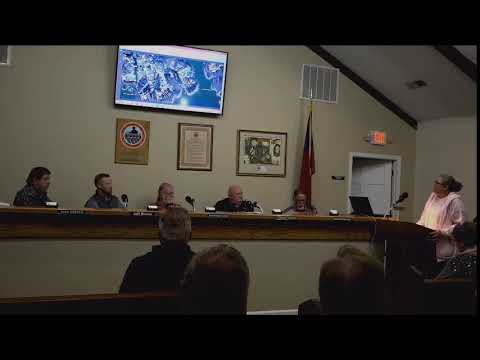
Transfer‑station staff and public commenters recounted operational problems. Jason, who identified himself as a transfer‑station worker, said he closed the facility gate at 1:35 p.m. on a recent Saturday but that a customer who ignored the closure required staff to remain until about 2:20 p.m. He told the board that single‑axle trucks and compactors from neighboring jurisdictions had arrived and that roll‑off containers were full. “We had 1 trailer to load. It was 3 trucks with 40‑yard containers,” Jason said. He urged the board to include on the work‑session agenda the actual day‑to‑day flow patterns staff see.
Resident Sandra Smith, who addressed the board during public comment, supported stepped‑up enforcement and higher fees for out‑of‑county users and told commissioners the transfer‑station dogs were escaping into nearby neighborhoods. Sheriff Carroll and county staff were named by speakers as working on animal control; Smith said animal control’s current weekday hours leave residents with limited weekend enforcement options.
Commissioners discussed other immediate steps staff could prepare for the next meeting: (1) an itemized proposal showing current and proposed tipping fees with separate commercial and out‑of‑town rates; (2) recommended uniform hours and signage clarifying the difference between the scale and the convenience center; and (3) options to secure additional hauling capacity so material does not pile up in the processing area. One commissioner requested comparative fee numbers for surrounding jurisdictions and private options.
The board and staff repeatedly credited transfer‑station employees for handling high volumes amid equipment limits and bad weather. Commissioners said the county is planning a new transfer facility but noted that paperwork and hauling capacity remain immediate constraints.
Public‑comment invitation: commissioners asked transfer‑station staff and other stakeholders to attend the planned work session.
Ending: No ordinance or fee change was adopted at the meeting. Commissioners directed staff to prepare a fee proposal and other options for review at the next scheduled meeting and set a work‑session target time of 5:30 p.m. next Tuesday, pending availability.