Get Full Government Meeting Transcripts, Videos, & Alerts Forever!
Get email alerts on the Emergency Communications topic
No spam. Unsubscribe anytime.
Douglas County 911 center reports strong staffing, outlines technology and contract challenges
Summary
At a Jan. 29 County Commission work session, Emergency Communications Center Director Tony Foster described the center’s staffing, funding mix and near-term technology plans, including a looming Motorola service-contract renewal and rollout of transcription and Spanish translation tools.
Douglas County’s Emergency Communications Center is nearing full staffing and meeting national answer-time standards while preparing for costly radio-system upgrades and new call-transcription tools, Director Tony Foster told the County Commission during a Jan. 29 work session.
Foster said the 911 center has budget authority for 35 positions and currently has 31 filled. "We currently have a budget authority for 35 positions," he said, adding that the center typically runs with about 33 operational staff and holds two slots to recruit high-performing candidates. Foster said the center’s new starting wage after a recent pay study is $24.23 an hour.
The center’s funding comes from a cooperative agreement among Douglas County, the City of Lawrence, Eudora and Baldwin City and from a state program Foster identified as the "911 Saves Act." Foster said Douglas County provides 33.33% of the center’s operating budget, Lawrence about 60%, Eudora 3.67% and Baldwin City 3%. He said the 911 Saves Act yields about $620,000 a year but—citing state statute—those funds are restricted to technology and call-delivery expenses and cannot be used for personnel.
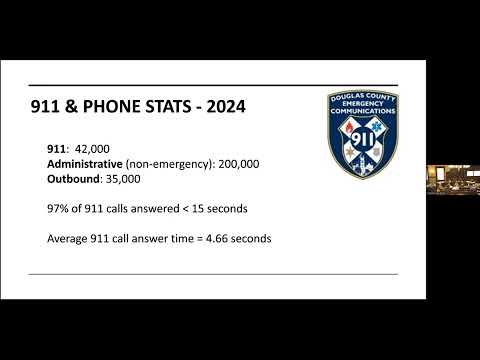
The center reported 2024 call volumes of about 42,000 911 calls, roughly 200,000 administrative or nonemergency calls, and about 35,000 outbound calls. Foster cited National Emergency Number Association (NENA) standards and said the center answered 97% of 911 calls within 15 seconds in 2024, with an average answer time of 4.66 seconds.
Foster described the county’s radio infrastructure as a multi-site P25 system that connects into a statewide core run by the Kansas Department of Transportation and administered through the Kansas Highway Patrol. He said the county maintains about 400 radios for local entities and supports roughly 1,600 total subscribers on the statewide system.
Looking ahead, Foster said the county will introduce a call-transcription tool from Motorola this year that can transcribe calls and provide Spanish translation inside the center to reduce reliance on external translators. He also said the center plans to implement emergency fire-dispatch protocols that were approved in the most recent budget, and that planning conversations are under way for a service-contract renewal with Motorola. "We anticipate that Motorola service contract [renewal] going up substantially," Commissioner Sarah said during the discussion; Foster and other staff said the center is coordinating with city partners and exploring state funding options to offset costs.
Foster also noted interoperability work tied to major events. He said planning for FIFA 2026 will provide an opportunity to test statewide and regional interoperability, and he said the center will brief commissioners on World Cup planning work in coming weeks. Foster added that the center is preparing to move into a new public-safety building designed for modern 911 operations.
Deputy Director Sonia Bay Beza and Foster described several service partnerships: transfers of certain crisis calls to the 988 system, dispatch support for Lawrence-Douglas County Fire Medical, fielding calls that require coordination with Osage County (which the ECC currently notifies by phone), and new dispatching for a mobile response team that accepts referrals from 988 or law enforcement. Foster said staff are exploring CAD-to-CAD web-services to increase visibility into partner unit availability.
Commissioners asked about turnover and retention. Foster said the center’s overall turnover is lower than typical 911 centers—he estimated an approximate 15% annual turnover, with most separation occurring during training. "Most of our turnover is in trainees," he said. Foster credited a positive workplace culture and the recent pay study with stronger retention than many centers experiencing much higher vacancy rates.
No formal actions or votes were taken during the work session; staff said the meeting was an informational work session and that public comment and formal actions occur at the 5:30 business meeting.
The commission and ECC staff invited commissioners to tour the center in the coming weeks.