Get Full Government Meeting Transcripts, Videos, & Alerts Forever!
Get email alerts on the Homelessness Programs topic
No spam. Unsubscribe anytime.
House passes bill allowing third-party administration of homelessness programs after disputed floor debate on oversight
Summary
House Bill 1019, which allows the Department of Local Affairs to use third-party contractors to administer homelessness programs funded under Proposition 123, passed 41-21 with opponents warning about constitutional limits and oversight gaps.
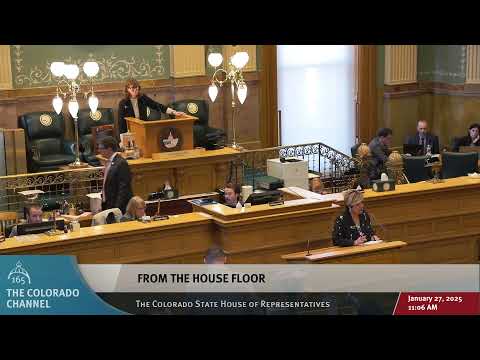
The Colorado House adopted House Bill 1019 on third reading and final passage by a vote of 41-21 with three excused members.
The bill authorizes the Department of Local Affairs (DOLA) to use third-party contractors to administer homelessness programs and related emergency rental-assistance activities funded through previously allocated resources, including funds from Proposition 123, a voter-approved funding source for affordable housing. Debate focused on oversight, fiscal transparency and a constitutional provision opponents cited that prohibits appropriations to private institutions without state control.
Representative De Grama opened floor debate by citing Article V, Section 34 of the Colorado Constitution, saying, "Appropriations to private institutions are forbidden," and questioned where the "absolute control" the constitution requires would be established for nonprofit contractors. De Grama criticized the fiscal note, which she described as showing zero direct cost, and warned of potential administrative-cost increases and weak oversight.
Representative Richardson, who said she voted yes in committee but opposed final passage, said a committee amendment requiring review of past performance for any contractor had been adopted but that she had wanted additional statutory reporting and SMART Act hearing requirements. "We have to have good strong controls on every dollar that we spend that belongs to our taxpayers," Richardson said, and said she would vote no on final passage.
Representative Sirota, identified in the transcript as a sponsor-level floor speaker, defended the bill as a technical correction implementing how Proposition 123 funds are delivered for homelessness initiatives, saying it "is simply how the state delivers dollars that are already allocated to this particular programming." Sirota noted DOLA's existing monitoring, auditing and reimbursement-based contracting and cited the Proposition 123 reporting requirement due Oct. 1 each year.
Other speakers raised concerns about transparency and tracking of where money goes and whether contracted nonprofit providers have sufficient licensing or capacity. Representative Wouk asked whether the program equates to ongoing rent assistance versus eviction prevention; the transcript records the question but does not include an answer to that question in the excerpt.
The House recorded votes during the roll call. When the machine closed, the clerk announced, "With 41 I, 21 no, 3 excused, House Bill 1019 is adopted." The transcript does not specify implementing rules or whether additional oversight amendments will be introduced in subsequent committee work.
Ending: The bill authorizes third-party contracts for homelessness programming under existing appropriations; opponents urged greater statutory controls and reporting, while sponsors described existing state contracting controls and Proposition 123 reporting as safeguards.