Get Full Government Meeting Transcripts, Videos, & Alerts Forever!
Get email alerts on the Youth Health topic
No spam. Unsubscribe anytime.
Waunakee presenters highlight youth substance use and mental‑health concerns from Dane County Youth Assessment
Summary
Presenters summarized Dane County Youth Assessment results for Waunakee students: notable vaping and alcohol exposure, high levels of anxiety and suicidal ideation, and planned focus groups and follow‑up actions by district staff and community partners.
Tim Decora, the project coordinator for the coalition's school outreach, and student and school social‑work presenters told the Waunakee Community School District committee on Jan. 29 that the Dane County Youth Assessment (DCYA) data show measurable substance use and widespread mental‑health concerns among middle‑ and high‑school students.
The assessment found that 12% of high‑school students reported at least one drink within 30 days and that 9% reported nicotine or tobacco use in the past year; 7% reported vaping THC or cannabis products during the year. Presenters also said 17% of seniors and 9% of another senior subgroup reported lifetime e‑cigarette or vape use. On mental health, Jessica Hickey, a high‑school social worker, said the data show “1 in every 5 students” had felt so sad or hopeless for two weeks in a row that they stopped doing usual activities.
The data matter because the district and its prevention partners use DCYA results to target grant‑funded efforts. Tim Decora said the coalition uses the assessment to inform its Drug‑Free Communities (DFC) grant work, and that the district plans follow‑up focus groups to validate and expand on survey findings. “In February we’re going to peel back the layers,” Decora said, describing an upcoming set of about eight to 10 student focus groups to ask the same questions directly of middle‑ and high‑school students.
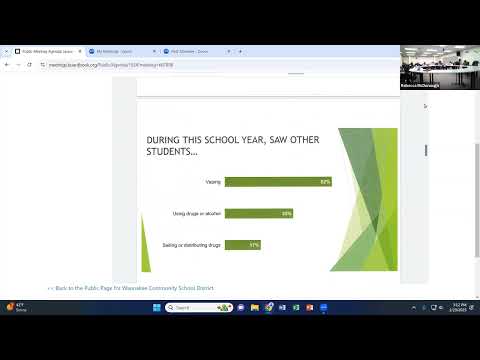
Presenters described specific findings that informed planned prevention work: student reports of seeing others vaping (52% of respondents during the school year), instances of alcohol use in homes where parents were unaware, and a range of nicotine and THC use frequencies. Jenna, a Waunakee High School senior who has participated in student prevention groups, summarized the student perspective on exposure and drivers: parents or peers often provide access and “peer pressure from friends or the excitement of college” can shape choices.
School social workers described mental‑health outcomes and current responses. Jonathan Wadham, a middle‑school social worker, and Jessica Hickey outlined school practices including suicide‑risk assessment using the Columbia screener, family safety planning, referrals to community psychotherapy providers, building bridges referrals and a Memorandum of Understanding with a local psychotherapy center that allows in‑school care. Hickey described self‑harm, suicidal ideation and attempts in both buildings: the district counted roughly 76 students at each building who reported serious suicidal thoughts in the past 12 months, and about 20 students in each building who had attempted suicide during that period.
Presenters and board members discussed service gaps and next steps. They noted a difference between students who report their own behavior and students who report seeing others’ behavior (the latter higher), and flagged access barriers to outside mental‑health care, including wait times. Staff said school‑based therapy and coordination with outside providers shortens missed instructional time and eases transitions after hospitalization. District staff and committee members also discussed transportation‑related attendance barriers and possible targeted transport or scheduling flexibility for students receiving in‑school therapy.
No formal policy votes were taken. Presenters said the coalition and district staff will return with focus‑group findings and recommended actions later in the school year.