Get Full Government Meeting Transcripts, Videos, & Alerts Forever!
Get email alerts on the Digital Inclusion Broadband topic
No spam. Unsubscribe anytime.
Utilities committee approves $760,000 payment to Digital C, conditions further disbursements on audit and legislative sign-off
Summary
The Cleveland City Council Utilities Committee voted to amend Ordinance 126-2025 to approve a $760,000 payment to Digital C after the company fell short of household subscription targets for 2024. The committee also added requirements for quarterly reporting, a pending audit and prior legislative approval of future payments.
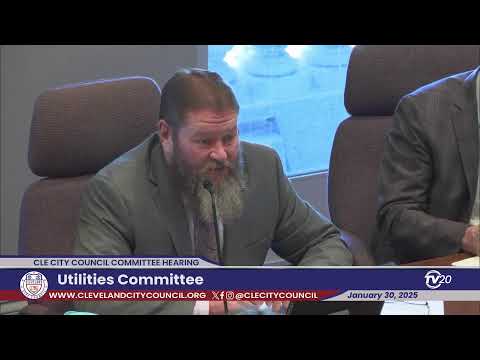
The Cleveland City Council Utilities Committee on Jan. 26 approved an amended Ordinance 126-2025 that authorizes a $760,000 payment to Digital C for 2024 work on the city’s broadband subscription program while placing additional conditions on future payments.
Committee members voted 5–1 to approve the amendment after extended questioning about Digital C’s reported results and the status of an ongoing audit. The committee said further disbursements must await a completed, clean audit and, by amendment, prior legislative approval.
The payment addresses the contract’s performance-based structure after Digital C reported 2,802 new household internet subscribers for 2024, short of the contract goal of 35,100 household subscriptions tied to a $1.75 million payment tier. Committee members and city staff told the committee that Digital C exceeded the contract’s digital-literacy metric for year one but did not meet the household subscription target.
“There's no money going out the door until results are provided,” said Councilman Casey, chair of the utilities committee, repeating committee sentiment that payments should match verified outcomes. Casey moved the legislation that was amended and advanced by the committee.
Digital C representatives told the committee about the composition of the 2,802 subscribers. “About 40% of our customers are self paying,” said a Digital C representative identified in the meeting as Josh. The company and administration provided a breakdown showing 261 households previously without broadband, 2,541 households counted as Affordable Connectivity Program (ACP) conversions, 1,271 self-pay customers, and 1,531 customers on some subsidy.
Ricardo Reynoso, the city official leading the audit process, said the financial and subscriber audit is ongoing and estimated it to be roughly halfway complete. “We are pretty confident it will happen within a couple weeks' time,” Reynoso told the committee, adding that Digital C has been cooperative and that the city’s internal audit team is reviewing submitted documentation.
Council members pressed for clearer reporting going forward and for delivery of quarterly reports specified in the contract’s Exhibit A-1. Councilwoman Spencer said quarterly reporting is in the contract and that the council had not received all of those reports; administration staff said some quarterly reports had been circulated but pledged to ensure consistent delivery to council offices.
Members debated whether the ordinance should specify an immediate dollar amount despite the incomplete audit. After discussion and multiple amendments — including adding Council President Blaine Griffin as a sponsor and inserting language that all further payments be conditioned on prior legislative approval — the committee settled on $760,000 as the payment figure. Committee members explained that figure as a per-install calculation that reduced the per-install payment for certain installs tied to Cleveland Metropolitan School District (CMSD) installs and other subsidies.
Councilman Harsh opposed moving forward before the audit was complete, calling it “premature.” Several other members urged continued partnership with Digital C while insisting on strict accountability, saying the program must deliver affordable internet to Cleveland residents.
The committee also discussed the broader funding context: the project is supported by federal American Rescue Plan Act (ARPA) funds and state and philanthropic contributions. Council leaders said they want clarity on whether other funders would seek to recoup or alter commitments if local performance metrics are not met.
Next steps: the audit lead told the committee he expects to complete the audit in a matter of weeks; the ordinance, as amended, will proceed to the finance committee. Committee members instructed the administration and Digital C to provide quarterly reports going forward and to work with council members on outreach and marketing to increase subscriptions.