Get Full Government Meeting Transcripts, Videos, & Alerts Forever!
Get email alerts on the Sobering Crisis Stabilization Center topic
No spam. Unsubscribe anytime.
County details permanent sobering and crisis stabilization center plan, names site and starts neighborhood outreach
Summary
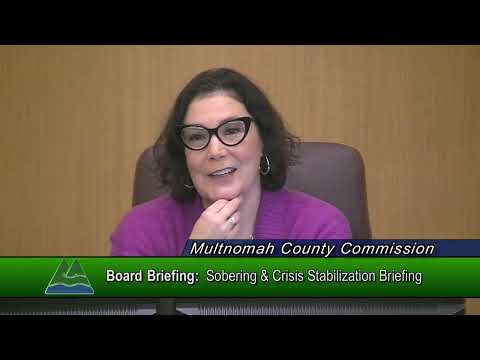
Multnomah County officials told the Board of Commissioners they have advanced planning and community engagement for a permanent 24/7 Sobering and Crisis Stabilization Center that will support the county’s HB 4002 deflection program, include withdrawal‑management services and be sited at a property the county entered into a purchase agreement to assess during a 60‑day due diligence period.
Multnomah County officials told the Board of Commissioners they have advanced planning and community engagement for a permanent 24/7 Sobering and Crisis Stabilization Center that will support the county’s HB 4002 deflection program, include withdrawal‑management services and be sited at a property the county entered into a purchase agreement to assess during a 60‑day due diligence period.
The plan: The permanent center is being designed to integrate sobering services, peer support, medical screening and withdrawal management. County staff said the center could have capacity of up to about 50 beds for sobering and withdrawal management, while an interim Pathway Center will add 13 reclining sobering beds when Phase 2 opens this spring to provide 24/7 care.
Background and legal context: House Bill 4002, signed by the governor, changed possession statutes and created an opportunity for a pre‑booking deflection program overseen by coordinated partners. Multnomah County convened a HB‑4002 leadership team composed of local public safety, judiciary and health partners to define deflection eligibility and completion criteria; the county began a field‑based deflection model on Sept. 1 and opened a Pathway Center in October to centralize many deflections.
“We will continue to provide deflection services at the center,” Anthony Jordan, senior manager of addictions and prevention services, said. Jordan described the Pathway Center’s screening, peer services and case‑planning work and said Phase 2 will add sobering beds, comfort medications and 24/7 operations.
Site and procurement status
Greg Hocker, assistant director for planning, design and construction in the Department of County Assets, told the board the county executed a purchase and sale agreement on Jan. 3 for property at 1901–1907 Southeast Grand Avenue and has a 60‑day due diligence period during which staff and the county’s design team will confirm site suitability. Hocker said the county is finalizing program details and is evaluating construction‑manager/general‑contractor proposals with an expected contract award in the next two months.
Operations and funding
Mark Harris from the county health department presented preliminary operating cost estimates and said the facility will be operated by a contracted partner while the county will continue to provide deflection services. Harris said acquisition costs will remain confidential until closing and that the county is exploring revenue sources for sustainability, including billing for withdrawal management and seeking a draft Oregon Administrative Rule that could expand billable crisis stabilization services. County staff also noted prior state capital investment and city contributions as potential supports and said additional operating details will be refined once a procurement for an operator is complete.
Community engagement and governance
County staff outlined a three‑phase engagement plan. Phase 1 included a public signup form and publication of a one‑page plan on the county sobering webpage. Phase 2, planned to begin after due diligence closes in March, will convene a “good neighbor” advisory group with residents, businesses and neighborhood collaborators to co‑create a good neighbor agreement that defines roles, responsibilities and mitigation measures. Phase 3 will report back to the sobering leadership team, continue engagement with providers, peers, hospitals and law enforcement, and prepare the site for opening.
Heather Marisol, behavioral health division director, described a leadership and governance structure that will include the Chair, Commissioner Bridal Edwards (who has championed the work), county health and justice partners, the city of Portland and other local public‑safety stakeholders. An advisory group of subject‑matter experts, culturally specific providers and people with lived experience will advise service delivery and operational design.
Board comments
Commissioners welcomed the progress and asked for additional detail on points including links to homeless services, transportation plans for people entering and leaving the site, language accessibility for outreach materials, release‑of‑information/data‑sharing arrangements with partner agencies, and how operating revenue will be sustained. Several commissioners emphasized the need to include street‑level homeless service providers, shelter operators and police jurisdictions in planning and implementation discussions.
Next steps
County staff said they will complete due diligence at the SE Grand Avenue property, finalize programing with the design team, continue neighborhood outreach and return to the board with updates in March and June. Staff also said they expect an operator procurement to be complete by June and that Phase 2 of the Pathway Center — adding 13 sobering recliner beds and comfort medications — is scheduled to open in the coming months.
Ending: County leaders characterized the permanent center as an integral part of expanding the behavioral‑health continuum and as a mechanism to divert people from jail and emergency departments, while noting that detailed operational and funding decisions remain pending procurement and rule‑making.