Get Full Government Meeting Transcripts, Videos, & Alerts Forever!
Get email alerts on the Housing Trust Fund topic
No spam. Unsubscribe anytime.
Supervisors postpone decision on Southwest Iowa Housing Trust Fund dues after detailed briefing
Summary
John McCurdy of the Southwest Iowa Planning Council presented the Southwest Iowa Housing Trust Fund’s programs and regional results; supervisors postponed a vote on budgeting $5,000 in dues for the county to March 12, 2020, after discussing distribution of funds and rural access to programs.
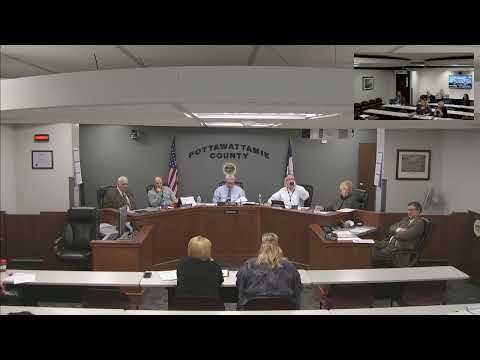
John McCurdy, director of the Southwest Iowa Planning Council, presented an overview of the Southwest Iowa Housing Trust Fund and the organization’s housing programs and financing to the Pottawattamie County Board of Supervisors.
McCurdy said the trust fund is a 501(c)(3) organization that serves an eight‑county region and that member counties pay a flat annual dues amount. “Each county pays $5,000 in dues,” McCurdy said. He described the trust fund’s core programs: owner‑occupied housing rehabilitation, a popular down‑payment assistance program (up to $4,000 forgivable; an additional $3,000 low‑interest loan is sometimes offered), demolition grants capped at $15,000, lead‑based paint abatement, short‑term loans for purchase‑rehab‑resell projects, and partnerships for new construction when funds are available.
McCurdy said the fund follows Iowa Finance Authority (IFA) rules, including annual Housing Assistance Plans (HAP). He said that, regionally, the trust fund has invested millions in housing projects over time and that per‑capita IFA distributions are the principal mechanism the state uses to allocate some funding to local housing trust funds. McCurdy provided county and regional figures, saying the non‑Council Bluffs portion of Pottawattamie County has about 4,400 low‑and‑moderate‑income households and that, regionwide, roughly 24,000 households meet that threshold. He said Pottawattamie County has received funds in proportion to its share of eligible households and that the fund has previously administered Council Bluffs’ housing trust work separately.
Supervisors pressed McCurdy and his staff on rural reach and program caps. McCurdy acknowledged that projects in unincorporated rural areas often carry higher costs—septic systems, outbuildings, and lead remediation can exhaust program budgets faster than typical city projects—and that the trust fund has completed relatively few projects in unincorporated areas (the presenter said about 30 unincorporated‑address projects across the region, with about 12 in Pottawattamie County over the fund’s history).
Several supervisors said they want assurance that additional money or any change in the county’s participation would benefit communities outside Council Bluffs and would not be absorbed only by city projects. One supervisor summarized that concern: “I want to make sure that equal amounts of money are still getting out to Pottawattamie County and not just specifically the city” (comment unattributed to a named speaker in the meeting record).
Following discussion, a supervisor moved to postpone the county’s decision on the dues and to seek additional information and legal review; another supervisor seconded. The board voted to postpone the decision to the board’s March 12 meeting. The postponement passed by voice vote; meeting record documents one vote of opposition.
Ending: John McCurdy and trust fund staff offered to provide additional data and to work with county staff and the board on options to target funds for unincorporated and small‑town projects. The board directed staff to obtain the resolution and additional documentation cited in prior correspondence and to continue discussions ahead of the March 12 meeting.