Get Full Government Meeting Transcripts, Videos, & Alerts Forever!
Get email alerts on the Public Comment Neighborhood Concerns topic
No spam. Unsubscribe anytime.
Residents press council for corridor investment, oppose neighborhood pumping station and raise solar-displacement concerns
Summary
During public comment the committee heard pleas for funding to improve the Finkle Corridor, community opposition to a proposed pumping station in Jefferson Chalmers, worries about large-scale solar projects and displacement, complaints about police behavior at the Rosa Parks Transit Center, and calls for more transparency and an oversight board.
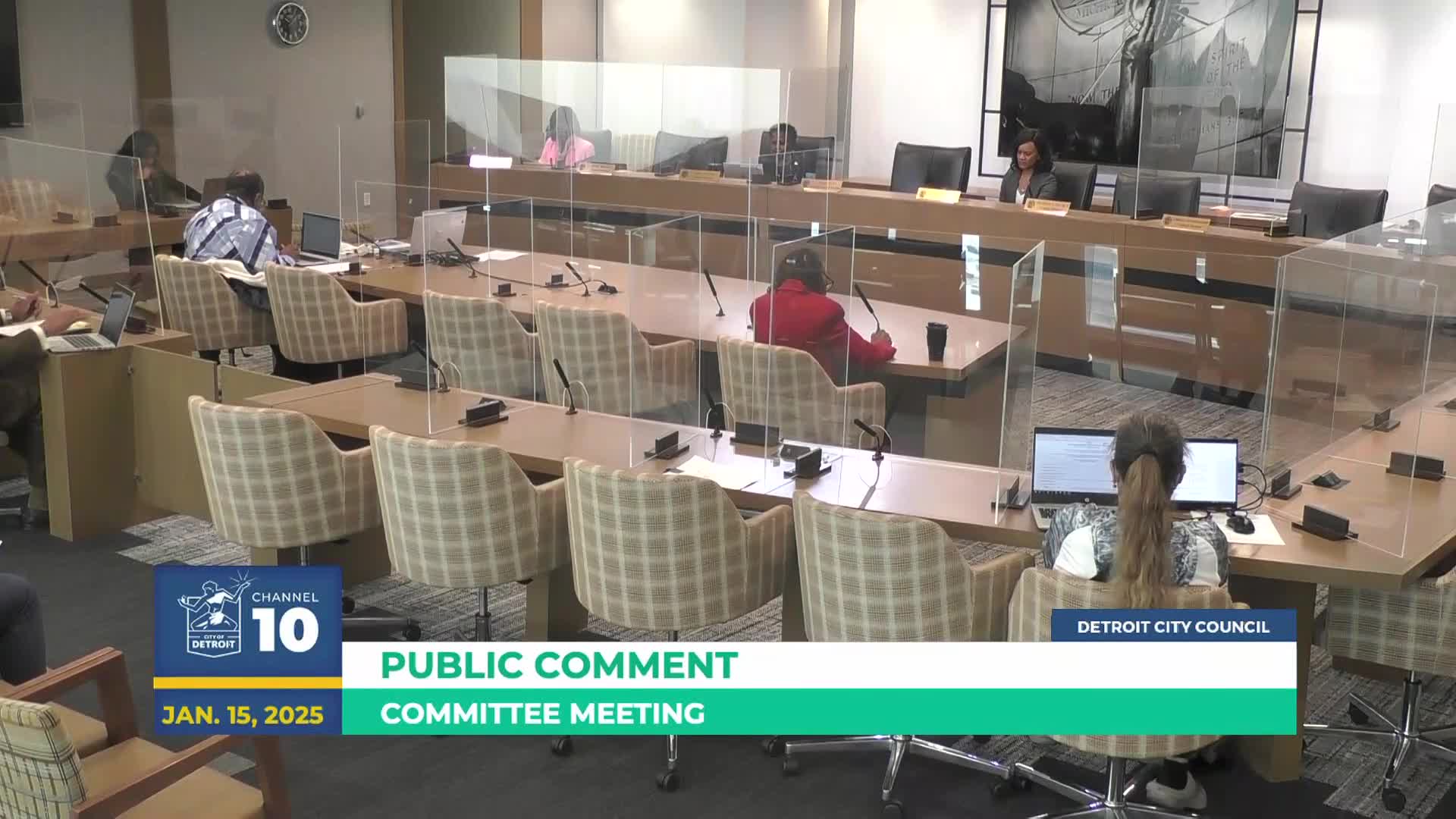
Members of the public used the Internal Operations committee’s public-comment period on Jan. 15 to press several neighborhood-centered issues: requests for equitable investment along the Finkle Corridor, objections to a proposed pumping station in Jefferson Chalmers, criticism of solar redevelopment and land-bank treatment, concerns about police conduct at the Rosa Parks Transit Center, and calls for greater transparency and a city council oversight body.
Betty A. Varner, president of DeSoto Hills World Black Association, thanked Mayor Mike Duggan and city staff for acknowledging the Finkle Corridor and work underway but urged the city to provide funding rather than a “wish list” of services. “We need monies,” she said, asking the city to treat the corridor comparably to other investment areas such as the Avenue of Fashion and other commercial corridors.
Scottie Bowman, speaking for Jefferson Chalmers residents, said attendees of a community advisory meeting understood the operational need for a pumping station but opposed placing an industrial facility “right in the middle of their neighborhood.” Bowman asked councilmembers to consider opposing a zoning change for the site and noted residents prefer locating such infrastructure on more suitable properties nearby.
A caller identifying as “No Detroit Solar Ugly” criticized proposed solar projects and land-bank practices, saying some neighborhoods have been left blighted despite long-term land-bank ownership and expressing concern that large-scale solar redevelopment may displace residents. The caller also raised eminent-domain language in a contract (referencing agenda language) and urged the council to be transparent about land-use and displacement mitigation.
A caller who identified herself as a community member from the Rosa Parks Transit Center described a person found nearly frozen and said officers ridiculed him; she asked councilmembers to be more mindful of disability and to expand transit access and services. The chair replied the committee would work with Building, Safety, Engineering and Environmental and other departments to address such concerns.
Other callers urged oversight and transparency. Mico A. Williams asked the committee to establish a public oversight board over city council subcommittees to “follow the money,” citing contracts and “verbal decisions” the caller said are not transparent. Nick Shelton asked why the Office of the CFO had not posted the annual comprehensive financial report on the city’s website as required by state law, and requested the administration upload the document.
Public comment concluded after the committee heard roughly four virtual speakers (the clerk reported four hands raised for virtual comment). Several commenters requested follow-up from staff and offered to meet with council members; the committee chair and members said they would seek additional information and coordinate with relevant departments.