Get Full Government Meeting Transcripts, Videos, & Alerts Forever!
Get email alerts on the Community Planning topic
No spam. Unsubscribe anytime.
Gilliam County town hall prioritizes childcare, housing and a pool upgrade; residents back endowment for long-term funding
Summary
At a Jan. 15 Gilliam County town hall in Condon, county officials and residents discussed a countywide strategic plan and ranked local priorities including childcare stability, housing, pool improvements and an endowment to support long‑term services.
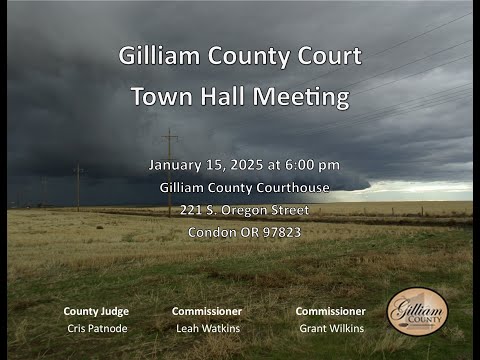
Gilliam County Court held a town hall meeting on Jan. 15 in Condon to gather public input on a county strategic plan and local development priorities, with participants ranking childcare stability, housing, pool improvements and creation of an endowment as top concerns.
County court members opened the meeting and said the town halls — one on each end of the county — are intended to align county goals with community priorities. Corey Michelo, facilitator with Fairwoods Consulting LLC, led a series of small-group work sessions in which attendees posted ideas on sticky notes, then used dot-voting to indicate preferences.
Catherine, city administrator for the City of Condon, presented a draft 20‑year vision developed through a rural development initiative involving local meetings and surveys. “What you need to know is that this is a 20 year plan,” Catherine said, summarizing the plan’s three broad focus areas: people, place and prosperity. The presentation assigned specific strategies to local organizations such as the Chamber of Commerce, Pioneer Community Development, Gilliam County Public Library, Summit Springs Village and the Times‑Journal.
Attendees used dot voting to prioritize development projects and improvements. The final tallies gathered by county staff showed the largest single item of support for an endowment fund (18 dots), pool improvements (14 dots) and increased funding/support for South Gilliam EMS and South Gilliam Fire (14 dots). Other highly ranked items included arts and culture (11 dots), addressing the north–south divide with more county‑wide events (10 dots), and a Liberty Theater rebuild (9 dots). Rural broadband, after‑school and summer programs, and housing were also recurring priorities.
The discussion repeatedly returned to childcare and after‑school care. School staff and parents explained current programming and gaps: Jennifer Hall, a school district representative, described an after‑school support program with brief academic and physical-activity components and a separate tutoring program for older students, and said funding and staffing limit expansion. Community members and service providers said funding stability, staffing and facility space are the main barriers to expanding child‑care and summer programming; one participant summarized the typical four funding streams for local child‑care centers as federal, state, county and parent fees.
Budget and long‑term funding were central themes. A county budget committee member, Wally Powell, had previously recommended town halls and suggested offering clearer budget narratives to help residents understand fiscal choices. County staff reported an unappropriated balance of approximately $11,000,000 in enhancement funds; participants and some court members discussed whether to keep contributions in a homestead rebate or to establish endowments for child care, housing, and health care. The homestead rebate figure cited during the meeting was $590 per eligible homeowner, paid under the county’s economic enhancement ordinance.
No formal county votes or ordinance changes were taken at the meeting. Instead, county staff and community organizations were asked to follow up: organizers said they would collect notes from the table work, tally priorities, post materials online and accept written comments through Feb. 14 at the county town hall email. Facilitators encouraged groups who spoke about summer and after‑school programming to collaborate and return to the court with coordinated plans that could be considered for funding or grant applications.
The county court scheduled a second town hall in Arlington on Feb. 11 and invited written comments and participation in follow-up planning. The meeting emphasized continued community engagement rather than immediate policy changes.