Get Full Government Meeting Transcripts, Videos, & Alerts Forever!
Get email alerts on the Detroit Land Bank topic
No spam. Unsubscribe anytime.
Detroit Land Bank presents Q1 report as residents press for clearer notices, faster rehabs
Summary
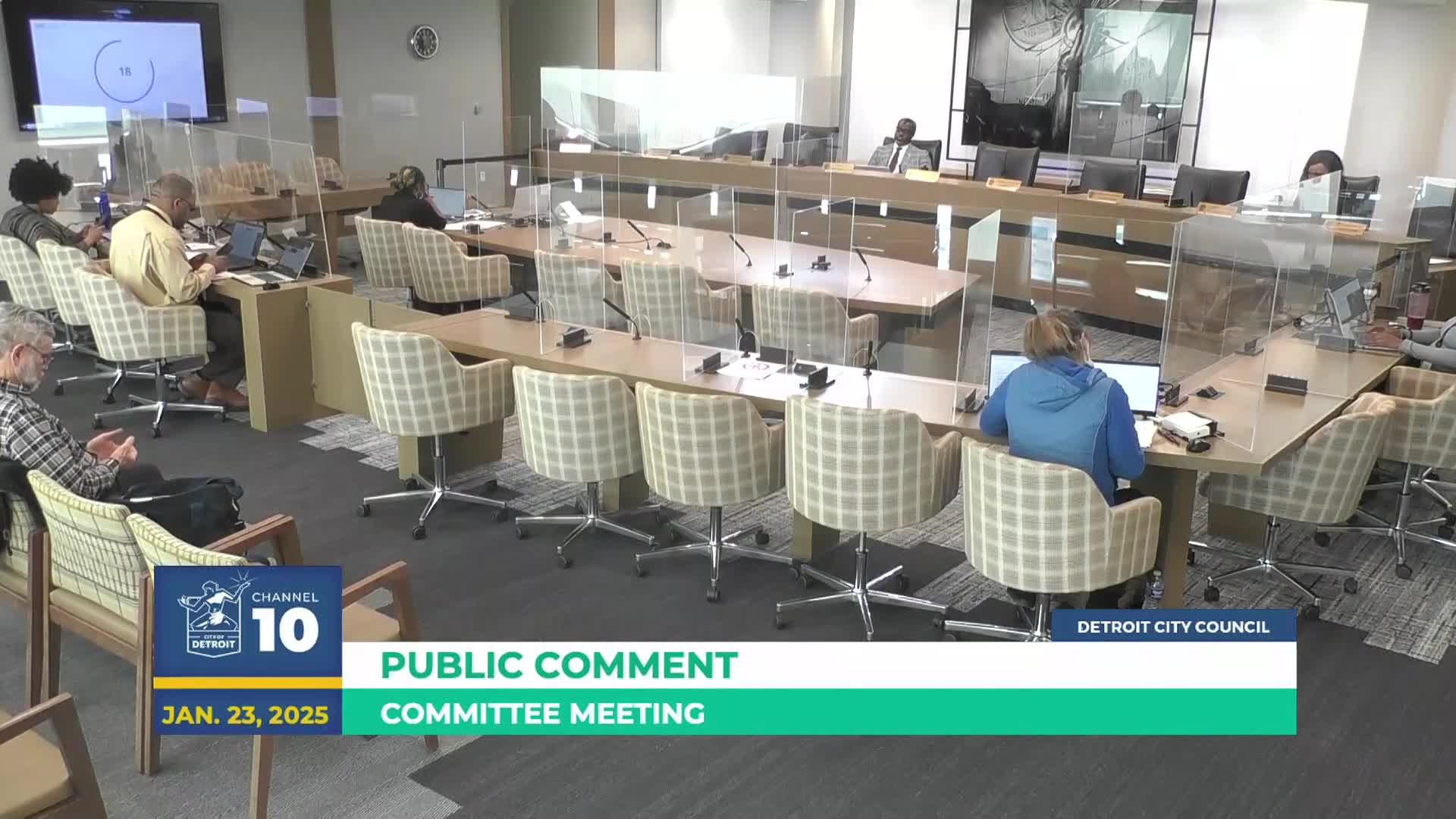
Detroit City Council members and residents pressed the Detroit Land Bank Authority on Wednesday over title clearance, customer service and how the agency notifies property owners before taking legal action, after the DLBA presented its Q1 2025 report.
Detroit City Council members and residents pressed the Detroit Land Bank Authority on Wednesday over title clearance, customer service and how the agency notifies property owners before taking legal action, after the DLBA presented its Q1 2025 report.
The Land Bank reported an inventory of about 66,170 properties, “almost 60,000 pieces of vacant land” and a structure inventory of roughly 5,500 properties, and said it sold nearly 17,000 structures to date and almost 30,000 lots. The DLBA also reported nearly 1,300 buyback closings, more than 2,000 nuisance-abatement compliance outcomes, 72 community events in Q1 and more than 14,000 incoming calls handled in the period.
Council members said they hear repeated complaints from residents who say Land Bank customer service is hard to navigate. “How are you getting this information out to the public and getting it out in a way that is shareable, easily consumed and digestible?” asked Council President Pro Tem James Tate. DLBA CEO Tammy Daniels said the authority has expanded in-person “back to the district” events, increased social-media activity and signed a communications vendor to launch new tools, including web chat and chatbots, intended to provide quicker, self‑service answers.
“Our goal is not to take the property,” Daniels said when describing nuisance-abatement work. “It is to have the private property owner step up and take responsibility for their property so that it does not act as a blight on the community.” She told the committee nuisance-abatement cases generate multiple notices and court filings before a transfer of interest occurs and that, where owners respond and agree to rehabilitate, the Land Bank dismisses litigation and monitors compliance.
Council Member Leticia Johnson and other members pushed for clearer public-facing notices. Johnson asked that disclaimers about cut water lines appear more prominently on listings and closing materials after staff confirmed that some properties have water lines that need replacement — an often expensive item for a buyer to handle. “Can you make it larger? Can you give people an actual indication of what it will take to replace that waterline?” Johnson asked. Daniels said the agency includes a detailed closing packet and a disclaimer on listings and will share closing‑packet materials with council offices for possible improvements.
Daniels and CFO/COO Reginald Scott also described the DLBA’s buyback and “finish line” programs. The buyback pathway transfers deeds to occupants who complete financial‑ and home‑maintenance training; Daniels said Q1 hosted a buyback graduation for 77 participants. The “finish line” grant pays for a last‑mile item — a furnace or water heater, for example — that prevents a purchaser from achieving compliance. Daniels said the grant has relied on limited charitable funds and that “if we have $20,000 left, that would be a stretch.”
Responding to data questions, Reginald Scott said exit‑survey results show 78% of recent purchasers were Detroit residents, with a median income around $34,000. Robert (Rob) Lynn, the Land Bank’s planning analyst, said much of the structure inventory consists of accessory buildings such as garages and sheds, plus a small number of commercial parcels.
Public commenters at the meeting raised a range of concerns tied to the Land Bank. Several speakers pressed the council to deny or limit renewal of the DLBA’s memorandum of understanding (MOU) with the city, criticized perceived lack of responsiveness to emails and phone calls, alleged improper disposals or low‑price sales of parcels, and urged greater transparency. One frequent commenter said the Land Bank was operating “unlawfully” after an earlier MOU expired; Daniels and council members said the Land Bank had conducted seven MOU town halls and gathered resident feedback about priorities like maintenance and preference for Detroit residents to buy property.
Council members also asked for more granular Land Bank metrics — for example, how many inquiries are duplicate contacts about the same situation — so staff can target workload and reduce repeat requests. Tate and Johnson offered to make council distribution lists available for DLBA communications so council offices can help broadcast key notices.
Council action: the Committee of the Whole moved to receive and file the DLBA Q1 report (line item 6.8). Members raised follow‑up questions and the motion carried with no objections in committee.
Votes at a glance: the committee recorded several procedural motions during the meeting. Actions taken included: receiving and filing the DLBA Q1 report (line item 6.8); sending Parcel Sale line item 6.3 (Collective 8 LLC/Marcus Burns) to formal session with a recommendation to approve; continuing line item 6.2 for one week to allow additional petitioner information; returning zoning/landscaping text amendment (line item 6.6) in four weeks; and sending contracting and property transfer items (7.1 and 7.2) to formal session as noted in the record.
What’s next: Council members asked DLBA staff to publish clearer, easily shared materials explaining common pitfalls (title clearance, potential water‑line replacement costs, program eligibility) and to provide more district‑level metrics on inquiries and outcomes. Daniels said the authority will continue town halls and expand its communications platform, planned for launch in late March or early April, to provide web chat, social‑media access and a chatbot for quick answers.
The committee closed after directing staff follow‑ups and moving other consent and administrative items to formal session.