
County prepares cuts and transition fund after Metro cuts forecast for Supportive Housing Services
Get AI-powered insights, summaries, and transcripts
Subscribe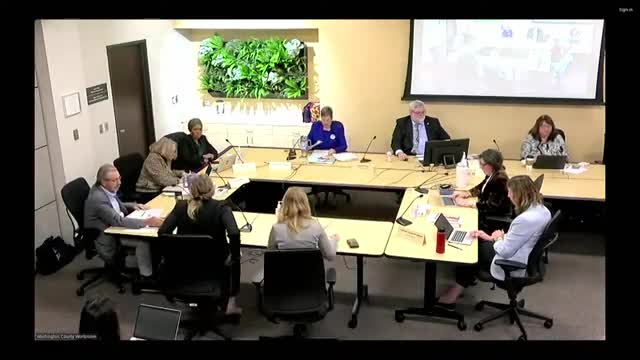
Summary
Washington County staff told commissioners Metro’s updated five‑year forecast reduced projected SHS revenues and recommended accelerated program ramp‑downs plus a transition fund to smooth a planned 15% reduction in system capacity.
Molly Rogers, Director of Housing Services, told the Board the county has entered its fourth year of implementing the Supportive Housing Services (SHS) measure and that Metro’s updated five‑year forecast shows materially lower revenue collections.
“This will be a challenging year ahead,” Rogers said. She told commissioners the county must move from an “emergency response” posture toward an “essential system” that prioritizes outcomes and sustainability, and that doing so will require both program rightsizing and a transition fund to smooth reductions.
Assistant Director Jess Larson summarized the financial details and Metro’s forecast: staff said county budgeting that previously assumed a $115,000,000 allocation would need to be adjusted toward roughly $98,000,000 in actual receipts under the updated forecast, and that Metro’s update represents roughly a $51,400,000 downward revision in the regional forecast for the current fiscal year. Larson told the board these forecasts are not actuals but are Metro’s current best estimate and that the county should plan conservatively.
Staff recommended several steps: accelerate immediate ramp‑downs of temporary programs funded at pandemic‑era levels (including a motel voucher program and expanded eviction prevention funding), plan a transition fund to smooth reductions over two to three years, and use a combination of remaining carryforward funds, assigned capital commitments, and a portion of the Tri‑County Regional Investment Fund (RIF) to seed the transition fund. Staff also recommended setting the FY 2025‑26 base budget to Metro’s updated forecast ($100,400,000 was cited in the presentation as the forecasted base) while using a transition fund to avoid abrupt cuts.
Rogers and Larson identified program areas that could be reduced over time to achieve an estimated 15% system reduction: rapid rehousing (noting no current participant would be forced from existing housing), some workforce‑support programs (housing careers), and a reconfigured data‑quality staffing approach (such as not funding one full‑time data position at every provider). Staff estimated reductions from several candidate program adjustments could total roughly $7–9 million; the county would also reduce some internal FTEs through attrition.
Rogers said the county began planning earlier in the year after Q1 financials showed spending pace consistent with depletion of the previously projected base; she told commissioners the county had approximately $96,000,000 in carryforward at the start of the fiscal year but that most of those monies were already committed through board actions. Staff identified roughly $14,000,000 of remaining carryforward, proposed assigning $7,000,000 for two capital items (approximately $5,000,000 for a Beaverton access center and $2,000,000 for land/site preparation for a pod shelter), and suggested the remaining ~ $7.6 million be available for transition uses. Staff also reported an unallocated portion of the Tri‑County RIF equal to Washington County’s share of about $9,800,000 that could be proposed for one‑time transitional support across the three counties.
Commissioners asked for clarifications about timing (whether reductions would be implemented in the current fiscal year or phased into FY 2025‑26), the treatment of current program participants (staff said no household would be removed from existing housing placements), and how the county will meet statutory reporting and data requirements if data‑quality positions are adjusted (staff said reporting obligations remain and they will seek a more efficient, sustainable approach to data quality). Several elected officials emphasized the need to state both fiscal year and program year (staff confirmed FY 2025‑26 corresponds to program year 5).
No formal vote was taken; staff sought direction and said they would return with a budget supplemental and more precise figures. Staff also indicated they would pursue a coordinated request to the Tri‑County planning body and Metro to use unassigned RIF funds for a transitional purpose and would bring a specific budget amendment for board action.