Get Full Government Meeting Transcripts, Videos, & Alerts Forever!
Get email alerts on the Hemp Regulation Definition topic
No spam. Unsubscribe anytime.
Virginia subcommittee lays hemp-definition bill on table after safety and enforcement concerns
Summary
A Virginia House subcommittee adopted a substitute to align the state hemp definition with the federal standard, heard extensive testimony for and against it, and then voted 10–0 to gently lay the bill on the table while requesting further study by VDACS.
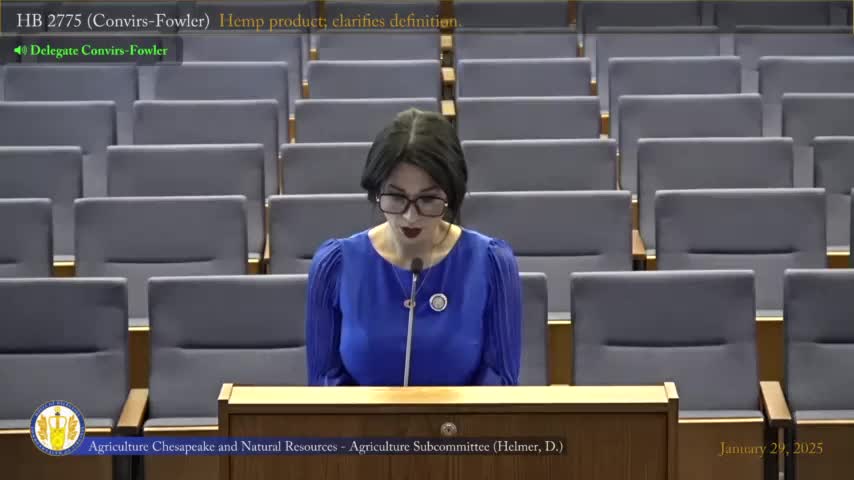
Delegate Converse Fowler introduced HB 2,775 and its substitute as a technical change to align Virginia’s hemp-product definition with the federal standard, saying the measure would “clarify Virginia's definition of hemp product by aligning it with the federal definition.”
The bill drew lengthy testimony from hemp growers, processors and students who said the state’s current rules — including a 25:1 CBD-to-THC ratio in state code alongside the 0.3% THC threshold — have harmed small farmers and businesses. Eric Spannbauer, owner of East Coast Collective, said the change is limited: “The only thing that we are trying to change is the definition of hemp.” Multiple business owners and Virginia Tech student groups told the subcommittee the substitute would restore market access and jobs lost after the prior Kilgore/Hanger legislation took effect.
State regulators and some public-policy advocates countered that the substitute could widen the market for intoxicating or synthetic cannabinoids. Nikia Thomas, program manager for the Office of Hemp Enforcement at the Virginia Department of Agriculture and Consumer Services (VDACS), testified that VDACS’s primary concern is public safety and enforcement. “This change will open up the marketplace for variations of products,” she said, warning that exclusions in the language could allow products with other isomers and derivatives into the market and that such products “can have THC content up towards 15%.” Representatives from the Virginia Catholic Conference also urged caution, noting the lengthy deliberations that produced the current statutory language.
Members of the subcommittee asked whether the substitute would change the 0.3% THC threshold; supporters and an industry expert responded that Virginia’s 0.3% THC threshold would remain but that the bill seeks to remove the additional 25:1 CBD-to-THC ratio requirement in current state code that they said penalizes farmers and processors. Supporters said the ratio requirement raised processing costs and reduced farmer revenue. VDACS and other witnesses recommended a more deliberative approach through a work group or study to assess enforcement and public-safety implications.
The committee first approved the substitute by voice vote earlier in the hearing. After final discussion and a brief period for additional testimony and clarification, a committee member moved to “gently lay HB 2,775 as substituted on the table” and requested that a letter be sent to the commissioner of VDACS asking for further study of the issue. The motion passed 10–0.
The action effectively pauses formal committee advancement of the substituted bill and directs VDACS to assist with further study; committee members said the record and additional technical input will inform any future action.
Votes at a glance: the substitute to HB 2,775 was adopted by voice vote during the hearing; subsequently the committee voted 10–0 to lay the bill on the table and request a study/letter to VDACS.