Get Full Government Meeting Transcripts, Videos, & Alerts Forever!
House AC&R Committee advances PFAS monitoring, groundwater and conservation measures; tables one plant‑based labeling bill and advances air‑monitoring and baby‑
Summary
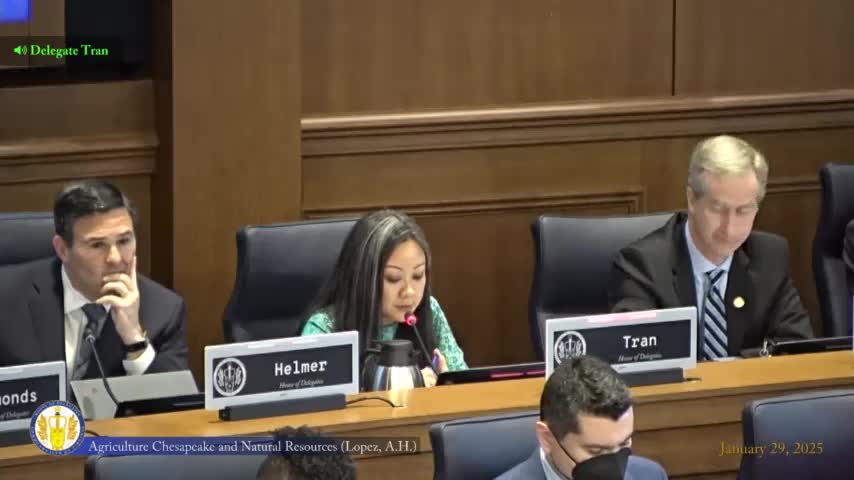
The House Agriculture, Chesapeake and Natural Resources Committee on Wednesday reported a range of bills addressing water quality, conservation and food labeling while tabling one controversial measure on plant‑based food labels.
The House Agriculture, Chesapeake and Natural Resources Committee on Wednesday reported a range of bills addressing water quality, conservation and food labeling while tabling one controversial measure on plant‑based food labels.
The committee reported House Bill 2050, a bill that creates an Occoquan Reservoir PFAS reduction program and requires certain facilities to monitor for PFOS and report using U.S. Environmental Protection Agency test method 1633 by Oct. 1, 2025. Beginning July 1, 2028, the bill directs that PFAS discharges from covered facilities not exceed any maximum contaminant limits for PFAS in drinking water promulgated on or before Jan. 1, 2025; the subcommittee recommendation was reported with a substitute by a 21‑0 committee vote.
Why this matters: the Occoquan reservoir supplies drinking water to parts of northern Virginia; the measure would require monitoring and tie discharge limits to any federal or state maximum contaminant limits adopted before 2025, potentially triggering enforcement or compliance actions if future standards are set.
Key committee actions and context
- Water and wastewater. HB 2050 (Occoquan PFAS reduction program) was reported with substitute and will go to Appropriations (vote 21‑0). The bill requires monitoring using EPA Method 1633 or an EPA/DEQ‑approved alternative and links future discharge limits to maximum contaminant limits in effect as of Jan. 1, 2025.
- Environmental‑justice and air monitoring. House Bill 2030, as substituted, establishes an environmental‑justice task force and directs coordination with the Department of Environmental Quality (DEQ) to build on the existing Tidewater Air Monitoring Evaluation (TAME) project. The committee reported the substitute and referred the matter to the Rules Committee (vote 11‑9). The substitute narrows the original scope so the committee can rely on DEQ’s ongoing monitoring work and requires the report to include recommended actions to mitigate identified risks.
- Groundwater and conservation. The committee extended the Eastern Virginia Groundwater Management Advisory Committee sunset to July 1, 2029 (HB 2327, reported with amendments 21‑0), and moved multiple conservation funding and reallocation bills (including HB 2170 regarding soil and water conservation cost‑share funds) to the next steps by unanimous or near‑unanimous votes.
- Agriculture and inspections. The committee reported HB 1837…
Already have an account? Log in
Subscribe to keep reading
Unlock the rest of this article — and every article on Citizen Portal.
- Unlimited articles
- AI-powered breakdowns of topics, speakers, decisions, and budgets
- Instant alerts when your location has a new meeting
- Follow topics and more locations
- 1,000 AI Insights / month, plus AI Chat