Get Full Government Meeting Transcripts, Videos, & Alerts Forever!
Get email alerts on the Environment topic
No spam. Unsubscribe anytime.
House AC&R Committee advances PFAS monitoring, groundwater and conservation measures; tables one plant‑based labeling bill and advances air‑monitoring and baby‑
Summary
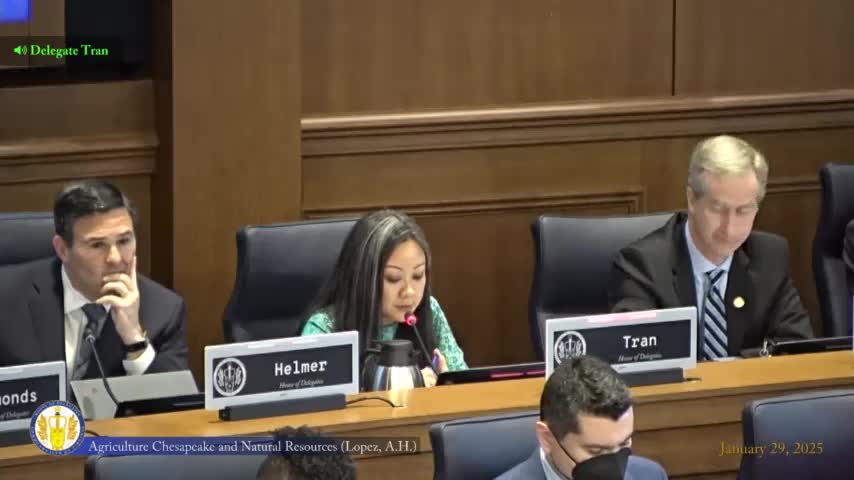
The House Agriculture, Chesapeake and Natural Resources Committee on Wednesday reported a range of bills addressing water quality, conservation and food labeling while tabling one controversial measure on plant‑based food labels.
The House Agriculture, Chesapeake and Natural Resources Committee on Wednesday reported a range of bills addressing water quality, conservation and food labeling while tabling one controversial measure on plant‑based food labels.
The committee reported House Bill 2050, a bill that creates an Occoquan Reservoir PFAS reduction program and requires certain facilities to monitor for PFOS and report using U.S. Environmental Protection Agency test method 1633 by Oct. 1, 2025. Beginning July 1, 2028, the bill directs that PFAS discharges from covered facilities not exceed any maximum contaminant limits for PFAS in drinking water promulgated on or before Jan. 1, 2025; the subcommittee recommendation was reported with a substitute by a 21‑0 committee vote.
Why this matters: the Occoquan reservoir supplies drinking water to parts of northern Virginia; the measure would require monitoring and tie discharge limits to any federal or state maximum contaminant limits adopted before 2025, potentially triggering enforcement or compliance actions if future standards are set.
Key committee actions and context
- Water and wastewater. HB 2050 (Occoquan PFAS reduction program) was reported with substitute and will go to Appropriations (vote 21‑0). The bill requires monitoring using EPA Method 1633 or an EPA/DEQ‑approved alternative and links future discharge limits to maximum contaminant limits in effect as of Jan. 1, 2025.
- Environmental‑justice and air monitoring. House Bill 2030, as substituted, establishes an environmental‑justice task force and directs coordination with the Department of Environmental Quality (DEQ) to build on the existing Tidewater Air Monitoring Evaluation (TAME) project. The committee reported the substitute and referred the matter to the Rules Committee (vote 11‑9). The substitute narrows the original scope so the committee can rely on DEQ’s ongoing monitoring work and requires the report to include recommended actions to mitigate identified risks.
- Groundwater and conservation. The committee extended the Eastern Virginia Groundwater Management Advisory Committee sunset to July 1, 2029 (HB 2327, reported with amendments 21‑0), and moved multiple conservation funding and reallocation bills (including HB 2170 regarding soil and water conservation cost‑share funds) to the next steps by unanimous or near‑unanimous votes.
- Agriculture and inspections. The committee reported HB 1837 (clean‑up aligning dealer licensing with USDA) 21‑0 and HB 2313 (annual inspections of boarding establishments by the state veterinarian and localities) referred with a substitute to Appropriations 21‑0.
- Food labeling and actions. The committee laid HB 2633 (a proposal to require specific labeling for certain plant‑based protein products) gently on the table after debate (vote 11‑10). Separately, the committee reported HB 1844 (a Maldonado bill requiring batch‑level disclosure for select toxic elements in baby foods via QR code and website) and referred it with substitute to Appropriations by a 21‑0 vote.
Public testimony and technical input
Witnesses and agency staff joined committee members during debate and the public comment period. Jay Ford of the Chesapeake Bay Foundation described the air‑monitoring substitute as “a much more streamlined bill” that leverages the TAME project and directs policy recommendations and reporting. DEQ’s Brandon Bull said the agency was still reviewing the substitute and noted the TAME project runs on a grant (roughly half a million dollars) and the agency needed to confirm the substitute fit that grant’s scope.
Parents and medical professionals urged action on baby‑food transparency. Sarah Callahan described her son’s lead exposure and urged passage of HB 1844 so parents can “quickly scan a QR code to make informed decisions.” Dr. Matt Major, a pediatric hospitalist, testified that early childhood exposure to heavy metals can have lasting neurodevelopmental effects and supported the bill.
A separate debate focused on whether misbranding penalties in existing meat and food inspection statutes – which VDAC staff described as carrying Class 1 misdemeanor provisions under current meat inspection code – warranted changes in the plant‑based labeling bill. State veterinarian Sean Ross told the committee that current code treats certain inspection violations as Class 1 misdemeanors, and that civil penalties or other remedies could be considered by stakeholders.
Votes at a glance (selected committee actions)
- HB 2050 (Occoquan PFAS reduction program): Reported w/ substitute; referred to Appropriations; committee vote 21‑0. Key provisions: monitoring by Oct. 1, 2025 using EPA Method 1633; discharge limits to match MCLs published by Jan. 1, 2025; effective compliance date July 1, 2028.
- HB 2030 (Environmental Justice task force / TAME coordination): Reported w/ substitute; referred to Rules (11‑9). Substitute narrows scope to build on DEQ’s Tidewater Air Monitoring Evaluation and requires a report with policy recommendations and recommended priority planning districts for future monitoring.
- HB 2327 (Eastern Virginia Groundwater Management Advisory Committee): Reported w/ amendments (21‑0); extends sunset to July 1, 2029.
- HB 1837 (Dealers in agricultural produce, cleanup/USDA alignment): Reported (21‑0).
- HB 2313 (State veterinarian, boarding‑establishment inspections): Reported w/ substitute; referred to Appropriations (21‑0).
- HB 2633 (Labeling for certain plant‑based products): Laid on the table (gently) 11‑10 (motion to lay on table carried); action stops further committee consideration today.
- HB 1844 (Baby food batch disclosure via QR code): Reported and referred with substitute to Appropriations (21‑0). The substitute language requires manufacturers to provide batch‑level test results for specified elements (lead, arsenic, cadmium, mercury) via a QR code/website and link to FDA guidance.
- HB 2008 (Clarify VSMP authority to enter property for erosion/stormwater enforcement): Reported (19‑1).
- HB 2170 (Reallocate BMP cost‑share funds across districts when funds cannot be obligated by June 15): Reported w/ substitute (21‑0).
- HB 2516 (Facility response plans / reporting / civil penalties for hazardous discharges): Reported (21‑0).
- HB 2517 (Sewage‑sludge permitting exemption for bona fide university research; 5‑year sunset): Reported w/ substitute & amendments (20‑0).
- HB 2782 (Blue catfish daily limit change in tidal waters): Reported (21‑0) after the committee rejected a substitute that would have limited the change to certain reaches.
- HB 2061 (Forestry boundary quitclaim authorization): Reported (20‑0).
- HB 2306 (DCR acceptance of Oak Hill Farm and related amendments; continued agricultural uses): Reported and referred with amendments to Appropriations (20‑0).
- HB 2321 (Virginia Recreational Facilities Authority divest/transfer authority): Reported (20‑0).
- HB 2630 (Local tree canopy fund authority): Reported (20‑0).
- HB 2238 (Local tree preservation and developer requirements): Reported (11‑9).
- HB 2025 (Wildlife crossings program and related DCR and VDOT duties): Reported and referred with amendments to Appropriations (11‑9).
- HB 2656 (struck at the patron’s request): Subcommittee recommended striking; action recorded in committee minutes.
- HB 2267 (air‑monitoring substitute, patron Delegate Anthony): Reported w/ substitute and amendments (12‑9); substitute narrows the monitoring scope and tasks the Environmental Justice Council to consult with DEQ on priority communities.
- HB 2638 (permissive tree canopy authority – Del. Hope): Reported (18‑0).
- HB 2710 (chair’s proposal on standardized “best if used by”/“use by” date language): Tabled by a committee motion (19‑0); the chair asked staff to request further study from VDACS/other agencies before bringing it back.
Committee procedure and next steps
Most measures reported by the full committee will proceed to the House floor or to appropriations/rules as noted above. Several bills were reported unanimously or nearly unanimously after subcommittee recommendation; a small number produced close votes and one narrow lay‑on‑the‑table outcome for the plant‑based labeling bill (HB 2633).
The committee record shows agency staff and outside advocates working to narrow bill language and align statutory language with existing programs and federal grant timelines. Several bills were explicitly tied to future appropriations review, and at least one (the air‑monitoring substitute) prompted a request by DEQ staff for additional time to confirm that actions fit within pending grant agreements.
Quotes from the record
- “We’re not trying to put anybody out of business,” Delegate Delia Wilt said while defending her labeling bill during debate on HB 2633.
- “Violations are class 1 misdemeanor,” Sean Ross, the state veterinarian and director of the Division of Animal and Food Industry Services at VDAC, said when asked about current penalty provisions in the meat‑inspection code.
- “This is a much more streamlined bill,” Jay Ford of the Chesapeake Bay Foundation said of the air‑monitoring substitute, explaining the substitute leverages DEQ’s ongoing TAME work.
- “Rudy’s lead poisoning has carried many feelings …” Sarah Callahan said in public testimony supporting HB 1844, describing her son’s experience and urging parents be provided batch‑level test results.
Ending
Committee chairs said the meeting completed the committee’s work before crossover and asked subcommittee chairs and agency staff to continue technical work over the next weeks. Several bills will return with amendments or as appropriations referrals; the committee will reconvene to consider any carryover matters during the next legislative steps.