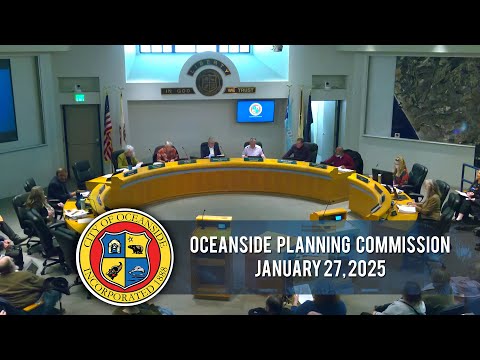
Planning Commission certifies EIR and approves Olive Park Apartments, a 199-unit 100% affordable project, with conditions
Loading...
Summary
The Planning Commission certified the final environmental impact report and approved the Olive Park Apartments project — a 199-unit, 100% affordable rental development — by unanimous 6-0 votes, with conditions and a required habitat-conservation easement.
The Oceanside Planning Commission on Jan. 27 certified the final environmental impact report and approved a development plan, tentative parcel map and density-bonus application to allow construction of a 100% affordable rental project of 199 apartments at the western terminus of Olive Drive. Both votes passed 6-0.
Staff presentation and project scope
Shannon Vitale, senior planner in the Development Services Department, told commissioners the reduced-density alternative (RDA) is the environmentally preferred project under the EIR and that the proposed RDA will occupy approximately 10.87 acres of a 43.5-acre parcel. The buildable pad is about 6.33 acres; the remaining 32.63 acres will be placed in a conservation easement and managed in perpetuity. Vitale said the project includes two four-story buildings (maximum 50 feet), 199 units ranging from about 540 to 1,109 square feet, roughly 36,000 square feet of common open space and 382 on-site parking spaces. The applicant and staff said the project was selected for $6 million in city financial assistance.
Shannon Vitale told the commission Olive Drive is the only legal access to the parcel as recorded in the original subdivision map, and the site is heavily constrained by topography, riparian areas and the adjacent North County Transit District (NCTD) Sprinter line. She said the project avoids Loma Alta Creek with a buffer exceeding 100 feet and that a significant portion of the parcel will be restored to coastal sage scrub (about 3.72 acres of restored habitat, resulting in roughly 19 acres preserved or restored on-site).
Applicant, outreach and design adjustments
Brian McHale of Capstone Equities and Dan Abom of Life of Planning Group presented the applicant’s revisions since initial submittal: they said the project has been reduced from earlier designs (previously analyzed at up to 282 units) to the current 199-unit plan, increased on-site parking from prior schemes to 382 spaces, and reconfigured internal courtyards to provide a full internal fire loop and additional turnarounds. Dan Abom said the project’s unit count had been reduced “from 400 units initially proposed, ... to 282 ... and then to the 199 that’s in front of you tonight.” The developers also said the project will be all-electric, will maximize roof area for potential solar, and includes a publicly accessible pedestrian/bicycle connection to the Sprinter station.
Technical reviews and public concerns
City staff and technical reviewers reported that the project’s Draft and Final EIR identified potential impacts in several areas (air quality, biological resources, cultural resources, geology and soils, tribal cultural resources) but concluded that, with the adopted mitigation measures and project-design features, impacts would be reduced to less-than-significant levels. Vitale said the project was conditioned to comply with the mitigation monitoring and reporting program.
The Oceanside Fire Department reviewed the project and did not recommend denial. Blake Dorris, community risk-reduction division chief for the fire department, said the department examines evacuation, brush-adjacent conditions, defensible-space considerations and the California Fire Code; he said a project of this size does not automatically preclude approval and that the department “takes a whole picture approach” to fire and life safety. Dorris explained that a code threshold in Appendix D of the California Fire Code requires a second means of access only when a multifamily project exceeds 200 units; the applicant’s 199-unit plan therefore falls below that numerical threshold.
Traffic, parking and neighborhood concerns
Traffic-engineering staff said signal timing and other adjustments on College Boulevard and the College/Oceanside corridors are ongoing; Tila Potter, the city traffic engineer, told commissioners the city had already implemented a split-phase protected-left signal operation at College and Olive to improve westbound egress and that the city could further monitor and adjust signal timing after occupancy. Yet dozens of neighbors urged commissioners to delay approval, citing persistent peak-hour congestion near College Boulevard and safety concerns during evacuations.
Public comment included a mix of opposition and qualified support. Opponents said Olive Drive is a narrow residential approach with parked cars and that adding a 199‑unit complex would create safety and evacuation issues. Supporters — including Diane Nygard of Preserve Calavera and the Sierra Club speaker — cited the project’s proximity to transit, its 100% affordable housing commitment and the value of permanently conserving more than 32 acres of habitat.
Votes and conditions
The Planning Commission took two separate votes: first to certify the Final EIR (Planning Commission Resolution 2025 E3) and second to approve the development plan D2046, tentative parcel map (E242) and density-bonus application DB241. Both motions passed 6-0. Staff noted a late revision to Condition of Approval No. 93 to clarify that 3.69 acres of disturbed habitat will be restored to coastal sage scrub and to outline the habitat restoration plan, implementation schedule and monitoring requirements requested by the U.S. Fish and Wildlife Service.
Clarifying details and next steps
Vitale and the applicant told commissioners that final engineering will address geotechnical recommendations and that cut-and-fill earthwork is being managed on site; staff added conditions that the project implement all mitigation measures in the EIR and follow the approved habitat-management and monitoring plans. The project must still comply with the city’s final map and building-permit processes and obtain all agency approvals required by mitigation conditions.
Ending
Commissioners said they wrestled with neighborhood concerns and the project’s community benefits. After public testimony and staff responses, the commission certified the EIR and approved the entitlements by 6-0. The decisions may be appealed to the City Council in accordance with the city’s appeal procedures.