Get Full Government Meeting Transcripts, Videos, & Alerts Forever!
Get email alerts on the Land Use Development topic
No spam. Unsubscribe anytime.
Residents urge commissioners to reject Eddie Jones warehouse, citing traffic, air quality and fire risks
Summary
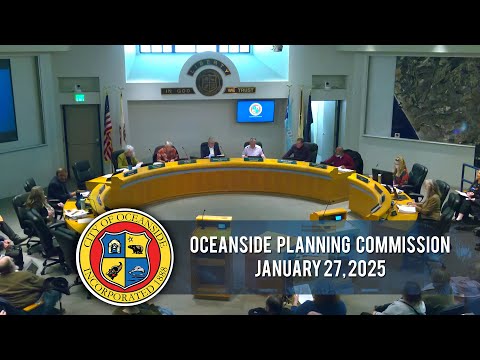
Dozens of Oceanside residents used the public-comment period of the Jan. 27 Planning Commission meeting to urge commissioners to oppose the proposed Eddie Jones warehouse, telling the panel the development would worsen traffic, air pollution, noise and emergency-evacuation risks for neighborhoods near the airport corridor.
Dozens of Oceanside residents used the meeting’s public-comment period to press the Planning Commission to reject the proposed Eddie Jones warehouse and distribution facility, saying the project would overload local roads, worsen air and noise pollution, and create safety risks for the nearby airport community.
Speakers from the nearby Airport/76 corridor neighborhood told the commission they plan to attend the formal project hearing and urged commissioners to factor public-safety and quality-of-life concerns into their review. Many asked that any approval be denied or conditioned with strict limits on truck access, hours and operating procedures.
The audience was led by residents who called the proposal oversized and incompatible with the neighborhood. Elise Buddy, a resident of Oceanside, said the 76 corridor cannot safely absorb the volume of heavy trucks the project would put on local streets and that the region’s existing traffic “is gridlock” during peak periods. Dr. Carol McConnell, who said she focuses on air pollution, warned of potential health harms to children and outdoor recreation users from diesel exhaust and asserted, “air pollution should be our number one focus on this project.” Gene O’Neil called the proposal “an absolute disaster for the airport community,” citing “constant truck traffic, deafening noise, toxic pollution and traffic congestion.”
Speakers pressed several recurring concerns:
- Traffic and circulation: Many residents said Olive Drive, Bennett and Foussat (the local access streets) and State Route 76 already experience heavy congestion and would be further stressed by semitrailer access to the site. Several speakers said emergency egress for adjacent neighborhoods could be compromised if trucks or new traffic volumes block the only available routes.
- Fire and evacuation risk: Multiple commenters cited recent regional fires and warned a large industrial site next to vegetated slopes and residential neighborhoods could complicate evacuations and fire-response operations. Anne Marshall noted the neighborhood’s limited two-lane bridge crossings over the San Luis Rey River and the possible co-mingling of 500 employees, residents and trucks in an emergency.
- Air quality and health: Doctors and parents called attention to nearby outdoor recreation sites — Prince Skate Park, the San Luis Rey River Trail and a parachute-drop business — that draw children and tourists, and they said prolonged diesel exposure could harm developing lungs.
- Noise and hours of operation: Neighbors asked that any conditional use permit, if granted, strictly limit night-time operations, truck deliveries and engine-idling, and require a publicly reviewed facility-management plan.
Several speakers urged the commission to hold the developer to the existing light-industrial allowances for truck terminals and to require a binding mitigation plan rather than rely on voluntary assurances. Dr. McConnell said light-industrial zoning historically allowed far fewer terminals and asked the commission to hold any applicant to the code’s limits unless the project’s impacts are fully mitigated.
Not all speakers proposed outright rejection; some urged modifications, including a binding facility management plan, truck routing restrictions, reduced overnight operations and formal notification to adjacent facilities if future changes to approvals are sought.
The comments were entirely in the public-comment portion of the agenda; the Planning Commission did not take formal action on the Eddie Jones project at this meeting. Commissioners and staff acknowledged the volume of public input and confirmed the project will return for formal hearings and a staff analysis.
Ending
Speakers closed by urging commissioners to weigh the community’s experience traveling the corridor, emphasize emergency access and require enforceable, public-facing conditions if the project proceeds. The commission did not vote on the Eddie Jones project at the meeting; the formal development application and any future hearing date were not decided in this session.