Get Full Government Meeting Transcripts, Videos, & Alerts Forever!
Get email alerts on the Cybersecurity Schools topic
No spam. Unsubscribe anytime.
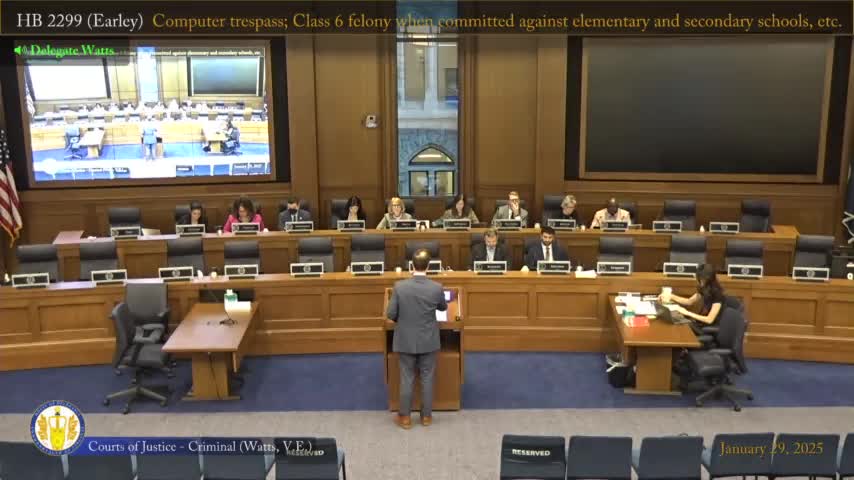
Subcommittee hears HB 2299 to elevate computer trespass against schools to felony; vote result not specified in transcript
Summary
HB 2299 would make computer trespass against elementary and secondary schools a class 6 felony; the subcommittee debated scope and charging implications but the vote outcome is not specified in the available transcript.
House Bill 2299, introduced by Delegate Early, would add elementary and secondary schools to the list of entities that, when targeted by computer trespass, may be charged at the higher statutory level (class 6 felony) rather than the baseline class 1 misdemeanor.
The patron told the subcommittee the proposal does not change the substance of the offense but only specifies that computer trespass against elementary and secondary schools is a class 6 felony “because this is sensitive as we’re often talking about data belonging to children.” He cited recent cyber incidents involving school systems, including a December 2024 incident affecting Hanover County Public Schools, and referenced national reporting that education-sector breaches have exposed millions of records.
Delegates asked practical questions. Delegate Hernandez asked whether a prank—such as a student changing passwords or sending silly emails from a teacher’s computer—could be charged as a class 6 felony under the bill; committee counsel said that, as written, a student accessing a school-owned computer to alter accounts could be charged as a class 6 felony, but that prosecutorial discretion would affect charging decisions.
Another delegate raised a statutory-interpretation concern: current code already covers the Commonwealth and local governments and “any department or agency thereof,” and several members said public schools are typically units of local government and therefore already covered. Counsel said public (government) schools likely would already be covered under the existing language, while private and religious schools would not; the patron said the bill’s primary aim is to call out schools explicitly to protect student data.
On procedure, the subcommittee considered motions to report the bill and also a motion to lay the bill on the table. The transcript records that members were asked to “cast your vote” on the motion to lay on the table, but the roll-call result is not stated in the section of the transcript provided.
Because the transcript does not record a final roll-call result for HB 2299 in the excerpt, this report records the motions and the substance of the testimony but does not assert an outcome that is not present in the record.