Get Full Government Meeting Transcripts, Videos, & Alerts Forever!
Get email alerts on the Technology Policy topic
No spam. Unsubscribe anytime.
Subcommittee tables bill that would ban TikTok access for children and create private right of action
Summary
A House courts subcommittee laid House Bill 2568 on the table after debate over scope, enforcement and whether singling out TikTok is effective or enforceable; vote 4-2.
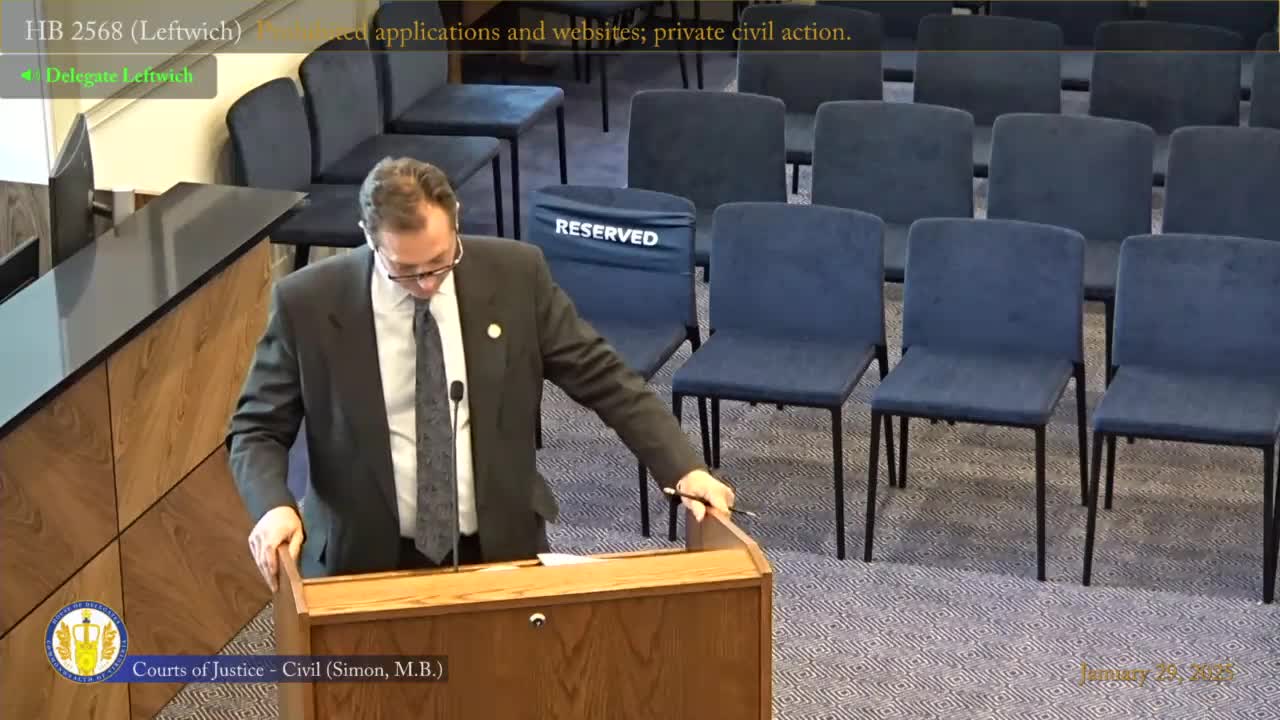
House Bill 2568, the measure sponsored by Delegate Leftwich that would bar TikTok (and ByteDance Ltd.) from providing access to the platform to any child in the Commonwealth and create a private cause of action for parents or guardians, was laid on the table by the House Courts of Justice Civil Law Subcommittee on a 4-2 vote.
The bill’s patron, identified in the hearing as Delegate Leftwich, told the subcommittee the bill “would prohibit, TikTok and ByteDance Ltd from providing access to TikTok to any child within the commonwealth and allows a child or child's parent, guardian, or custodian to bring an action against 1 of those entities for providing such access.” Leftwich cited examples of dangerous viral trends and said “the TikTok algorithm compounds the problem by promoting content that directs minors to engage in dangerous trends.”
Joelle Godwels, an Assistant Attorney General with the Virginia Attorney General’s Office Consumer Protection Section, testified in support of the bill on behalf of the Attorney General’s Office. Godwels said TikTok “has perhaps the most addictive algorithm of any of the social media platforms” and noted a 2023 Pew Research finding that TikTok is the most-used platform among 13- to 17-year-olds.
Opponents, including Eric Link testifying for the Northern Virginia Technology Council, told the subcommittee the bill lacked definitions and predictable compliance paths. Link warned that if the General Assembly creates a private right of action with “damages of $75,000 for each discrete violation,” the statute must define core terms such as “access” so companies can lawfully comply. He asked how the bill would treat a child who uses a parent’s phone to open the app.
Members questioned whether singling out TikTok is the right approach or whether the problem would simply migrate to other platforms. One member who moved to “lay the bill on the table” said the measure felt more symbolic than a practical fix; that motion was seconded and carried. The clerk recorded the final disposition as “laid on the table by a vote of 4 to 2.”
No further committee action was recorded at the hearing and the patron was thanked for appearing.
Ending: The subcommittee’s tabling leaves the bill inactive pending any reconsideration or a future motion to remove it from the table.