Get Full Government Meeting Transcripts, Videos, & Alerts Forever!
Get email alerts on the Gtib Local Grants Loans topic
No spam. Unsubscribe anytime.
State proposes $60M for GTIB; board hears surge in local loan and grant requests
Summary
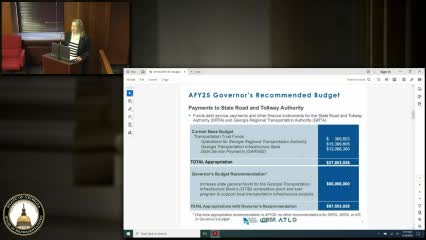
Director Janine Miller, who oversees the State Road and Tollway Authority, told the Transportation Appropriations Subcommittee the governor’s budget recommends $60 million in state general funds for the Georgia Transportation Infrastructure Bank (GTIB).
Director Janine Miller, who oversees the State Road and Tollway Authority and chairs the Georgia Transportation Infrastructure Bank (GTIB) program, briefed the Transportation Appropriations Subcommittee on GTIB activity and the governor’s recommended $60 million state general‑fund appropriation for FY25.
Miller said GTIB awards are competitive grants and low‑interest loans to local governments for projects that leverage state funds and local matching dollars; since 2010 GTIB has awarded $216,000,000 to 153 projects and that state funding has leveraged roughly $1.1 billion in total project value. “Since we kicked off the effort of issuing grants and loans in 2010, there have been $216,000,000 awarded to a 153 projects around the state,” Miller told the committee.
Miller said GTIB received strong demand in the FY25 application window: she reported about $62,600,000 in eligible project requests for FY25 with roughly $39,000,000 sought as loans. She said applications generally eclipse available funding and that local governments are seeking assistance to keep pace with rising construction costs.
On vetting, Miller said GTIB performs eligibility reviews and financial vetting in partnership with the Georgia Environmental Finance Authority (GEFA). In response to committee questions she said GEFA performs the financial review and that the GTIB staff rely on that vetting rather than duplicating work. Miller also said the program has a strong repayment record: “I'm not aware of a default,” she said when asked about delinquencies, noting the agency works with local governments when schedules or costs change.
Miller described program design changes: local governments may use GTIB loans as a match for locally administered LMIG (Local Maintenance and Improvement Grants) awards, and GTIB reinvests repaid principal into new awards. She said the program’s recent awards included a significant Locust Grove connector project (an 80% award covering $4,000,000 of that project) and a paving loan/grant combination for a dirt road near the Peach County mega site to provide workforce access.
Why it matters: Miller said a $60 million state appropriation could leverage several times that amount in total project investment; in prior cycles she said state dollars generated a larger total project value through grants and loans.
Ending: The subcommittee did not vote on the GTIB appropriation at the hearing. Committee members asked for more detail about total FY25 requests versus eligible requests; Miller pledged to supply the full request totals and further breakdowns to the committee.