Get Full Government Meeting Transcripts, Videos, & Alerts Forever!
Get email alerts on the Wildlife Health topic
No spam. Unsubscribe anytime.
Georgia DNR confirms first chronic wasting disease detection; activates response plan
Summary
The Georgia Department of Natural Resources reported a positive chronic wasting disease (CWD) test from a deer found on the Berrien–Lanier county line, activated its CWD response plan, and announced targeted sampling, testing, and public outreach.
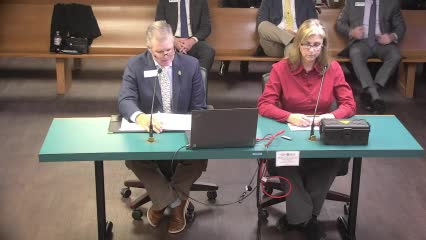
The Georgia Department of Natural Resources told the Natural Resources Committee that a deer tested positive for chronic wasting disease (CWD) on the Berrien–Lanier county line and the agency has activated its CWD response plan.
The finding prompted immediate steps including cluster sampling within a 1-mile radius of the harvest site, outreach to nearby landowners and processors, public meetings in Valdosta and Lakeland plus a virtual session, and expanded testing and communications, agency officials said. Commissioner (Georgia Department of Natural Resources) told the committee the agency had boots on the ground contacting taxidermists and processors and had issued a press release and local press briefings.
Dr. Johansen, a Georgia DNR official who briefed the committee on the disease, described CWD as a degenerative neurological disease caused by a misfolded prion that affects deer, elk and moose. "Once infected, it takes a deer about 18 to 30 months before it starts to show symptoms and signs," Dr. Johansen said, and she added that "100% of infected deer will die." She told lawmakers there are no treatments or vaccines and that infected animals can shed infectious prions into the environment before they appear sick.
Dr. Johansen said the agency has conducted statewide surveillance since 2002 and moved to a risk-based sampling model that raises sampling in counties adjacent to states with known cases. She said Georgia previously worked with the legislature to prohibit importation of live deer and carcasses from CWD-positive states in 2005 and amended that prohibition in 2022 to broaden the restrictions. The Centers for Disease Control and Prevention (CDC), Dr. Johansen said, has not documented CWD infection in people and recommends that hunters in the immediate area of a positive animal consider testing animals before consuming venison.
Agency officials described a targeted, cooperative approach rather than broad herd reductions. "We are not contemplating significant herd reductions," Dr. Johansen said, adding that the DNR will rely on hunter-harvested samples, roadkill and voluntary sampling by landowners and managers. The agency said it is seeking roughly 20–30 samples from the cluster area to estimate prevalence before the next deer season and plans to place freezers in CWD zones so hunters can voluntarily deposit heads for testing during the coming season.
Officials described logistics and costs: DNR staff said a standard diagnostic test costs about $25 and that turnaround to the lab is typically about two weeks at best; the agency said it will cover testing costs within the CWD surveillance area and that outside that area hunters may pay for testing. The DNR told lawmakers it can multiply state funds by three with Pittman‑Robertson federal funds and said it will provide a specific dollar request to the committee later the same day.
Lawmakers asked about alternative detection methods and human risk. Commissioner and Dr. Johansen told senators there is currently no approved live-animal field test: "the only approved test for CWD right now does require that the animal be dead and that lymph node tissue be removed and sent off for testing," Dr. Johansen said. On human risk she said, citing CDC guidance, that "CWD has not been shown to infect people. According to the Centers For Disease Control, no cases of CWD have ever been documented in people."
The agency said counties within a five-mile radius of the positive find will be included in the CWD management area and that surveillance will continue statewide. Officials reiterated the program goal of keeping prevalence low, "ideally below 5%," and described the response as a long-term, adaptive effort rather than a one-time eradication campaign.
Public meetings and expanded outreach materials, including updated web content and FAQs, were scheduled for the affected region; the DNR said it would continue social-media updates and media briefings and encouraged lawmakers to direct constituent questions to the agency. The DNR told the committee it will follow up with more precise budget numbers for additional staff, freezers and testing support.