Get Full Government Meeting Transcripts, Videos, & Alerts Forever!
Get email alerts on the Forestry Disaster Response topic
No spam. Unsubscribe anytime.
Georgia Forestry Commission details hurricane cleanup, mitigation programs and equipment requests
Summary
The Georgia Forestry Commission told the committee it cleared thousands of miles of roads after Hurricane Helene, mapped forest damage and requested capital funds for enclosed‑cab tractors and a firefighting helicopter to support recovery and increased wildfire risk.
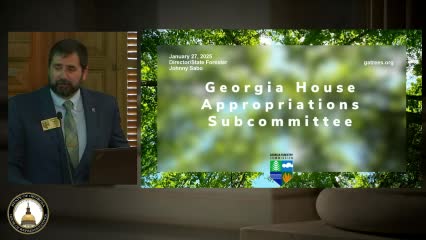
Georgia Forestry Commission Director Johnny Sabo briefed the appropriations subcommittee on post‑Hurricane Helene response, longer‑term wildfire risk and capital requests to replace open‑cab equipment.
Director Sabo said the commission reorganized into five regions last year to improve command and control and that crews cleared approximately 40,000 miles of roads in a 12‑day period following the storm. The commission reported a rapid field assessment program that established roughly 2,800 sample plots to help estimate timber damage; the director said the initial cleanup cost estimates average roughly $5,600 per acre in preliminary samples but cautioned the sample size was small and figures would be refined as claims and cleanup data accrue.
The commission described two state programs funded from the governor’s $100 million hurricane allocation: a fuel‑mitigation (reforestation cost‑share) program funded at about $22 million and a firebreak/roads cleanup program. Director Sabo said that the fuel‑mitigation program awarded up to $1,000 per acre and that applications for mitigation far outstripped available funds (the commission reported about $150 million in project applications for the $22 million fund).
For capital, the commission requested roughly $10.9 million to replace open‑cab tractors with enclosed‑cab, filtered‑air tractors focused in the impact area and about $4.78–5.0 million to add a modern firefighting helicopter to the state fleet. The director said the helicopter request is for an additional aircraft (not a replacement) with longer water‑carry capacity to support firefighting when ground access is limited. He said the agency has observed substantially longer suppression times where debris and high fuel loads from the storm make otherwise routine fires much harder to contain.
Director Sabo advised the committee that the next several years will carry elevated wildfire risk as fine fuels cure in spring and larger fuels become receptive over subsequent years; he urged continued investments in mitigation and equipment to reduce risk to communities.
Ending: Committee members thanked the commission for its field work and asked for further detail; Director Sabo said the commission will continue to provide updated cost estimates and program uptake figures as cleanup proceeds.