Get Full Government Meeting Transcripts, Videos, & Alerts Forever!
Get email alerts on the Agriculture Emergency Budget topic
No spam. Unsubscribe anytime.
Georgia agriculture agency details hurricane aid, bird-flu response and $37.4 million Atlanta market request
Summary
The Georgia Department of Agriculture told the House subcommittee it is operating around the clock to manage hurricane recovery, a confirmed avian‑influenza outbreak in commercial poultry and other pest responses while seeking legislative support for market and emergency‑response funding.
The commissioner of the Georgia Department of Agriculture outlined emergency response work and budget requests during a presentation to the House Appropriations Subcommittee on Economic Development.
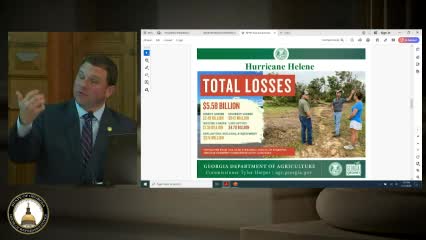
The department reported it activated operations after Hurricane Helene, which the commissioner described as causing “about a $5.5 billion impact to agriculture” in direct losses; the speaker also warned of additional future losses. The department said it partnered with more than 40 agricultural groups to raise about $1.8 million in private aid for producers and noted the governor directed $100 million in state relief last November. Of that $100 million, 75 percent was allocated to the Georgia Development Authority for low‑interest loans and 25 percent to the Georgia Forestry Commission, the commissioner said.
The department described the loan demand. It said it received 322 applications totaling about $121.3 million and has approved 40 applications for roughly $15.1 million so far. The department said applications closed Dec. 31; staff estimated another 250–260 applications could arrive that would represent roughly an additional $100 million in requests.
On avian influenza, the department confirmed a high‑path avian influenza (HPAI) event in a commercial poultry flock, describing it as the state’s fifth and sixth confirmed commercial flocks and placing Georgia among more than 35 states with HPAI outbreaks. The department said it activated an incident command structure and an emergency operations center on Jan. 16, secured affected premises, limited movement, and coordinated with USDA, public health, the Poultry Federation and local partners. The commissioner said the department’s public statement was that the state’s food supply remained safe and that there was no contamination of retail products.
The presentation also covered non‑emergency programs. The governor’s budget request includes $37.4 million for the Atlanta Farmers Market, the commissioner said, to continue infrastructure work including water, sewer and a retention pond and upgrades to security and technology. The department supports a separate FY‑26 request for additional hemp program funding (about $425,000 in the governor’s proposed budget) to hire inspectors and buy equipment as the agency continues to implement licensing and inspections; the department said it had issued about 37,100 hemp licenses since the law took effect Oct. 1 and completed about 100 inspections.
The commissioner briefed the panel on other requests: a capital ask of about $2.1 million to replace 51 high‑mileage departmental vehicles; and an equipment request of roughly $370,000 for emergency‑response gear tied to agricultural incidents (the department said it can provide a line‑item breakdown on request). The department said it will present additional FY‑26 emergency‑management position needs after lessons learned from recent events.
Committee members pressed the department on timing and disbursement. The commissioner said the Georgia Development Authority and the department are meeting weekly to roll out approved low‑interest loans and that the initial distributions (the $15.1 million referenced above) are being approved weekly. He said if additional funding arrived they could incorporate it into existing processes “to roll that out as quickly as possible,” estimating the current pipeline could be distributed over weeks rather than months.
The department also reported work on other biosecurity and pest responses: it said it deployed about 1,200 traps in a multi‑county Savannah area to track and control the yellow‑legged hornet, cited eradication of 47 nests in the most recent season, and said the program used a mix of five full‑time and several part‑time staff. The department said the National Plant Protection organization recognized its team with an award.
The commissioner repeatedly emphasized constraints and uncertainty: the department said some federal disaster aid had been authorized by Congress but state allocation and program details were still pending; it warned that many producers were making near‑term business decisions and that timing of additional state or federal funding would affect spring planting and supplier/lender decisions.
Ending: Committee members thanked the commissioner for the briefing and indicated follow‑up questions would be handled outside the hearing.