Get Full Government Meeting Transcripts, Videos, & Alerts Forever!
Get email alerts on the Human Trafficking Response topic
No spam. Unsubscribe anytime.
Attorney general, CJCC ask lawmakers for trafficking prosecutors and to stabilize state hotline
Summary
The attorney general proposed adding prosecutors and investigators in Augusta and Macon to expand human‑trafficking coverage outside Atlanta; the Criminal Justice Coordinating Council asked for $101,076 to stabilize a state trafficking hotline and create a victim advocacy unit.
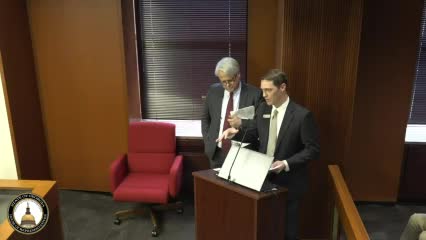
The attorney general’s office and the Criminal Justice Coordinating Council (CJCC) briefed the House Public Safety Committee on related requests to expand anti‑trafficking capacity across Georgia.
Travis Johnson of the attorney general’s office said the office wants to place prosecutors and investigators in the Augusta and Macon regions to broaden its human‑trafficking unit beyond Metro Atlanta. He cited referral and suspected report data showing suspected trafficking reports outside Atlanta and emphasized proximity to interstates as a factor in trafficking patterns. The AG’s office asked for positions to begin as early as April 1 if funding allows and provided rough salary figures: the two prosecutors referenced carry base salaries around $95,000 (according to testimony).
CJCC requested $101,076 in the amended budget to support and stabilize the statewide human‑trafficking hotline, which had been handled by nonprofit partners and was partially unmanned after a nonprofit partner’s change in August. CJCC said it answers roughly 20 hotline calls per month and proposed creating a specialized advocacy unit at CJCC to provide referrals, contract advocates and expand victim services; the agency said the one‑time amended funding would be paired with a fiscal‑2026 request to expand and annualize services including a new victim advocate position and contracted advocacy coverage for 24/7 hotline operations.
CJCC described past rapid response in recent incidents — for example, victim advocates were on the scene and staffed a recovery center after the Apalachee High School shooting — as evidence the model works when advocates are immediately available. The AG and CJCC both said they would continue to seek federal grants and nonprofit partnerships but that state funding is needed now for reliability.
Ending: Committee members asked about data supporting regional expansion and whether federal grants could cover the hotline. The agencies said data exist (referral counts and suspected reports) and that the hotline funding sought in the amended budget would be a stopgap while CJCC pursues longer‑term support.