Get Full Government Meeting Transcripts, Videos, & Alerts Forever!
Get email alerts on the Student Device Policy topic
No spam. Unsubscribe anytime.
Sponsor urges lockable pouches to limit student phone use; school boards warn bill is overbroad
Summary
Sen. Mike Wabamaw told the Senate Education Committee that locking personal electronic devices during the school day can improve mental health and classroom engagement; school boards and administrators opposed a mandatory statewide requirement, citing federal accommodation laws and local control.
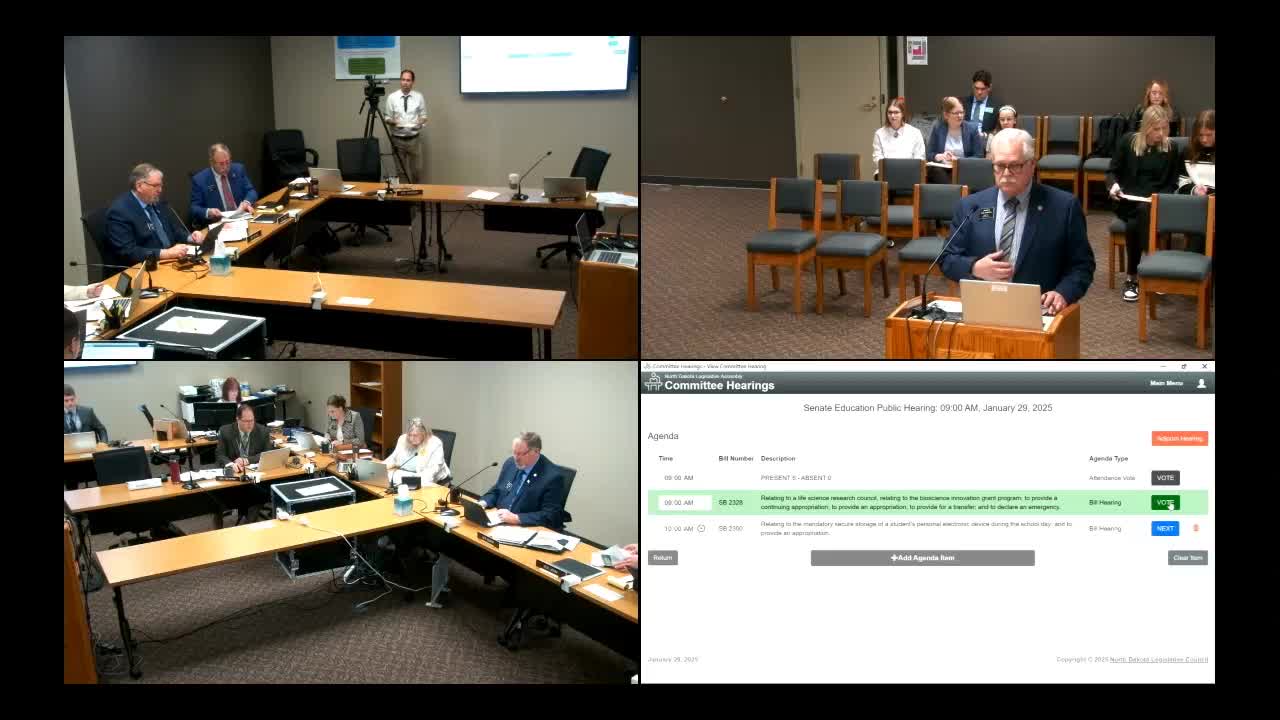
Senate Education Committee members held a hearing on Senate Bill 2300, which would require secure, student‑retained containers for personal electronic devices during the school day and include a state appropriation to purchase the containers for students.
The bill’s sponsor, Sen. Mike Wabamaw (R‑District 24), told the committee he has heard success stories from schools that restricted in‑school phone use and that research presented at conferences linked heavy social‑media use to increased teen anxiety and depression. Wabamaw said the measure is intended to reduce distractions and help students’ mental health and classroom engagement. Quoting U.S. Surgeon General Vivek Murthy, he said, “we are in the middle of a national youth mental health crisis,” and added that social media is an “important driver” of that crisis.
Under the plan described by the sponsor, each participating student would receive a lockable pouch to keep possession of their device during the school day. The sponsor said one vendor (Yonder) offers a neoprene bag with a magnetic seal that is unlocked by a teacher device; he estimated roughly $30 per pouch in materials when calculating an appropriation for grades 6–12 but did not present a total appropriation amount tied to enrollment.
Supporters who testified said the program can produce measurable improvements in student engagement, participation in activities and classroom climate. The North Dakota Bioscience Association’s Randy Schneider described the pouch and argued for a statewide approach after local success stories.
Opponents and neutral witnesses urged caution. Chrisann Norby Jonner, in‑house legal counsel for the North Dakota School Boards Association, said the proposal would “take local control completely away from our individual school districts” and that the bill does not account for federal accommodation requirements under the Individuals with Disabilities Education Act, Section 504 of the Rehabilitation Act, and the Americans with Disabilities Act. Norby Jonner said some students rely on electronic devices for translation, communication, individualized education program (IEP) supports and medical monitoring and that not every district has resources to provide school devices when accommodations are required.
Amy Copas, executive director of the North Dakota Council of Educational Leaders (representing K‑12 administrators), also opposed a state mandate and described a range of locally developed policies; she described a Rugby school implementation in which magnetic wall pouches hold student devices and open at bell times.
Jordan, deputy director of the Industrial Commission (testifying neutral), discussed procurement and operational issues and said similar grant programs administered by the commission are reimbursement‑based and typically require matching funds; he noted the commission already has experience with technical review and contract administration for state grant programs.
Committee members asked multiple technical questions about exceptions for medical and special‑education needs, how the pouches would be controlled during the day, whether the bill would override existing district policies that already restrict phone use, and whether the appropriation should cover a wider range of devices (tablets, laptops). The sponsor said the bill could be adjusted to address legitimate accommodation needs and that districts with effective existing policies could be treated similarly, but he stressed he wanted a statewide discussion that would allow the legislature to revisit the law if necessary.
No committee vote was taken on the bill. The chair said the committee will revisit the proposal next week, asked the sponsor to provide a sample vendor device for members to inspect, and indicated staff from the Department of Public Instruction may be asked to answer outstanding implementation questions.
Ending: The bill prompted a split record in committee: the sponsor urged a mandatory, statewide approach to reduce student screen time and improve mental health, while school‑district representatives urged preserving local control and ensuring federal accommodations are met. The committee closed the public testimony and said it will revisit the bill after receiving additional information and a physical sample of the proposed storage device.