Get Full Government Meeting Transcripts, Videos, & Alerts Forever!
Get email alerts on the Parental Rights topic
No spam. Unsubscribe anytime.
Lawmakers hear split testimony on Senate Bill 2244, a broad parental-rights bill for schools and health care
Summary
Senate Bill 2244 would codify parental rights over children's education, medical records and other areas; supporters urged passage citing parental access and transparency, opponents warned of conflicts with existing law, indemnity and litigation exposure and child-protection and attendance consequences.
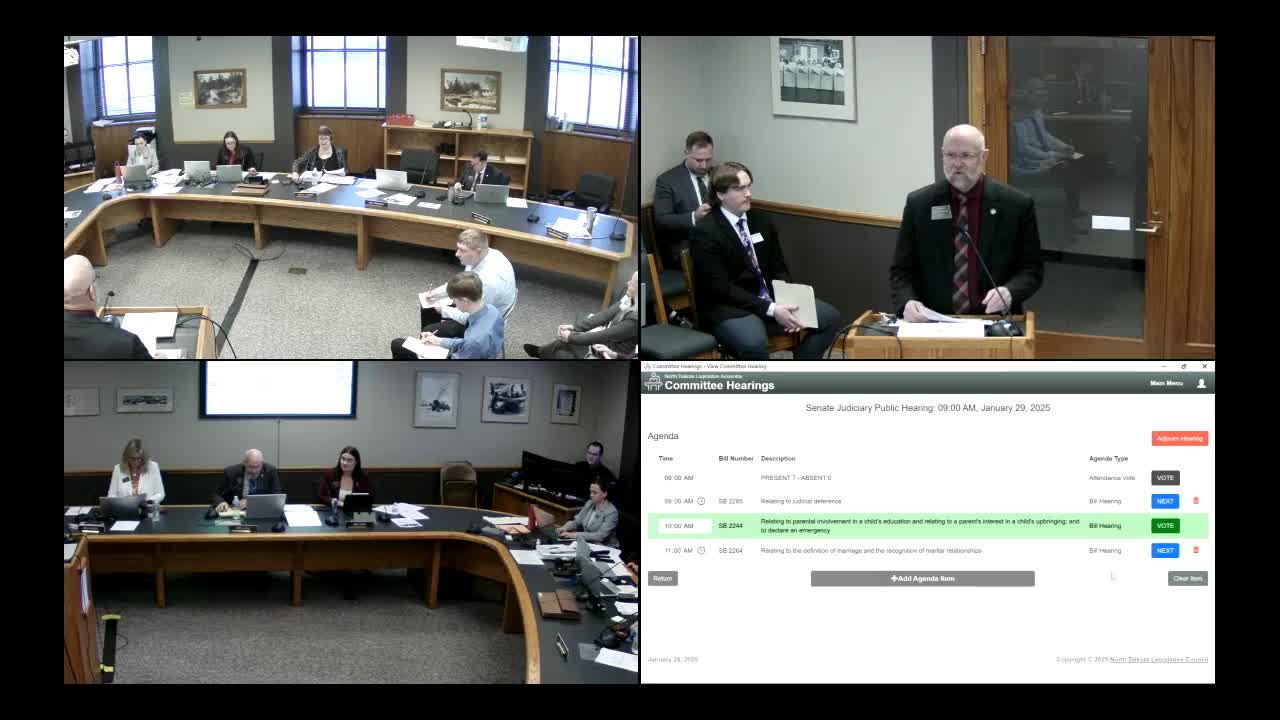
The North Dakota Senate Judiciary Committee heard hour-long testimony on Senate Bill 2244, a measure sponsored by Sen. Bob Paulson that would codify a broad set of parental rights over a child's upbringing, education and certain health-care decisions.
Sen. Bob Paulson told the committee the bill would enshrine parents’ authority to review curricula, direct moral and religious training, consent to health care and prevent schools from withholding information that reveals a student’s transgender status, subject to narrow exceptions for abuse reporting and court orders. He asked the committee to remove an emergency clause that appeared in the draft.
Supporters included the North Dakota Family Alliance and individual parents. Jacob Thompson of the Family Alliance said the bill "supports that parents are the final arbiters in their child's education, physical and mental health treatment, moral and religious training, and general upbringing." A parent who testified remotely, Kimberly Hurst, said she was charged $615.87 by a school district to review her children's curriculum and described situations where she believes schools taught material despite an opt-out.
Opponents included representatives of teachers and school boards, health-care counsel and superintendents. Mike Eierman, general counsel for North Dakota United, said the 2023 legislature already enacted a related law (House Bill 1362) and said SB 2244 reintroduces the contested term "fundamental right" and an attorney-fee remedy that his organization had successfully removed last session. Eierman warned the bill contains internal inconsistencies about when and how parents' rights may be limited and that restoring the phrase "fundamental" could invite litigation.
Amy DeCook, executive director of the North Dakota School Boards Association, noted that districts already implement parental engagement practices and said the bill's tight time frames for responding to record and curriculum requests could overburden districts. She and others opposed the indemnity and attorney-fee provisions, cautioning that the law could expose districts to more suits and that school boards would be required to pay school personnel's defense costs.
Health-care counsel raised concerns about conflicts with existing statutory exceptions that allow minors to consent to certain care or allow implied consent in emergencies. Melissa Hower of the North Dakota Hospital Association warned the bill's "notwithstanding any other law" language could nullify those existing statutory exceptions and create conflicting duties for providers.
Other witnesses described practical concerns: Alexander Public School Superintendent Leslie Bieber said mandatory-notification language in the bill could conflict with child-protection training that instructs reporters to notify child-protection services first when abuse is suspected; she also warned that broad opt-outs could worsen chronic absenteeism. Jordan Carpenter of Alliance Defending Freedom testified in favor and argued the measure codifies parental rights consistent with U.S. and state precedent.
Ending: The committee heard extensive, divergent testimony and did not vote on the bill at the hearing. Lawmakers asked for clarifications and signaled possible amendments, particularly around statutory conflicts, indemnity or attorney-fee language, emergency clause removal, and timing requirements for records access.