Get Full Government Meeting Transcripts, Videos, & Alerts Forever!
Get email alerts on the Civil Commitment topic
No spam. Unsubscribe anytime.
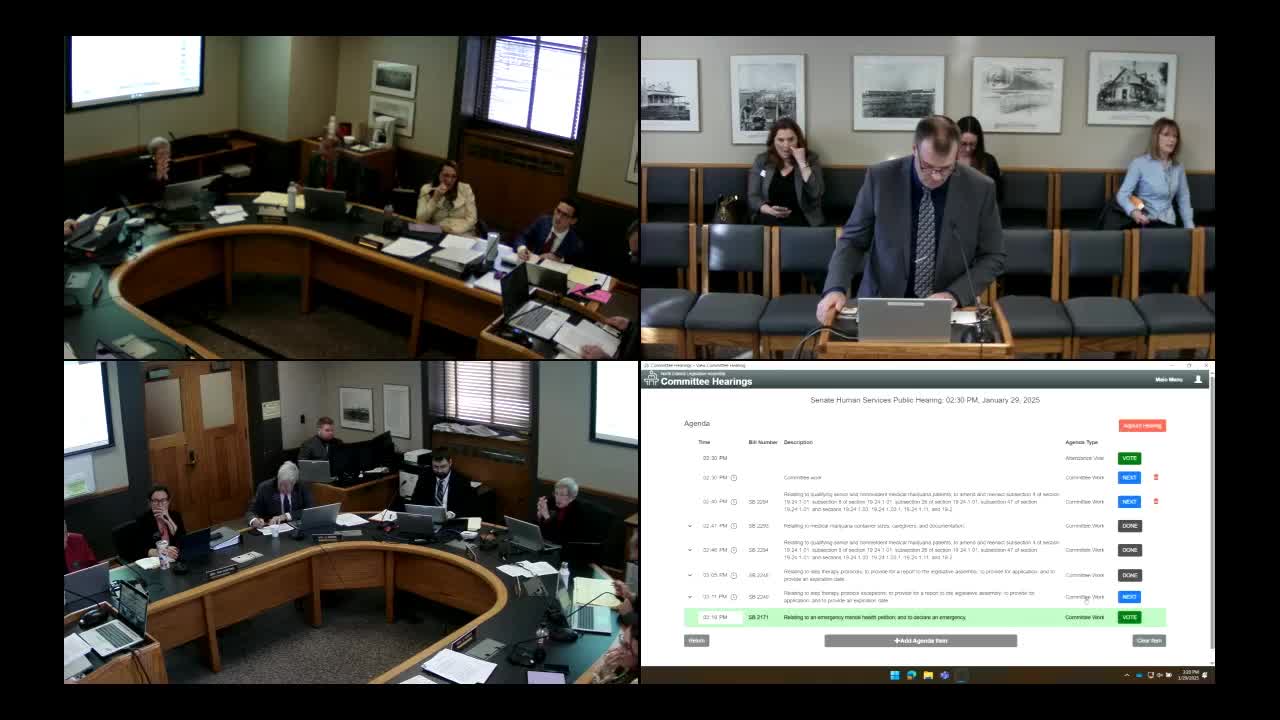
Committee discusses 24‑ vs. 72‑hour emergency evaluation window; directs staff to draft 'as medically necessary up to 72 hours' language
Summary
Committee members debated whether the statute triggering civil‑commitment evaluation clocks should be 24 or 72 hours and directed staff to draft an amendment stating detention for evaluation may be conducted "as medically necessary, up to 72 hours."
The Senate Human Services Committee discussed proposed language for emergency detention and evaluation timelines under the civil‑commitment process, including whether the statutory evaluation window should be 24 hours or 72 hours. Department of Health and Human Services staff and clinical consultants participated in the discussion and the committee directed legislative staff to draft an amendment establishing the period as "as medically necessary, up to 72 hours."
Why it matters: The statute sets the timeframe for courts and treatment facilities to complete an initial evaluation and either release the individual or pursue further involuntary commitment procedures. Committee members noted practical challenges in obtaining lab results and clinical assessments within 24 hours and expressed concern for border and cross‑jurisdictional cases where neighboring states use different timelines.
Key clarifications: Department staff explained the process and forms used: medical facilities complete an application for evaluation and emergency admission (GN5) and request law‑enforcement transport (GN6); upon arrival at a treatment facility the facility provides notice of purpose and rights (GN8) and then the 24‑ or 72‑hour clock begins at the treatment facility’s admission. Committee members asked whether law enforcement needs a separate court order for transport; the department said law enforcement may transport to a treatment facility under existing statute without a court order in most situations.
Decision and next steps: Committee members asked staff to draft an amendment that would set the detention/evaluation window as medically necessary up to 72 hours, and asked that the draft return for review at the next meeting. The committee approved a motion to draft and consider that language and will view the drafted amendment on the scheduled Monday meeting.
Ending: Members noted the need to balance patient safeguards and provider legal clarity and asked staff to return language that preserves medical judgment while setting a clear maximum period.