Get Full Government Meeting Transcripts, Videos, & Alerts Forever!
Get email alerts on the Administrative Law topic
No spam. Unsubscribe anytime.
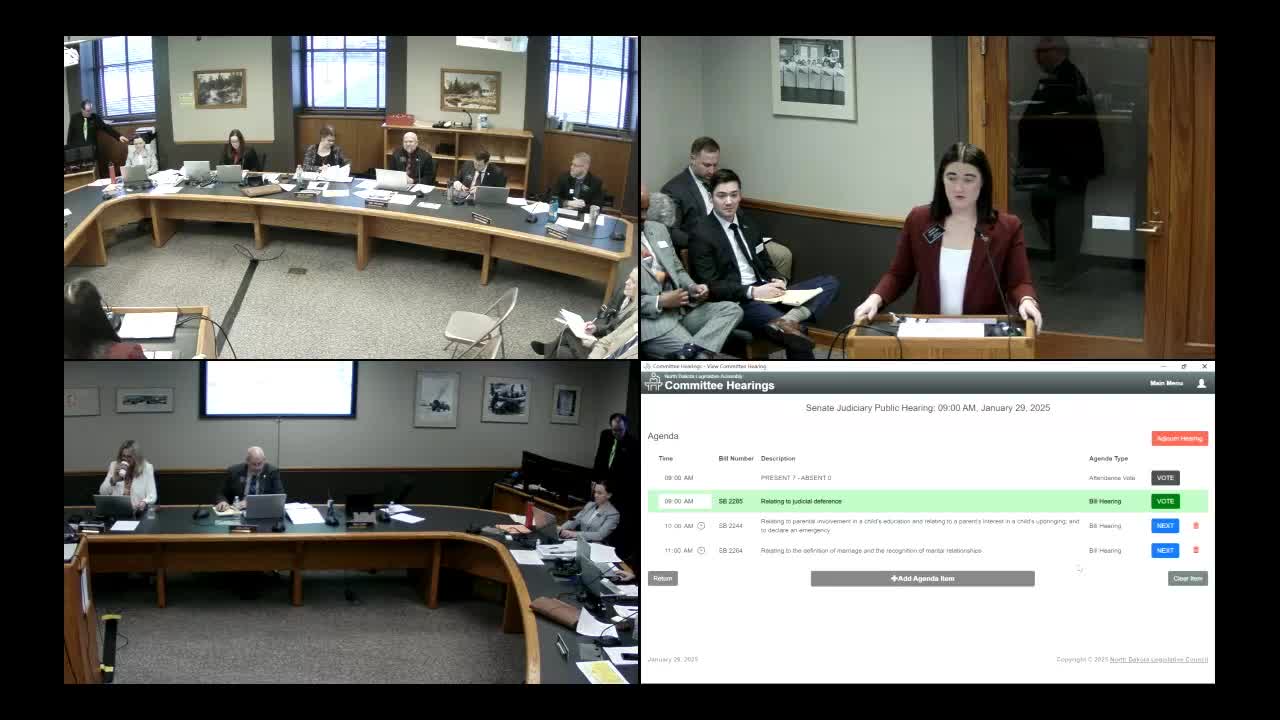
North Dakota hearing on Senate Bill 2285 pits judicial deference supporters against state agencies
Summary
Senate Bill 2285 would limit judicial deference to agency statutory interpretations; supporters say it restores separation of powers after the U.S. Supreme Court's Loper Bright decision, while state regulators and elected commissioners warn it could hamper technical oversight and invite litigation.
A North Dakota Senate Judiciary Committee hearing on Senate Bill 2285 on judicial deference featured testimony from the bill sponsor, legal advocates and multiple state agencies with sharply different views.
Sen. Claire Correa, the bill's prime sponsor, told the committee SB 2285 would require judges to follow statutes rather than automatically deferring to agencies’ interpretations of ambiguous laws. "This is a matter of proper separation of powers," Correa said, adding the bill does not prevent judges from agreeing with an agency after weighing the evidence.
Supporters framed the measure as a response to the U.S. Supreme Court’s June 2024 decision in Loper Bright v. Raimondo, which limited longstanding Chevron deference. Jackie Hall, executive director of the North Dakota Association for Justice, described Loper Bright as "an emphatic rejection of agency deference" and said SB 2285 would align state law with that ruling and the Administrative Procedure Act.
Opponents included officials from elected and appointed regulatory bodies who warned the bill would disrupt existing, technical regulatory processes and likely increase litigation. Randy Christmann, chair of the North Dakota Public Service Commission, said many PSC decisions involve factual fact-finding and technical judgments—such as whether a utility’s investment is "used and useful"—that are not well-suited to purely judicial inquiry. "The courts don't do that kind of investigation," Christmann said, noting the PSC’s public hearing processes and federal audit relationships under programs such as SMCRA and PHMSA.
Johannes Pauls Graff, general counsel for the North Dakota Insurance Department, and Nathan Anderson, director of the Department of Mineral Resources, made similar points about the insurance and oil-and-gas contexts. Anderson said agency staff often include engineers and geoscientists whose technical expertise helps the agencies craft and enforce rules that suit North Dakota’s unique circumstances.
Several witnesses urged caution or amendment. Christmann and Graff suggested carving elected constitutional officers out of the bill; Christmann said he would remove his opposition if elected agencies were exempted. Brad Peterson of Protection Advocacy noted a related case pending before the North Dakota Supreme Court, Nathan Zant v. Department of Human Services (2024 N.D. 0222), and asked the committee to consider that decision's potential guidance.
Committee members asked clarifying questions about legislative intent, the role of administrative rules, and whether the bill would prevent courts from considering legislative history. Correa and witnesses said courts already consider intent where appropriate and that SB 2285 aims to ensure the statute governs rather than an agency’s separate regulation.
The hearing closed without a committee vote and committee members took a recess. No formal amendments or votes on the bill were recorded at the hearing.
Ending: The hearing recorded strong disagreements about whether a statutory change is needed in North Dakota. Supporters framed SB 2285 as restoring courts’ interpretive role after Loper Bright; agency witnesses warned of technical harms and urged either rejection or a carve-out for elected agencies. The committee did not act on the bill at the hearing.