Get Full Government Meeting Transcripts, Videos, & Alerts Forever!
Get email alerts on the Victim Restitution topic
No spam. Unsubscribe anytime.
Bill to let judges order parental-loss restitution for children of victims draws support and procedural concerns
Summary
House Bill 1558 would allow judges to order parental-loss restitution to financially support minor children when a parent or guardian is killed in certain driving-related criminal offenses; supporters including MADD and victim-family members urged the measure, while indigent-defense counsel warned of constitutional and probation-supervision complications.
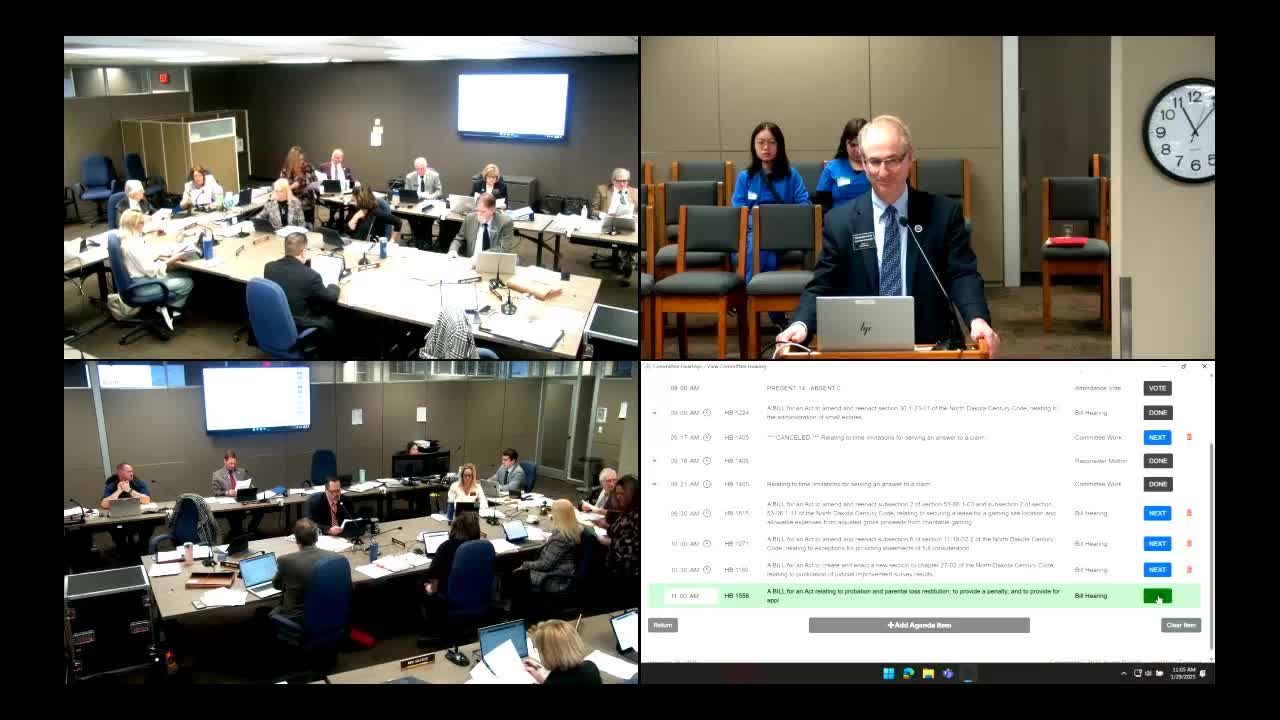
BISMARCK, N.D. ' House Bill 1558, sponsored by Representative Austin Schauer, would authorize judges to order parental-loss restitution to support minor children when a parent or guardian is killed in certain driving-related criminal offenses. The bill drew emotional testimony from a surviving grandfather and support from Mothers Against Drunk Driving (MADD), and legal caution from the commission representing indigent-defense clients.
Schauer said the proposal would allow courts to consider factors such as the child's financial needs, standard of living, custody arrangements and educational costs when setting a parental-loss restitution amount. The sponsor said payments could be ordered at the court's discretion and that the bill includes a mechanism to avoid double recovery: a civil settlement received by the surviving parent or guardian could be subtracted from the court-ordered restitution.
Tom Deutscher, whose family was killed in a 2012 crash cited by the sponsor, testified in support and urged the committee to consider the long-term financial strain on surviving children and relatives. Frank Harris, director of state government affairs for Mothers Against Drunk Driving, told the committee that six states have enacted similar measures (sometimes known as "Bentley's Law") and that the bills are narrowly tailored to drunk- or drug-impaired driving deaths.
Travis Fink, executive director of the North Dakota Commission on Legal Counsel for Indigents, testified with legal reservations. Fink said a 2016 constitutional amendment (Article I, Section 25) and subsequent North Dakota Supreme Court interpretation require full restitution and affect how courts may order restitution and consider a defendant's ability to pay. He noted the statutory timeline and supervision implications: felony probation is ordinarily supervised, and imposing a lifetime or prolonged supervised probation solely to collect restitution could create fiscal and constitutional issues. Fink also said civil judgments for unpaid restitution already occur; the court could record civil judgments if restitution remains unpaid.
Committee members asked about insurance proceeds, the doctrine against double recovery and how payment timelines would be enforced when defendants are incarcerated for long terms. Sponsor and supporters said the bill is discretionary, case-by-case, and intended as an additional remedy for child victims rather than a universal mandatory penalty.
The committee closed the hearing without recording a committee recommendation; supporters urged further consideration and the sponsor offered an amendment drafted with judicial input to allow civil-judgment entry for unpaid parental-loss restitution.