Get Full Government Meeting Transcripts, Videos, & Alerts Forever!
Get email alerts on the Judicial Transparency topic
No spam. Unsubscribe anytime.
Judicial improvement survey publication rejected by committee amid concerns about counsel and politicization
Summary
House Bill 1189, which would have published summaries of judicial-improvement surveys given to judges early in their tenure, received opposition from the judicial branch and the committee recommended do not pass, 10-4, citing concerns about confidentiality, purpose of the improvement program and the risk of politicizing judicial evaluations.
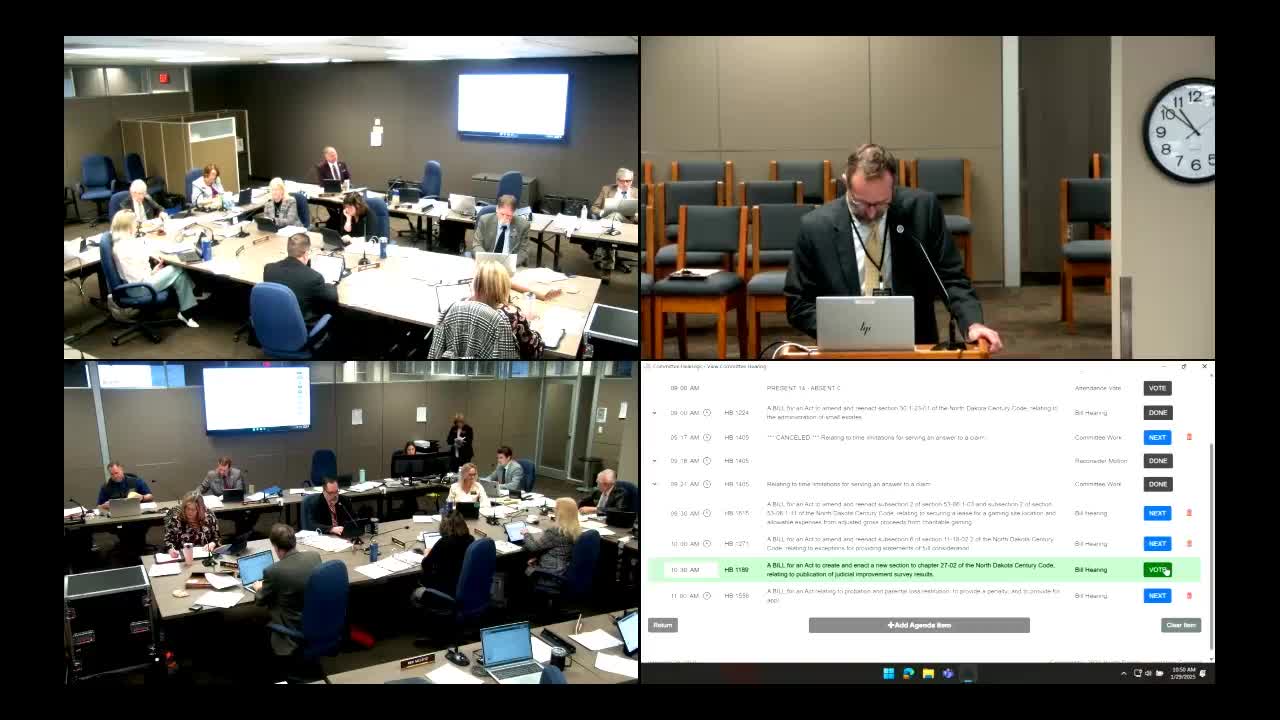
BISMARCK, N.D. ' The House Judiciary Committee recommended do not pass (10-4) on House Bill 1189, a bill that would have required publication of summaries of judicial-improvement survey results.
Representative Nathan Tholman introduced the bill as a transparency measure to help voters obtain information about judicial candidates and sitting judges. He said the intent was not to politicize evaluations but to provide a summary of survey feedback given to newly seated judges.
Sally Oliver, testifying for the judicial improvement program, urged the committee to reject the bill. She said the program was created so new judges could get candid, confidential feedback from peers and lawyers to assist with early-career improvement; survey results are given to a judge's chosen reviewer and then destroyed. Oliver said the confidential nature of the program produces candid feedback that judges use for self-improvement and that public release risks politicizing otherwise constructive feedback. She described a 90% satisfaction rate reported by judges and reviewers about the usefulness of the program.
Committee members discussed other states where public surveys exist, noting those states typically conduct public surveys in jurisdictions with retention elections; witnesses and committee members raised examples where organized campaigns have sought to undermine public judicial surveys.
After discussion, Representative Wolf moved a do-not-pass recommendation and the committee recorded a 10-4 do-not-pass vote.