Get Full Government Meeting Transcripts, Videos, & Alerts Forever!
Get email alerts on the Charitable Gaming topic
No spam. Unsubscribe anytime.
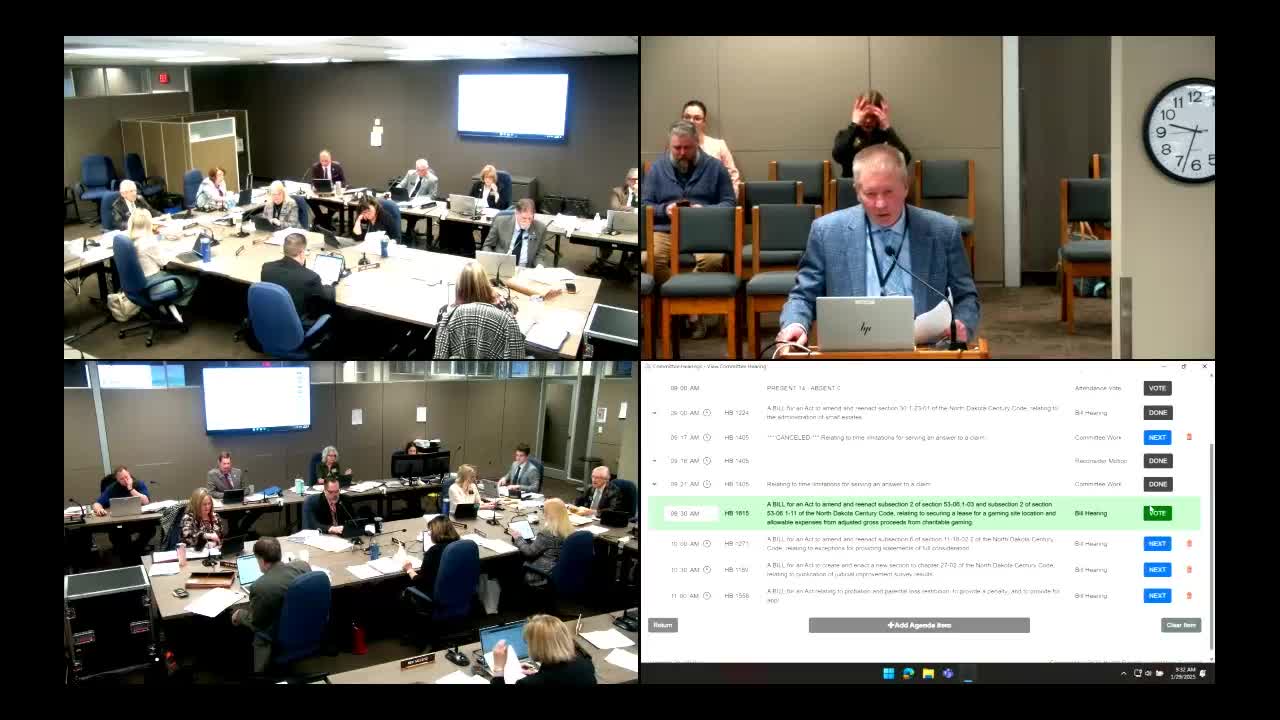
Committee hears HB 1615 on charitable gaming site authorizations, split on role of local authority
Summary
House Bill 1615 would clarify charitable gaming site authorization procedures and raise the allowable expense percentage for smaller charities to 62% on quarters of $100,000 or less; supporters say it levels the field for site owners, while the attorney general's gaming director raised concerns about process sequencing and oversight.
BISMARCK, N.D. ' Lawmakers heard hours of testimony on House Bill 1615, a bill that would clarify how charitable gaming site authorizations are obtained and adjust allowable expense percentages for smaller charities.
Representative Jim Greenieke (District 28), sponsor of the measure and proponent of an amendment drafted with input from the League of Cities, told the committee the bill does not expand gambling but clarifies the relationship among a private establishment owner, the charity and the local governing body when securing a lease and seeking site authorization. Under the amendment, an establishment owner may enter a lease with a charity and then seek city or county approval; the local governing body retains authority to approve or deny the site authorization and the attorney general's office remains the licensing regulator.
The bill also contains a financial provision: if a charity reports adjusted gross proceeds of $100,000 or less in a quarter, the charity may use 62% of proceeds for allowable expenses, up from 60%; if proceeds exceed $100,000 in a quarter, the allowable expense cap remains 60%. Proponents said the modest increase would help small-town charities cover rising costs for equipment, staffing and rent.
Supporters included Scott Meske of the North Dakota Gaming Alliance, Bill Kalanick of the Charitable Gaming Association of North Dakota, and Rudy Martinson representing the North Dakota Hospitality Association; they argued the bill clarifies longstanding practice that a lease is a private agreement between charity and site owner and the governing body's role is approval, not replacement of private selection.
Deb McDaniel, director of the Attorney General's gaming division, testified in opposition and raised process concerns. She said current practice is for the organization to obtain AG licensing first, then seek local site authorization, and then submit a rental agreement to the AG's office so the office can verify rent limits. McDaniel said ordering the lease first could undermine local oversight and complicate enforcement of statutory rent limits. She also questioned whether cities would become responsible for reviewing rental agreements and asked whether the revised sequence would create administrative conflicts.
Representatives and witnesses discussed the role of ordinances, local policy or resolutions, and whether a lease should be expressly contingent on local approval. The North Dakota League of Cities asked that local denial authority include policy or resolution (not just ordinance) to avoid requiring a formal ordinance process for routine local conditions. The committee did not take a final floor vote during the hearing.
Proponents urged a do-pass recommendation; opponents asked for further refinements to preserve the order of state licensing and local oversight while addressing administrative questions raised by the AG's office.