Get Full Government Meeting Transcripts, Videos, & Alerts Forever!
Get email alerts on the Property Tax Reform topic
No spam. Unsubscribe anytime.
House bill would remove some mill-levy authority for Garrison Diversion, shift dollars to state; park districts warn $1M bond cap is too low
Summary
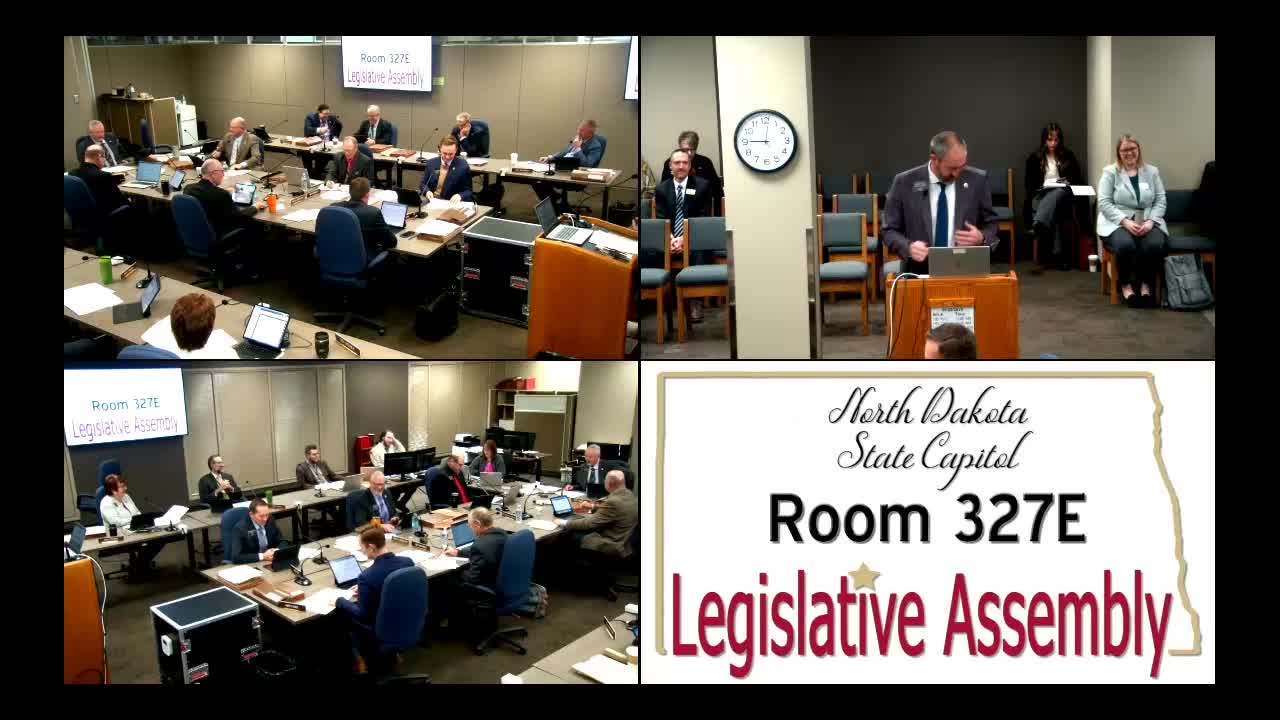
House Bill 1572 would remove some local mill-levy authority for the Garrison Diversion Conservancy District and county extension service and shift roughly $19.8 million of levy funding to the state, sponsor Representative Jared Haggart told the House Finance and Taxation Committee.
House Bill 1572 would strip some general mill-levy authority from the Garrison Diversion Conservancy District and county extension service and replace much of those levies with state funding, sponsor Representative Jared Haggart told the House Finance and Taxation Committee. Haggart said the bill also creates a uniform property-tax reporting system and allows electronic opt-in delivery of property tax statements.
The bill would carry a fiscal note of about $19.8 million to hold Garrison Diversion and county extension harmless if their local levy authority is removed, Haggart said; he told the committee the appropriation is split roughly $9.5 million for Garrison Diversion and $10.3 million for extension. “I wanted to give the committee an opportunity to work through some ideas other than caps,” Representative Jared Haggart said in his opening remarks.
Why it matters: Committee members asked whether the state would assume the levy formerly charged only in counties served by the Garrison Diversion project. Haggart and Chair Craig Hedlund said the move would put those dollars on the state general fund. Hedlund noted that the Garrison Diversion budget already receives the bulk of its funding from the state; Representative Hager later observed that 28 of North Dakota’s 53 counties participate in the conservancy district.
Park districts and recreation advocates objected to a separate provision that would limit park-district general-obligation bonds that can be issued without a public vote. Cole Higland, director of the Mandan Park District and a representative of the North Dakota Recreation and Park Association, said the bill’s language would cap nonvoter GEO borrowing at $1,000,000 and that size-based differences among communities make a flat dollar cap disproportionate. “The $1,000,000 cap is what really concerns us for the park district,” Higland said, noting his district’s undesignated fund balance and that levying constraints can force requests for deferred-maintenance grants.
Jerry Rostow, a commissioner for the Fargo Park Board, testified in neutral and asked the committee to consider raising the cap to at least $10,000,000 for rapidly growing cities such as Fargo, where current statute allows substantially larger debt without a public vote. Rostow said about 40% of the Fargo sports center and Island Park pool projects’ costs were private gifts and in-kind donations and that those projects have produced heavy public usage.
Other bill provisions discussed included a new section describing mechanics of reimbursing repealed levy authority; removal of some tax-reporting language from property tax notices; and a uniform data reporting system Haggart said would let the Legislature run models on valuation impacts when large property tax bills are proposed.
The committee took testimony in support and opposition and closed the hearing with no formal vote recorded.
Details: Committee members pressed Haggart on fairness, given that only participating counties pay the Garrison Diversion levy today. Haggart said the sponsor’s intent is to provide property-tax relief for homeowners and businesses. Representative Steiner expressed concern about equity if the state picks up a levy that benefits a subset of taxpayers; Hedlund and Haggart said the state already pays most of Garrison Diversion’s costs.
What’s next: The committee closed the hearing after receiving testimony from park districts and county representatives and will consider possible amendments before any committee recommendation.