Get Full Government Meeting Transcripts, Videos, & Alerts Forever!
Get email alerts on the Superintendent Search topic
No spam. Unsubscribe anytime.
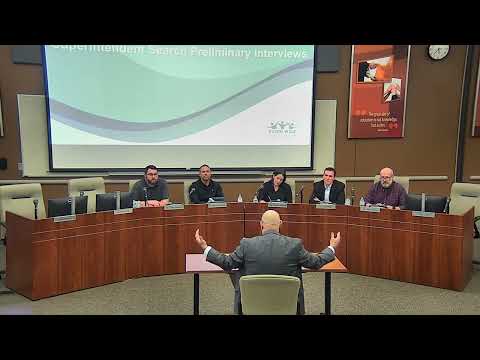
Kennewick board conducts preliminary superintendent interviews with three candidates
Summary
The Kennewick School District board held its scheduled preliminary interviews for superintendent candidates. Three finalists outlined priorities including local decision-making, fiscal strategy, school safety and career-technical partnerships; board members asked about parental rights, discipline, and use of federal COVID-era funds.
The Kennewick School District Board of Directors conducted preliminary interviews with three superintendent candidates during an evening meeting, allotting roughly 45–50 minutes for each candidate to respond to questions from the five-member board.
The interviews brought forward candidates' priorities for the district and repeated themes across candidates: (1) local control and community partnership in implementing state requirements; (2) dealing with funding pressures and long-term fiscal planning; (3) strategies to support student behavior and safety; and (4) workforce and career-technical programming to improve postsecondary outcomes. Board members asked questions about the recently enacted parental-rights measures, collective bargaining, school safety and the district’s use of one-time ESSER funds.
Dr. Castilleja, who identified himself as a longtime Eastern Washington educator and former principal and superintendent, told the board he favors local decision-making and an inclusive leadership style. He summarized his approach simply: “They listen more than they speak,” and said his strength is to “lead complex organizations simply.” Castilleja described a focus on professional learning communities (PLCs) to improve instruction and said he uses a decision model that reserves “root” decisions for the superintendent and delegates others to school leaders. On finances he described structural state funding challenges, warned districts cannot sustain current cost pressures indefinitely, and said part of the work must be advocacy in Olympia. On discipline he emphasized multi-tiered supports rather than suspension as the primary lever and said suspensions should be limited to safety-related cases. He also spoke about contracted security and training programs such as ALICE for active-incident awareness.
Matt Mallory, introduced as currently serving as a superintendent in a small Washington district, stressed listening to community priorities and establishing clear short- and long-term objectives that build on the board’s strategic plan. Mallory described weekly collaboration time for staff in his district and said that approach supported curriculum and instructional alignment. He said transparency with the public is essential to sustain community support for levies and bonds: "Parents are a partner," he told the board, and said the district should share financial data and involve citizens in budget discussions. Mallory also described using ESSER funds for classroom space, technology and meals during the pandemic, and said levies he led passed after focused community outreach.
A third candidate, Christopher (given name in the transcript), emphasized career and technical education and partnerships with local employers and higher-education institutions. He described designing career-pathway programs that, he said, informed state-level work and that led to national consulting roles; he framed the superintendent role as one of setting a clear vision and supporting localized pilots and measurement through an improvement-science approach. Christopher described concrete strategies for closing achievement gaps by developing district data dashboards, identifying transition points (for example, the 5th–6th grade transition), piloting targeted schedule changes and aligning interventions to measured needs. He also cited work expanding dual-credit access and apprenticeship pathways as levers to increase postsecondary completion.
Across candidates, board members pressed on the effect of recent state laws on local practice and how each candidate would balance compliance with reflecting community values. Candidates repeatedly said legal compliance is required, and that explaining the reasoning to families and working through local policy and curriculum-adoption processes were essential steps. On collective bargaining, each candidate described experience negotiating with labor groups and framed bargaining as an ongoing relationship that benefits from clear communication and interest-based practices where feasible.
The board did not take any votes on personnel or policy at the meeting; the session consisted of candidate presentations and question-and-answer exchanges. The board indicated it would continue interviewing additional candidates at scheduled times later in the evening and into subsequent sessions.
The transcript records the board opening the evening’s session at 5:30 p.m. and scheduling additional interviews (the chair noted a 6:30 p.m. start for a subsequent interview).