Get Full Government Meeting Transcripts, Videos, & Alerts Forever!
Get email alerts on the Dynamic Scoring topic
No spam. Unsubscribe anytime.
ALC Executive Subcommittee Authorizes Contract with REMI for Dynamic Scori ng Model
Summary
The ALC Executive Subcommittee approved a contract with REMI to provide a dynamic economic scoring model to supplement static fiscal impact statements. Members cited faster turnarounds, no usage caps, and potential for better-informed legislation; the bureau will adopt procedures for requesting and producing impacts.
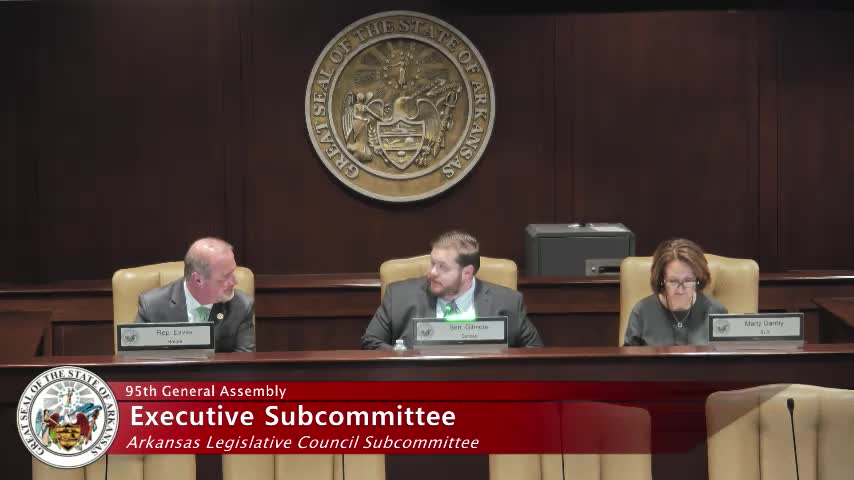
The ALC Executive Subcommittee voted to authorize the Bureau of Legislative Research to enter a contract with REMI to provide a dynamic economic modeling program, the panel decided during an executive-subcommittee meeting.
Representative Lundstrom, the member who introduced the effort, said dynamic scoring would give legislators a fuller picture than static fiscal impact statements. “We need to see not only the front of the picture but the back of the picture… we’re asked to make multimillion-dollar decisions with 1 economic impact statement,” Representative Lundstrom said.
The REMI team—Dr. Peter Evangelakis, senior vice president of economics and consulting; David Ingram, senior economic associate; and Scott Lerer, assistant business administrator—told members the model uses decades of academic literature and is updated annually with official data sources. A REMI representative said a requested command-line interface (CLI) is intended to make running a large number of analyses more efficient for staff who must process many bills during session.
Members asked how quickly REMI could return analyses. REMI said straightforward requests can often be turned around in about a day; more complex bills may require additional background work and take longer. The REMI team and bureau also said there is no cap on the number of analyses that can be run under the proposed software license.
Senator Rice moved the authorization; a second was recorded and the committee approved the motion by voice vote. The motion as spoken on the record was: “I move that the Bureau is authorized to enter into a contract with RAMEY for modeling program at the price not to exceed 192,000 plus” (contract language in the transcript stops after “plus” and no further dollar breakdowns were specified on the record).
Director Marty Garrity told members the bureau will need policy direction on procedures once the software is available, including whether dynamic scoring will be run only for filed bills or also for draft bills, whether analyses should be performed on bills individually or in relation to other bills, who on the legislative side may request a scoring, and how the bureau will handle workload. Garrity noted the contract, as drafted for committee review, contemplates two staff positions devoted to dynamic scoring; comparing models used elsewhere, some offices staff three people for this work.
Members signaled support but left procedural details unresolved. Senator Hester stressed that model outputs are only as reliable as model inputs and asked whether REMI was confident in the data and parameter updates; REMI replied that the model is re-estimated regularly and data are refreshed every year. Representative Brooks and others pressed on turnaround and staffing implications for the bureau; REMI and bureau staff acknowledged those operational questions must be addressed before full implementation.
The subcommittee directed staff to return with recommended procedures and to continue discussions at the next executive-subcommittee meeting.
Ending: The committee approved the authorization and agreed to finalize operational procedures in subsequent meetings before the REMI model is deployed for routine use.