Get Full Government Meeting Transcripts, Videos, & Alerts Forever!
Get email alerts on the Fire And Rescue Cip topic
No spam. Unsubscribe anytime.
Bradford County fire chief outlines $650,000 for Sampson City living quarters, seeks state appropriations for engines and brush trucks
Summary
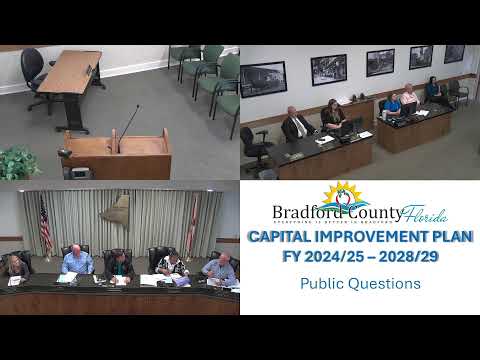
Chief Carter presented the Fire & Rescue section of the county's five-year Capital Improvement Plan, confirming $650,000 already appropriated for Sampson City living quarters and asking the board to pursue state appropriations for replacement engines, ambulances and two brush trucks.
Chief Carter, Bradford County's fire rescue chief, told the Board of County Commissioners on Jan. 28 that the county currently has $650,000 available for living quarters construction at the Sampson City station and that the department is pursuing state funding for several apparatus replacements.
Carter said the Sampson City living-quarters money was reappropriated after a 2020 reorganization that moved fire rescue out of the sheriff's office and changed the scope of originally awarded appropriations. "That funding amount is actually 650,000 that we have left in that line," Carter said, noting the 650,000 had already been appropriated by the state and that it will cover Sampson City but not living quarters at Thoressa.
The chief told commissioners a new fire engine costing $475,000 has already been appropriated by the state for the current fiscal year, and that ambulance replacements are expected to be paid from PMT/MCO revenue (unpaid Medicaid reimbursements). For fiscal 2025-26 Carter said the department is requesting $1,255,000 for a new engine and a new tanker, and that fiscal 2026-27 would include additional brick-and-mortar appropriations for remaining stations if construction and funding timelines require it.
On apparatus timing and costs Carter estimated an ambulance would cost about $350,000 if purchased new but said the department would consider remounts (less expensive) when feasible. He told the board that two brush trucks were planned for fiscal 2027-28, with a $500,000 placeholder for both. Carter said those figures are worst-case estimates intended to support appropriation requests and that some units built for volunteer departments are aging: "Most of them are anywhere from 99 to I think our newest brush truck in the fleet is probably a 2,009," he said.
Commissioners and staff discussed alternatives if state appropriations do not arrive, including setting aside smaller, recurring general-fund amounts each year to partially finance purchases. The board asked staff to consider phasing costs over multiple years and to provide a vehicle inventory and replacement schedule so elected officials could evaluate whether to commit county dollars in the CIP if appropriations fail to come through.
Carter said two new complete fire apparatus are due for delivery next month from prior appropriations, and that planned surpluses of older apparatus would create some revenue to offset future purchases. He also flagged that some engine overhauls (he cited a 2013 engine needing roughly $40,000 in work) are looming and that failing to replace aging vehicles can create operational gaps.
The commission did not take formal votes on by-item funding during the workshop; commissioners instructed staff to revise the CIP with clarified line items, provide an equipment inventory, and return with the next iteration ahead of the March budget workshop.
Ending: The board scheduled a February 4 start to a five-part fire assessment process; staff said that assessment and the requested inventory will inform final CIP recommendations and any decision about committing county funds if state appropriations are not secured.