Get Full Government Meeting Transcripts, Videos, & Alerts Forever!
Get email alerts on the Commercial Kennel Licensing topic
No spam. Unsubscribe anytime.
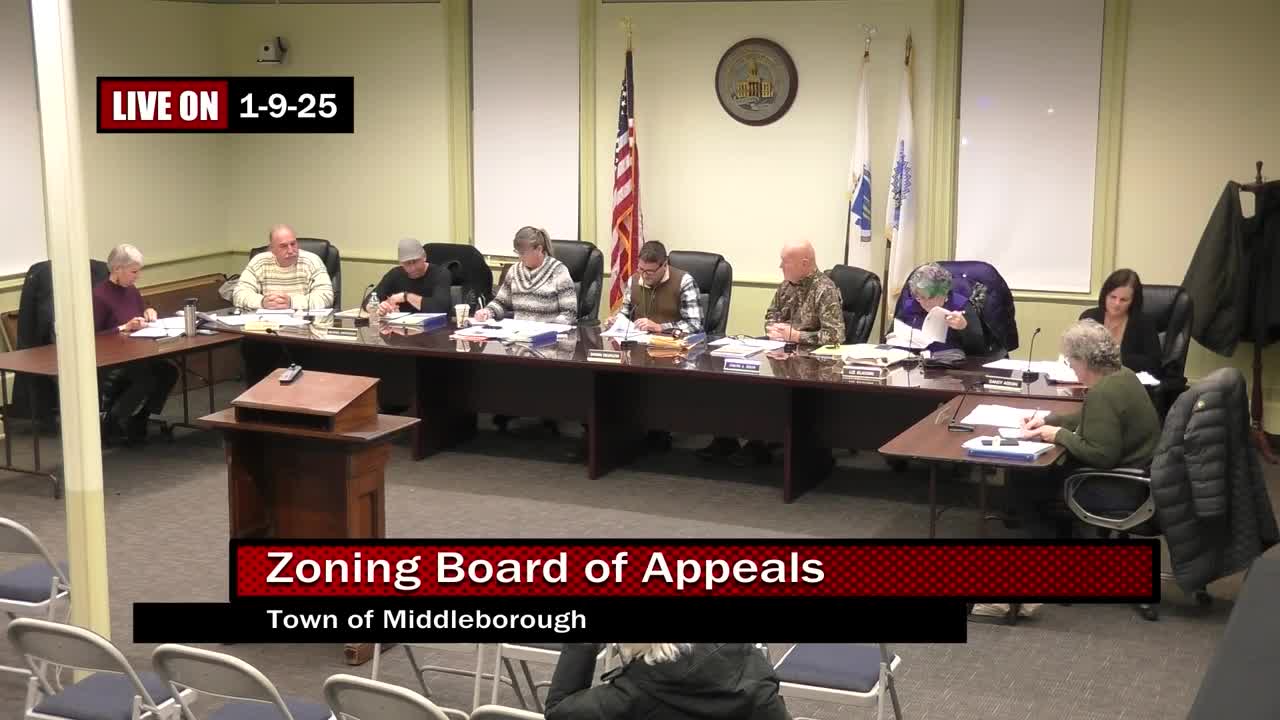
Middleborough Zoning Board OKs permit for 'Sully's Happy Tails' doggy daycare at 378 Wareham St.; strict noise and site conditions attached
Summary
The Middleborough Zoning Board of Appeals approved a special permit for a commercial kennel license at 378 Wareham Street, authorizing a doggy daycare called Sully's Happy Tails with up to 20 dogs and a set of mitigation measures aimed at limiting noise, light and other community impacts.
The Middleborough Zoning Board of Appeals voted unanimously to grant a special permit for a commercial kennel license to Robert Sullivan for a proposed doggy daycare at 378 Wareham Street, subject to several site and operational conditions.
The board opened the hearing after receiving written comments from town departments and state conservation staff. Animal control officer Kevin Rykart reviewed the plans and told the board in a letter that he would set a maximum of 20 dogs, ages 6 and older, for the facility and would inspect the site before issuing a final kennel license. The conservation commission issued an Order of Resource Area Delineation for wetlands on the lot; the health agent said the property must obtain sewage-disposal permits and paperwork before the health department would sign off.
The applicant, Robert Sullivan, described plans for a single-story building on the front-left corner of the roughly four-acre lot and said his daughter, Veronica Sullivan, who he said has seven years of experience at a similar facility, would manage the day-to-day operation. “She'll be the one managing and running the facility,” Sullivan said.
Neighbors and nearby homeowners raised concerns in public comment about noise, odor and property values. Megan Schreiner of Pine Ridge Way told the board she opposed the license, saying, “20 dogs sounds like an enormous amount of noise to me, especially during the summer.” Attorney James W. Marsh, representing immediate abutters, recommended a larger buffer, plantings and an acoustic wall, and asked the board to require enforceable noise monitoring and limits.
In response, Sullivan and members of the board described several design and operational measures: the building will have R‑30 insulation on the walls and no windows facing the nearest house; the outdoor yards will use solid vinyl fencing and artificial turf with a paved perimeter to deter digging; a double‑door “airlock” entry will control animal movement; and the applicant proposed an earthen berm topped with evergreen plantings as a visual and sound buffer. Sullivan described two outdoor enclosures split by dog size and said the site plan separates large and small dogs and includes a small “chill room” inside the building for dogs that need to be isolated.
After discussion the board approved the permit with the conditions read into the record by a member of the board. Those conditions, as stated in the motion, include: a berm along the westerly property line a minimum of 6 feet high (constructed at the maximum safe height using a 3:1 slope where required), evergreen plantings (referred to in the record as “Green Giants”/arborvitae) on top of the berm, solid vinyl fencing 6 feet high for outside runs with specified 8‑foot sections on the westerly rear portion and on the front facing Route 28; a modification to close the left side of the building overhang to limit light spill; hours of operation and site use limits to restrict dogs outside from about 8:30 a.m. to 6:00 p.m. while allowing customer drop‑offs/pickups earlier (conditions recorded read: drop‑off/pick‑up window 06:30 a.m.–6:00 p.m.; dogs outside 08:30 a.m.–6:00 p.m.); two staff on site as proposed; a maximum of 20 dogs, ages 6 and older (the animal control officer may change that cap based on future inspections or operational changes); no retail sales (no food, pet products or on‑site sales beyond identification/signage on the building); parking and stormwater to follow the submitted engineering and survey plans; and weekly dumpster service for solid waste. The board also required that final building and health approvals be obtained before operation and that the animal control officer inspect the completed facility and grant the kennel license.
The board closed the hearing, made findings, and voted to approve the special permit; the official vote was recorded as unanimous and the hearing record shows the decision will be filed with the town clerk and subject to the standard appeal period.
Board members and town staff emphasized that the permit is conditional on the applicant completing the engineering, septic/permitting and the site work described in the conditions. The animal control officer’s letter and the conservation commission materials will be part of the licensing record and the animal control officer will perform at least one inspection after construction and annually thereafter as part of license enforcement.
The board’s approval does not authorize overnight boarding; the applicant said the operation will be daytime-only at this time and the record shows the permit was limited to daytime daycare. The health department letter in the file notes that a sewage disposal permit and paperwork are required before health sign-off.
The board made findings that the site is appropriate for the proposed use in the General Use district, that conditions provided reasonable safeguards, and that traffic/parking and utilities were adequate based on submitted plans. The decision was approved subject to the conditions listed in the record and will be filed with the town clerk for the 20‑day appeal period.