Get Full Government Meeting Transcripts, Videos, & Alerts Forever!
Get email alerts on the Education Licensing Complaints topic
No spam. Unsubscribe anytime.
Bill shortens TSPC complaint timeline; substitute-teacher group urges broader reform
Summary
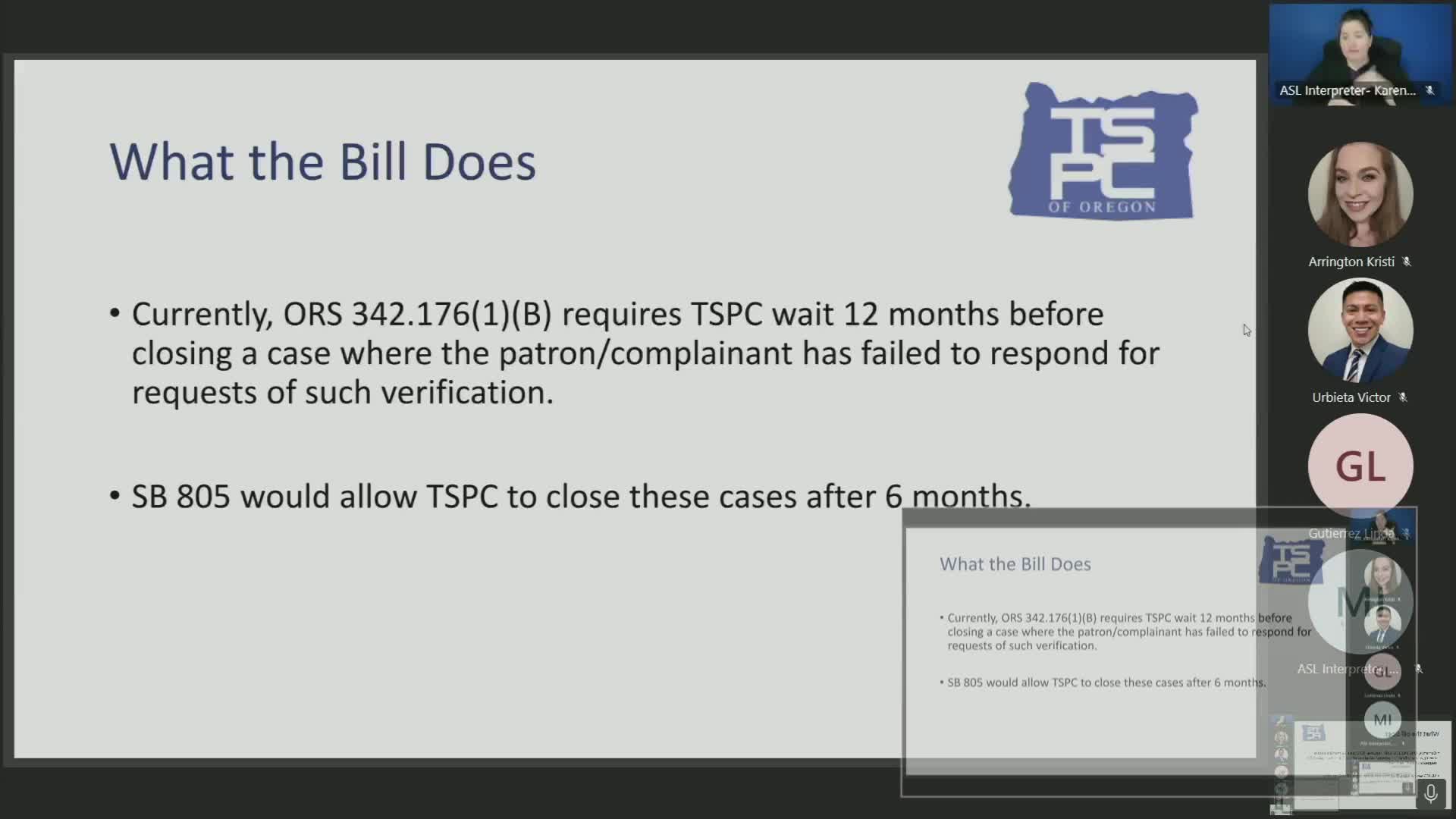
Senate Bill 805 would let the Teacher Standards and Practices Commission close a complaint after six months if a patron asked to pursue local resolution does not respond, rather than the current 12 months; TSPC says the change improves accuracy of its active-case data.
Senate Bill 805 would allow the Teacher Standards and Practices Commission to close complaints in its intake process after six months if a patron asked to pursue local resolution does not respond, rather than the current 12-month period in statute. TSPC said the change would make agency data on active complaints more accurate while preserving the ability for a patron to reactivate a matter if they later provide verification that the district did not resolve it.
Christina Edgar, TSPC’s director of professional practices, told the Senate Committee on Education that the agency currently asks patrons to try local resolution before the commission opens full proceedings, excluding allegations of sexual or physical abuse. Under the proposed change, if a patron does not provide verification within six months TSPC could close the file; if the patron later submits verification the case may be reactivated.
Testimony at the hearing raised broader concerns about TSPC’s complaint, investigation and public-discipline processes. Debbie Ferry, representing the Oregon Substitute Teachers Association (ASTA), said ASTA was neutral on SB 805 but urged the Legislature to form a task force to review and overhaul TSPC’s entire process for background checks, complaints, investigations and contested-case procedures. Ferry told the committee that substitute teachers are frequently targeted for complaints, that TSPC’s processes can be costly and slow for educators, and that educators who have completed discipline sometimes remain on a public list maintained by TSPC.
Nan Baker Croft gave personal testimony recounting a long legal history in which she said a conviction was overturned by the Oregon Supreme Court but that she continued to have difficulty obtaining work because records remained accessible in TSPC or other systems. ASTA and witnesses asked the committee for clearer pathways for licensed educators who have completed any discipline to be removed from a publicly posted list, and for a broader review of how licensing actions, historical records and court datasharing affect employment.
TSPC said no additional staff or funding would be needed to shorten the verification window from 12 to 6 months and that the change would reduce stale matters in the agency’s active caseload (TSPC reported roughly 515 open cases in testimony). The committee did not take formal action on SB 805 during the hearing.