Get Full Government Meeting Transcripts, Videos, & Alerts Forever!
Get email alerts on the Judicial Data And Caseloads topic
No spam. Unsubscribe anytime.
Oregon Judicial Department shows rising caseloads, data dashboards and daily feeds to track unrepresented defendants
Summary
State court administrators told a Public Safety subcommittee that criminal filings — particularly misdemeanors tied to possession laws — and unrepresented defendants have grown, and that new data dashboards and a nightly data warehouse feed are being used to track backlogs, set-asides and court performance across Oregon.
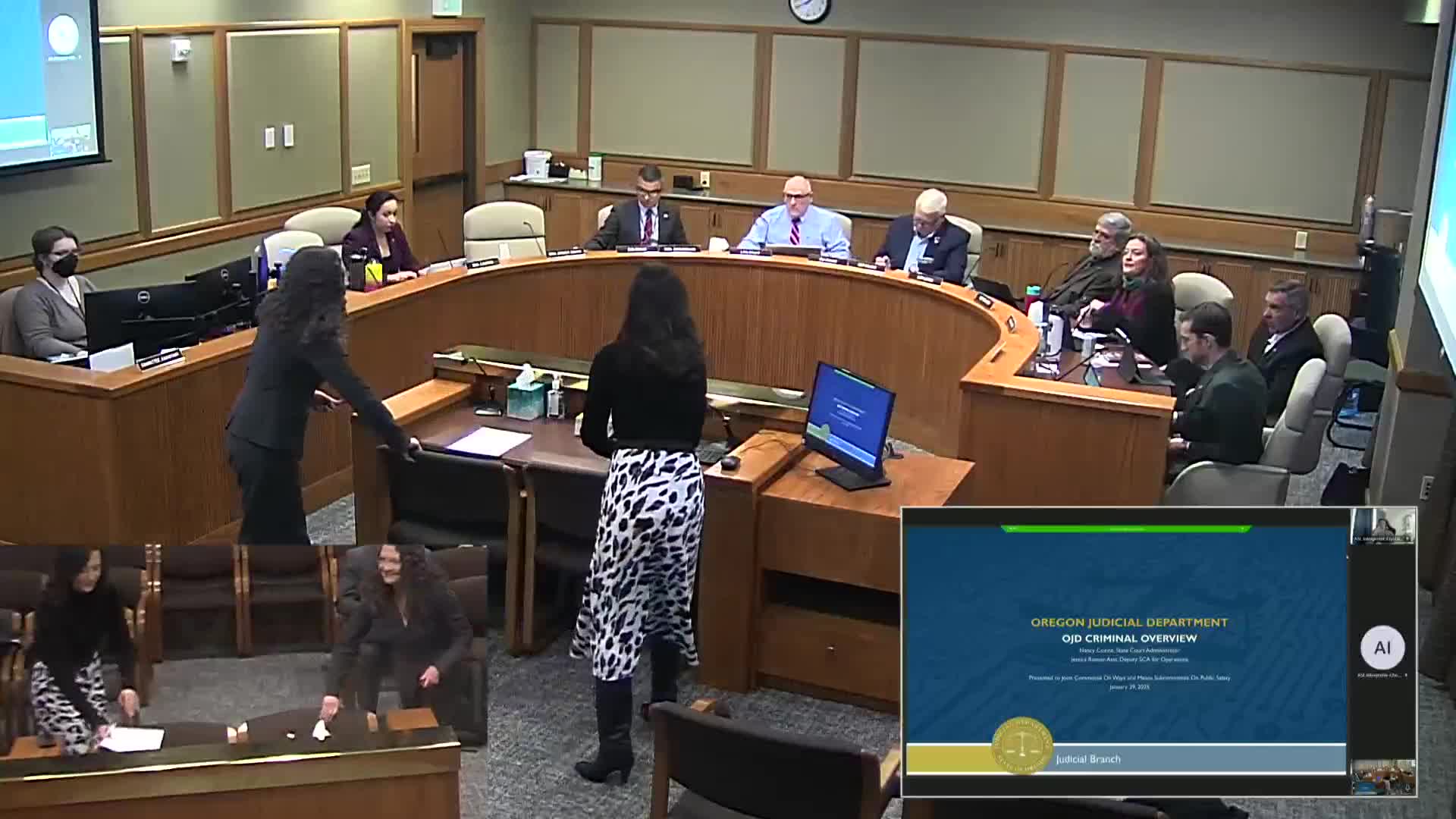
The Oregon Judicial Department told the Public Safety Subcommittee of the Joint Ways and Means Committee on Jan. 29 that criminal caseloads are rising in several categories, that an “unrepresented” defendant crisis is slowing case resolution, and that new data tools and nightly feeds are being used to monitor and coordinate responses across state partners.
Nancy Kozine, state court administrator, said criminal filings “continue to be a very significant portion of our workload,” and highlighted increases in drug-related misdemeanors, some serious felonies and a spike in requests to set aside records following recent statutory changes. Kozine and Jessica Rozier, assistant deputy state court administrator for operations, described the Oregon eCourt program’s Odyssey case management system, a judicial data warehouse and public dashboards that OJD uses to track filings, time to disposition, clearance rates and unrepresented individuals.
Why it matters: Committee members were told the number of people who lack counsel and the growing complexity of cases — more digital evidence, more mental health evaluations and greater volumes of filings — are creating persistent backlogs and longer dockets. OJD said timely sharing of data with partners such as the Oregon Public Defense Commission (OPDC) and the Office of Economic Analysis (OEA) helps identify counties and charges where targeted interventions may speed resolution.
Key figures and trends
- Murder filings: Kozine said the department recorded 146 murder-case filings in 2024 and noted that, while the percentage increase appears large, the raw number is much smaller.
- Diversion and DUI: Kozine said DUI remains the most commonly filed misdemeanor and that about 60% of DUI cases are diversion-eligible; OJD reported roughly 4,400 successful diversion completions per year on average.
- Drug enforcement misdemeanors (DEM): Kozine linked a recent rise in misdemeanor filings to House Bill 4002, which she said recriminalized possession and is driving many DEM filings. She said OJD has recorded a large cumulative number of DEM charges since the law’s implementation; the department also noted many DEM cases include at least one additional charge.
- Set-aside requests: Kozine said set-aside filings increased sharply after statutory change (identified in the presentation as Senate Bill 3.97), and that OJD still has over 16,000 set-aside matters to process, many of them partial set-asides that require manual review of court records.
- Unrepresented defendants: OJD staff said the number of unrepresented defendants has reached all‑time highs in recent months — with nearly 27,100 unrepresented misdemeanor cases and about 1,600 unrepresented felony cases cited during the presentation — and that courts are seeing thousands of people charged who are eligible for appointed counsel but have not yet had counsel assigned.
Court processes, behavioral-health and competency (aid-and-assist)
Kozine described a significant increase since 2020 in cases referred for aid-and-assist (competency) evaluations. She summarized the state hospital and local restoration placement process and the statutory time limits OJD follows for restoration: 90 days for most misdemeanors, up to six months for some felonies described as “minor,” and up to a year for major felonies; cases that cannot be restored within the statutory period must be dismissed. Kozine told the committee that individuals whose criminal cases are dismissed for lack of fitness often reenter the criminal system soon afterward.
Data, integrations and dashboards
Jessica Rozier walked the subcommittee through OJD’s technical stack and the department’s data-sharing arrangements. She said OJD operates the Odyssey circuit‑court case management system plus several specialized systems (pretrial, treatment courts, jury and appellate systems), replicates case data nightly to a judicial data warehouse, and publishes public dashboards at courts.oregon.gov/data.
Rozier summarized three performance measures OJD uses to assess timeliness and workload: time to disposition (closed cases), clearance rate (cases closed versus cases filed), and the age of pending cases (open cases past the time standard). She told the committee these measures help identify where courts are falling behind and where targeted action can reduce backlogs. "The data warehouse is just like what it sounds. It's a storage facility for all our data," Rozier said.
Rozier also described multiple integration types: internal batch processing in Odyssey for bulk actions (fine reductions, mass sealing), outbound feeds (text reminders, data to OEA, DOC, DHS, DOR, OPDC), inbound feeds (eCitations), bidirectional lookups (DMV driver history), and web services used for real-time public-facing features. She said OJD provides daily or nightly feeds to OPDC that identify unrepresented individuals and case details down to charge level and county; OPDC uses that data to reconcile caseloads and look for “low-hanging fruit” such as high volumes of a single charge in a county that may be diversion-eligible.
Transparency and public access
OJD staff demonstrated public dashboards covering cases filed, closed and pending, clearance rates, time to disposition, and an unrepresented dashboard that allows filtering by charge and court. Rozier said these dashboards go back at least 15 years for many measures and are intended to enable internal and external users — including OEA and OPDC — to see trends and drill down to county and charge‑level detail.
Questions and follow-ups
Representative Graber asked how polysubstance cases are categorized when more than one substance appears; Kozine said she would investigate how crime-lab reporting and charge coding handle multiple substances. Committee members asked for county- and charge-level comparisons; OJD said that county-level performance measures and charge breakdowns are available on the public dashboards.
No formal actions or votes were taken; the presentation was an informational hearing and the committee scheduled additional hearings with the Criminal Justice Commission and other partners to follow.
Ending
Co-chairs and OJD staff characterized the dashboards and nightly data feeds as tools to help manage growing workloads, allocate resources and coordinate with public-defense and health partners. Kozine and Rozier told the subcommittee they will continue sharing updated dashboards and data with the committee and with partner agencies as OJD refines its automation for set-asides and other bulk processes.