Get Full Government Meeting Transcripts, Videos, & Alerts Forever!
Get email alerts on the Procurement Equity Disparity Study topic
No spam. Unsubscribe anytime.
Delray Beach to present disparity-study findings March 11; city, CRA and consultant outline next steps for vendor outreach
Summary
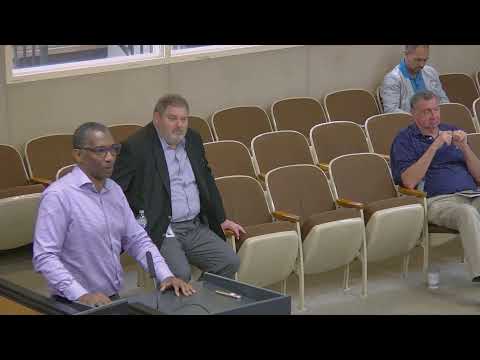
Delray Beach officials and the consultant conducting the city’s disparity study told a public forum that a draft final report will be presented to the City Commission on March 11 and outlined how the study could lead to focused procurement changes.
Delray Beach officials and the consultant conducting the city’s disparity study told a public forum that a draft final report will be presented to the City Commission on March 11 and outlined how the study could lead to focused procurement changes.
Jeff Horace, assistant city manager for the City of Delray Beach, opened the session and said, “This meeting is not to talk about the results. This meeting is to make sure everybody's clear on what a disparity study is, and what the outcome of it can be.” Horace and other city officials emphasized the study addresses ownership and dollars going to minority- and woman-owned businesses, not the racial composition of a company’s workforce.
Keen Independent Research consultant Joseph (Joe) Broad explained the legal and technical framework that guides how public bodies use disparity studies. Broad said federal case law requires two elements before a race- or gender-conscious contracting program can be legally adopted: a “compelling governmental interest” supported by evidence of a substantial disparity, and a program that is “narrowly tailored” to that evidence. Broad described Keen’s methodology: analyzing city and CRA contract records, surveying thousands of Southeast Florida businesses about the work they can perform, and comparing dollars awarded to minority- and woman-owned businesses against the estimated availability of such businesses for similar work.
Broad summarized the consultant’s technical approach: the analysis is dollar-weighted, controls for type of work and prime-versus-subcontract roles, and seeks to compare “what is the observed utilization of minority and woman owned businesses, and what could have been given a level playing field.” He gave a hypothetical example of a contract participation goal, saying a prime contractor might be asked to show “here’s my plan to reach this 10 percent goal of minority or women on business participation.”
Renee Chaddising, executive director of the Delray Beach Community Redevelopment Agency, told the audience the CRA’s purchasing data has been added to the study. “Our purchasing is much, much smaller than the city,” Chaddising said, and she explained that while the CRA funds large infrastructure projects, the city’s public-works departments manage procurement for those projects. Both Horace and Chaddising urged attendees not to assume a particular outcome before the study is released, and said the CRA is legally required by state statute to follow any city procurement policies the commission adopts.
City staff described several outreach and implementation steps they are pursuing regardless of the final study results. Those include re-running or repeating the city’s small-business expo (staff said one was held in 2024 and staff planned another in May), encouraging local businesses to register in the city vendor system, coordinating with Palm Beach County and the Florida Department of Transportation (FDOT) to use their certified MBE/WBE lists for verification, and asking department staff to contact at least one certified minority- or woman-owned business when soliciting informal quotes. Jeff Horace said the city is likely to rely on existing certification infrastructure rather than creating its own in-house certification process.
Multiple small-business owners and residents asked how large projects, joint ventures and subcontracting are counted. Broad and county representatives said the consultant can account for joint-venture or centering/partnering arrangements only if the city’s procurement data records the percentage ownership or the certified partner’s share. Alan Gray of Palm Beach County described the county’s Centimeters partnering approach that gives certified local firms more direct access to large projects. Broad said that without ownership-percentage data, the study can only classify utilization based on the ownership on file for the contracting entity in the city’s records.
Attendees asked about legal durability and timing. Broad said entities that adopt race- or gender-conscious elements generally plan to re-evaluate programs about every five to six years and that the Supreme Court precedent requiring strict scrutiny remains the guiding test. Horace and other staff said they are in contact with the city’s lobbyist and legal advisors and have not been informed of state-level action that would halt local implementation work.
Speakers pointed small businesses to available technical assistance. The FAU Small Business Development Center (SBDC), which has a local presence at the Delray Beach Chamber of Commerce, was highlighted as a free resource to help with vendor registration, business plans and preparing to work with government buyers. City staff described efforts to make vendor registration and insurance requirements proportionate to the size of work when possible so small vendors are not excluded by unnecessary barriers.
The meeting produced no formal votes. The next formal public step is the presentation of the draft final disparity-study report to the City Commission on March 11; any policy actions would follow that presentation and would be subject to legal review and public deliberation.
A calendar item: staff said they plan another small-business expo in May and encouraged local businesses to register on the city’s vendor page to receive procurement notifications.