Get Full Government Meeting Transcripts, Videos, & Alerts Forever!
Get email alerts on the Infertility Care topic
No spam. Unsubscribe anytime.
Committee Hears Bill to Protect Infertility Care and IVF from Government Limits
Summary
House Bill 1477, introduced by Representative Carla Rose Hansen, would place definitions and protections for fertility health care into state law. Physicians, patients and advocacy groups testified that the measure is intended to prevent local or state restrictions that could impede IVF or embryo-freezing practices.
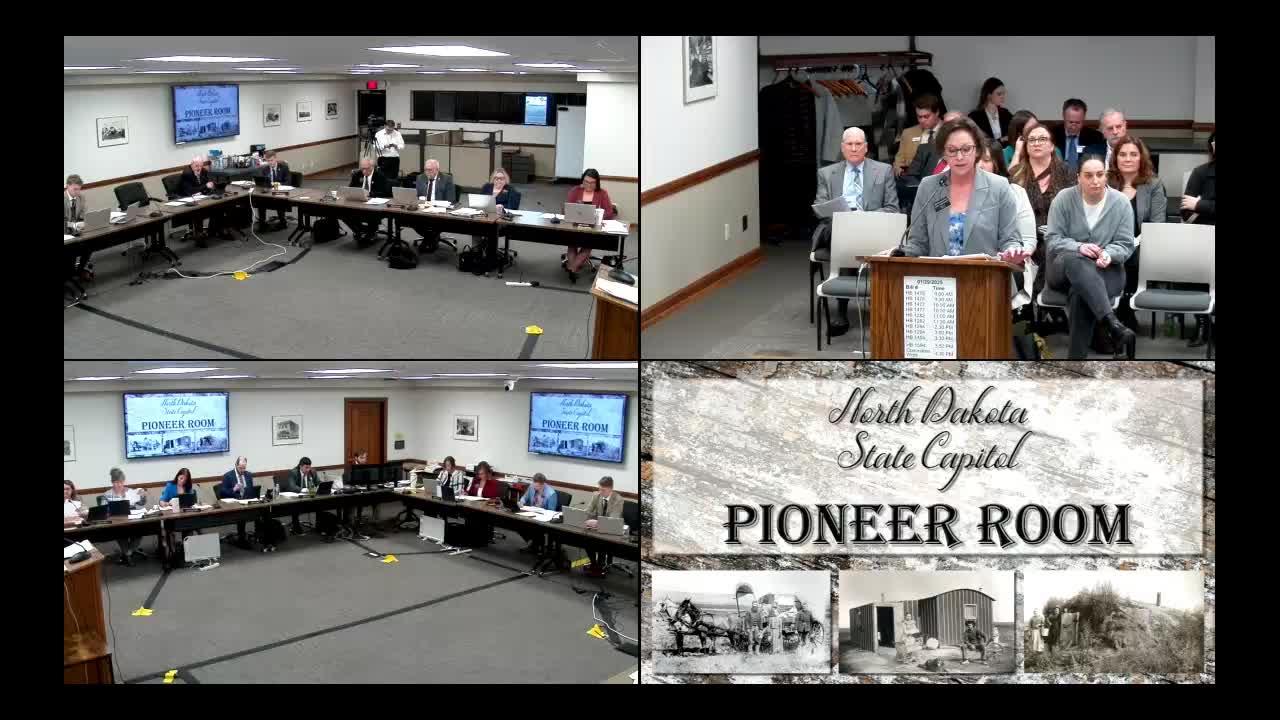
Representative Carla Rose Hansen opened the House Human Services Committee hearing on House Bill 1477, saying the measure would define fertility health care in statute and bar state and local government interference with infertility treatments including in vitro fertilization (IVF).
"Let's keep the government out of our doctors' offices," Representative Carla Rose Hansen said, asking the committee for a due-pass recommendation and noting two technical Medicaid amendments she intended to offer.
Dr. Stefan Christiansen, a reproductive endocrinologist who established an IVF program in Fargo, described the scope of IVF care in North Dakota. "In 2023, we completed 520 cycles of IVF," Dr. Christiansen said, and he said the clinics in the state recorded "over 200 babies born from IVF in this state" in 2023. He told the committee that about 3 percent of U.S. births are conceived with IVF and characterized restrictions or bans on IVF as potentially devastating: he said court decisions and personhood measures in other jurisdictions have halted IVF services.
Hansen and witnesses warned that proposals to redefine personhood or otherwise extend protections beginning at fertilization could unintentionally criminalize or limit standard fertility practices, including embryo freezing used for cancer patients' fertility preservation. Hansen cited an Alabama state supreme court decision she said had treated embryos as people and temporarily shut down IVF clinics there; she also referenced prior North Dakota personhood ballot measures and current bills in the Legislature with related language.
Multiple patients and advocates testified in support. Alyssa Bratton, who described having endometriosis and using IVF to build her family, and other parents described long, costly medical journeys. Tara Harding (formerly Bradner), who runs infertility-support activities and a clinic, told the panel that infertility is a medical condition affecting roughly one in six couples and criticized misconceptions about IVF.
Committee members asked clinicians about the number of embryos commonly created in a cycle, how many embryos typically survive to blastocyst stage, and whether clinics or patients commonly discard embryos; clinicians described standard clinical practices including single-embryo transfers and freezing of remaining embryos. Witnesses said it is uncommon for patients to request embryo destruction and described lab safeguards and rules intended to prevent past abuses.
No opposition testimony was offered on HB1477 during the hearing. Representative Hansen asked the committee for a due-pass recommendation and distributed proposed technical amendments related to Medicaid.