Get Full Government Meeting Transcripts, Videos, & Alerts Forever!
Get email alerts on the Volunteer Firefighter Tax Credit topic
No spam. Unsubscribe anytime.
Senate committee hears bipartisan push for $1,000 volunteer firefighter tax credit
Summary
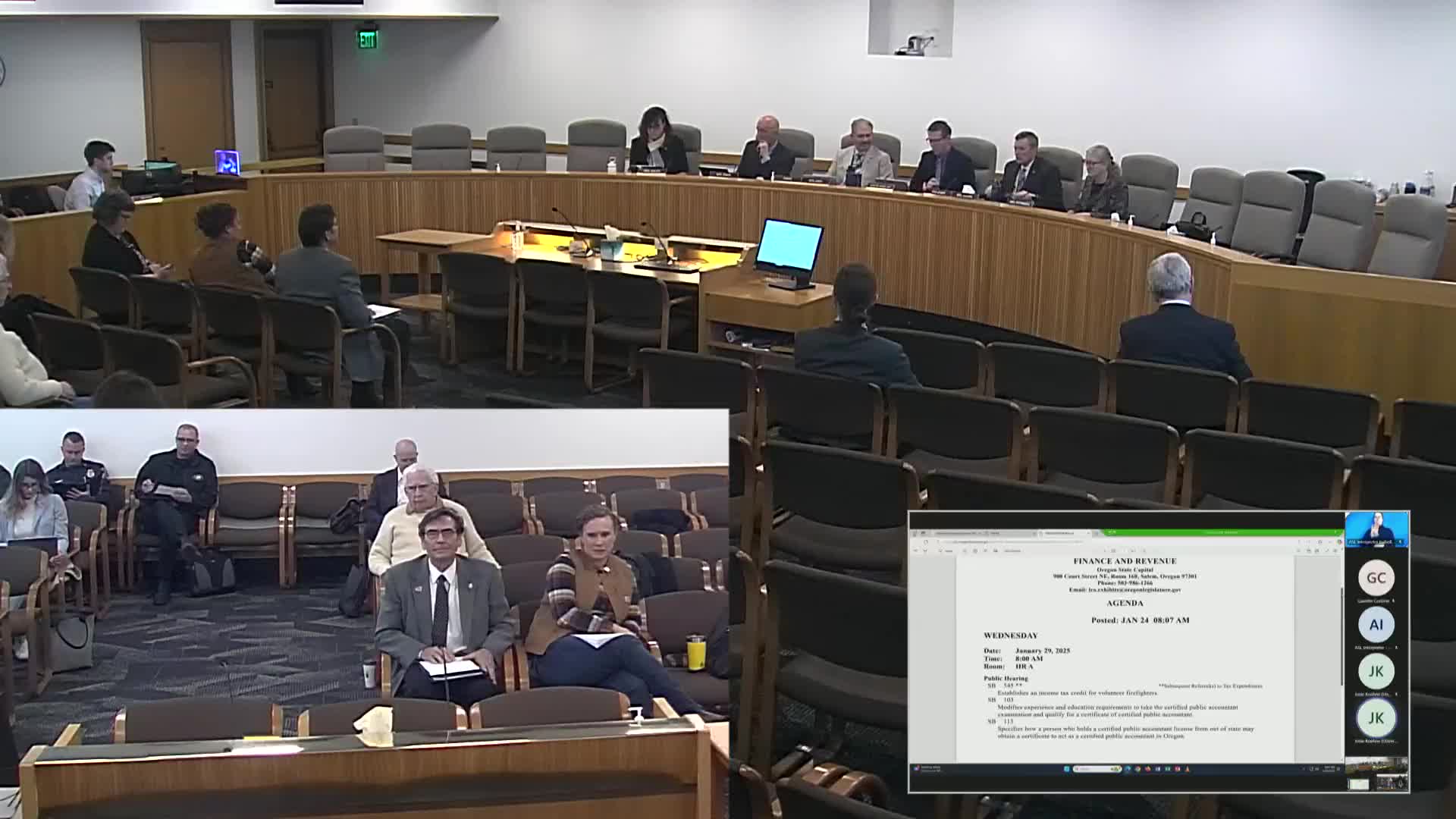
The Senate Committee on Finance and Revenue heard testimony on Senate Bill 545 on Jan. 29, 2025, a bill that would create a nonrefundable $1,000 personal income tax credit for qualifying volunteer firefighters for tax years 2026 through 2031.
The Senate Committee on Finance and Revenue heard testimony on Senate Bill 545 on Jan. 29, 2025, a bill that would create a nonrefundable $1,000 personal income tax credit for qualifying volunteer firefighters for tax years 2026 through 2031.
Senator Janine Salmon, state senator for Senate District 15, told the committee, “Oregonians from all corners of the state rely on volunteer firefighters to respond to traffic accidents, house fires, brush fires, wildfires … and so many other events that happen outside of city limits in some of our most rural areas of the state.” Salmon, one of the bill’s introducers, described the credit as a modest recognition intended to aid retention and recruitment.
The bill would be a nonrefundable credit and require certification by a fire chief using a Department of Revenue form. Representative Jamie Kate, House District 11, said the bill “is simple. The creation of a $1,000 tax credit for our volunteer firefighters to aid in recruitment efforts and retention of our volunteers across the state.” Kate described qualifying criteria in the measure and said volunteers often shoulder heavy training burdens and out-of-pocket costs.
Supporters from the fire service emphasized volunteer dependence across Oregon. Brian Stewart, director with the Oregon Fire Chiefs Association, testified: “Volunteer firefighters are the majority of firefighters in Oregon. They are critical for our response locally and for our state mutual aid system.” Ben Stang, fire chief of Polk County Fire District 1, described the training and ongoing time commitment for volunteers and said a tax credit would help affirm that “we see them and that we appreciate them.”
The Department of Revenue urged clarification of overlap with an existing rural EMS provider credit and explained administrative steps. Megan Dennison of the Oregon Department of Revenue said the department would “convene a rules advisory committee involving fire departments and fire districts” to create a certification process and noted the credit is nonrefundable: “So the taxpayer would need to have a tax liability.”
Opponents and alternative proponents urged state direct appropriations and targeted training support rather than a universal tax credit. Josie Kerner, speaking on behalf of TexFerners Oregon (as presented), argued the state should fund equipment and training directly, proposing $10,000 per recruit to fire departments to cover PPE and training. John Calhoun of Tax Fairness Oregon cautioned that if the credit is too small to change behavior “the state will simply be throwing away funds that are needed to deal with our fire and wildfire crisis,” and pointed to a 2023 appropriation, House Bill 2294, that provided $5 million for apprenticeship pilot projects.
Cost estimates presented to the committee varied. Department of Revenue staff said past analyses put the potential fiscal effect in the range of roughly $6 million to up to $8 million per year. Witness testimony referenced a roughly $8.7 million estimate tied to the number of volunteers, and association leaders said not every volunteer would qualify for the credit under the bill’s certification criteria.
The committee also discussed program design details reflected in the bill: a certification process signed by a fire chief; disallowing a taxpayer from claiming both this credit and the existing rural EMS credit under ORS 315.622 for the same tax year; and the statutory 6‑year review/sunset schedule for tax credits. Questions from senators focused on how “active volunteer” status would be verified and the fiscal implications of creating a new tax credit.
Committee members closed the public hearing on SB 545 after hearing the panel of supporters and opponents. No committee action or vote occurred at the Jan. 29 hearing; committee staff indicated a future work session or staff fiscal analysis would be scheduled to examine the revenue impact and potential amendments.
While proponents framed the proposal as a recruitment and retention tool and a statewide recognition of volunteer service, opponents recommended prioritizing direct appropriations for PPE and training and evaluating existing pilot projects before establishing a recurring tax credit.