Get Full Government Meeting Transcripts, Videos, & Alerts Forever!
Get email alerts on the Immigration Employment topic
No spam. Unsubscribe anytime.
Committee hears bill to penalize employers who knowingly hire unauthorized workers
Summary
Lawmakers heard testimony on House Bill 1291, which would authorize state enforcement and penalties for employers who knowingly employ workers without lawful status. Sponsors and opponents debated enforcement resources, E-Verify, business-license suspensions and federal preemption concerns. The committee held the bill for amendment.
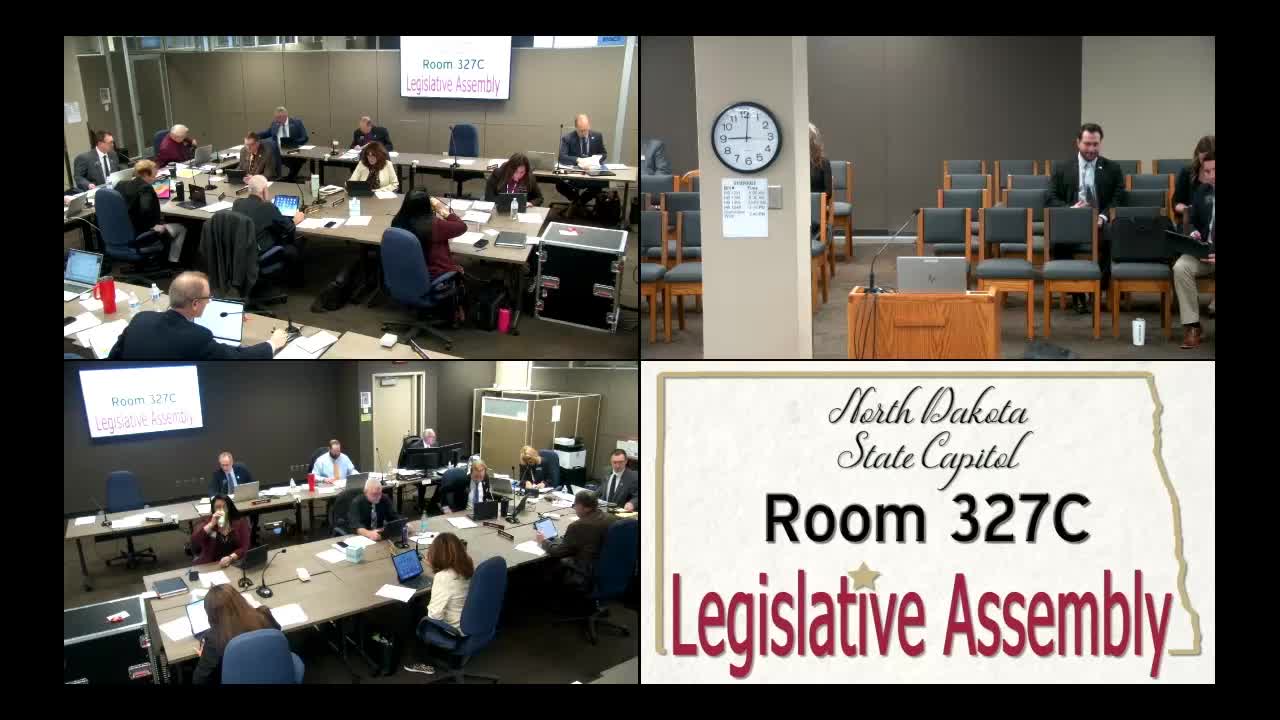
BISMARCK — The House Industry, Business and Labor Committee opened a hearing Tuesday on House Bill 1291, a measure that would allow state enforcement and civil penalties against employers who knowingly hire workers without legal immigration status.
Representative Matt Heilman, R‑Bismarck, said the bill is intended to prevent employers from hiring unauthorized workers and to give the state tools to enforce that prohibition. “I don't believe that people who don't have legal status should be taking the jobs from those who are legal,” Representative Matt Heilman said while presenting the bill.
Heilman told the committee the bill uses a knowledge standard — prohibiting employers who "knowingly" hire unauthorized workers — and would direct the labor commissioner to investigate violations and assess civil penalties. He also said legislative staff should remove language that would have referred alleged violations to the attorney general for prosecution because the measure is written as a civil enforcement scheme.
The bill prompted questions about enforcement logistics, costs and overlaps with federal law. Zachary Greenberg, interim commissioner of the North Dakota Department of Labor and Human Rights, recommended a do‑not‑pass, saying the department lacks investigatory authority, legal authority and capacity for immigration enforcement and that the measure raises federal preemption and discrimination‑law concerns. “Assigning immigration‑related investigation to the Department of Labor and Human Rights raises constitutional, legal and practical concerns that could lead to federal preemption challenges,” Greenberg said.
Business groups and labor organizations focused on specific penalties and practical effects. Eric Spencer, president and CEO of the Greater North Dakota Chamber, said the chamber supports enforcing lawful hiring but opposed suspension of business licenses as written. “When we think about suspending a business license, what are we suspending here? Is it the ability for a hospital to operate?” he asked. Landis Larson, president of the North Dakota AFL‑CIO, urged mandating E‑Verify as a preventive measure instead of creating new state enforcement.
Committee members pressed on several operational questions: how the labor commissioner would investigate, whether small sole proprietors and agricultural operators without business registrations would be covered, and whether the penalty structure — a $5,000 fine for a first offense escalating to $30,000 for a third — is proportionate. Representative Casper raised concern that suspension of a business license could be a severe first‑offense penalty given uncertainty about how an employer would prove termination of unauthorized employees.
Heilman said he is open to modifying penalty amounts and offered to file an amendment clarifying which enforcement authority would levy the civil penalties rather than referring matters for criminal prosecution. He also told the committee he supports providing whatever full‑time equivalents the labor commissioner needs to implement an enforcement program.
No formal committee vote was taken. Members discussed possible amendments, including clarifying the knowledge standard, addressing sole proprietors and agricultural employers, and considering E‑Verify requirements. The committee held the bill over for further work and possible amendment.
The hearing combined legal, administrative and policy concerns: proponents framed the bill as filling an enforcement gap they said exists when federal authorities do not act; opponents cited constitutional preemption, discrimination risks and the department's limited investigatory capacity. The committee indicated it will consider amendments that narrow enforcement language, adjust penalties and clarify administrative procedures before further action.